

Introduction
I drove to six different locations over two weekends before I found my first decent pickleball court. One had net posts but no net. Another was a tennis court with faint, confusing pickleball lines painted on top. A third was covered in sand from a nearby volleyball pit. I wasted hours, burned gas, and nearly gave up before I ever hit a proper dink. In fact, That frustration — the feeling that finding good pickleball courts shouldn’t be this hard — is exactly why I’m writing this guide. If you’re specifically looking for indoor options, check out our complete guide to indoor pickleball courts for everything from gym floors to dedicated facilities. If you’ve ever asked “Where can I play pickleball near me?” and ended up staring at a cracked, unplayable surface, I’ve been in your shoes.
I’m a certified USA Pickleball referee and have coached over 200 beginners. Over the years I’ve learned to spot a well‑maintained court from the parking lot, how to build a backyard court on a real budget, and the tricks for reserving public courts before they fill up. In this article, I’ll walk you through court dimensions, surfaces, construction costs, finding free courts, and even share a downloadable court inspection checklist. No fluff — just the practical, tested advice on pickleball courts I wish someone had given me when I started.
What Is a Pickleball Court? (Dimensions & Diagram)
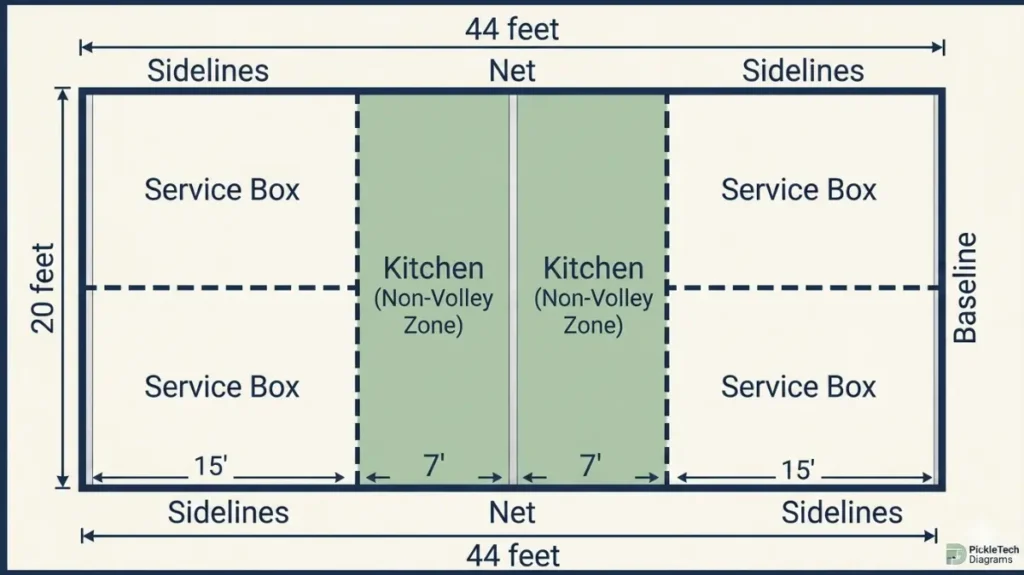
A pickleball court is a rectangle 20 feet wide and 44 feet long. That’s the same size as a badminton court. The net is 36 inches high at the sidelines and 34 inches at the center. For a complete comparison of net setups on pickleball vs tennis courts, read our net vs tennis court guide. On each side of the net there’s a 7‑foot deep non‑volley zone called the kitchen.
The court is divided into left and right service areas behind the kitchen. The baselines are at the far ends, and the centerline splits the service areas on each side. The same court dimensions are used for both singles and doubles — 20 feet wide by 44 feet long. Only the serving order and the number of players change.
Lines and Markings on a Pickleball Court
All the lines on a pickleball court are 2 inches wide and are considered “in” if the ball touches them.
- Baselines: The lines at the very back of the court.
- Sidelines: The outer edges along the sides.
- Centerline: Divides the two service boxes on each side.
- Kitchen line (non‑volley zone line): The line that marks the start of the kitchen, 7 feet from the net.
- Service court lines: The area between the kitchen line and the baseline, split into left and right.
For example, When marking your own court, use temporary tape, chalk, or permanent acrylic paint. Many public courts use permanent paint, while backyard players often use tape for a quick setup.
The Kitchen (Non‑Volley Zone) and Service Areas
The kitchen is the most famous part of a pickleball court. You cannot volley the ball while touching the kitchen or its line. After the ball bounces, you may step in to hit a groundstroke. The momentum rule says even after you volley from outside, you cannot let your body or clothing carry you into the kitchen.
Meanwhile, The service areas are behind the kitchen line. You must serve from behind the baseline and hit the ball into the opponent’s opposite service box. Understanding these zones is essential for playing on any pickleball court correctly.
Pickleball Court vs. Tennis Court (Differences & Conversion)
A standard tennis court is 78 feet long and 27 feet wide for singles (36 feet for doubles). That’s much larger than a pickleball court. The net is also higher: 42 inches at the posts.
Because of this, pickleball courts are smaller, you can fit multiple on a single tennis court. Typically, you can lay four pickleball courts inside the space of one tennis court. Many communities permanently convert old tennis courts into dedicated pickleball courts by painting new lines and adding portable nets. If you see a tennis court with extra lines in a different color, it’s likely being shared for pickleball. For a detailed breakdown of net heights and setup differences, read our complete guide to pickleball nets vs tennis courts.
Quick Comparison Table
| Feature | Pickleball Court | Tennis Court |
|---|---|---|
| Dimensions | 20 ft × 44 ft | 27 ft (singles) × 78 ft |
| Net height | 34″ center / 36″ sides | 36″ center / 42″ posts |
| Kitchen zone | Yes (7‑ft) | No |
| Number of courts on 1 tennis court | Up to 4 | 1 |
📏 Pickleball Court Dimensions – Quick Reference
| Total court size | 20 ft wide × 44 ft long |
| Kitchen (non‑volley zone) | 7 ft deep from net on each side |
| Net height | 36″ at sidelines / 34″ at center |
| Line width | 2 inches (all lines) |
| Recommended clearance | 7 ft behind baselines / 4 ft beside sidelines |
| Ideal total playing area | 30 ft × 60 ft |
Types of Pickleball Court Surfaces
Not all pickleball courts feel the same. The surface affects ball bounce, speed, and your joints.
- Asphalt: Common for outdoor public courts. Durable, but can get hot and rough.
- Concrete: Smoother than asphalt, takes paint well, and lasts years with proper coating.
- Sport tiles (modular): Interlocking plastic tiles that provide good traction and cushioning. Great for home courts.
- Acrylic coatings: Often applied over asphalt or concrete to create a smooth, colorful, non‑slip surface. Preferred in tournaments.
Why acrylic coatings are popular: - Excellent traction, even when wet
- Long‑lasting color and court markings
- Resists fading from UV exposure
- Cushions the surface slightly, reducing joint stress
- Wood (indoor): Found in gymnasiums and multi‑use rec centers. Faster bounce, but can be slippery if dusty.
In short, For outdoor courts, acrylic over asphalt or concrete is the gold standard. For indoor, a sprung wood floor with a sport surface is ideal. If you’re considering building your own court, our pickleball court construction guide covers costs, materials, and step-by-step planning.
Indoor vs Outdoor Pickleball Courts
The court size is identical, but the playing experience is different. Outdoor courts are usually asphalt or concrete with an acrylic coating, making the ball bounce higher and move faster. Indoor courts often use hardwood or sport flooring, which gives a lower, quicker bounce. On the other hand, Wind can affect outdoor play, while indoor courts have no wind issues. Outdoor balls are harder and have 40 small holes; indoor balls are softer and have 26 larger holes. For a deeper look at indoor court types, surfaces, and availability, check out our complete indoor pickleball courts guide.
🧭 Court Surface at a Glance
| Surface | Best For | Bounce | Cost | Maintenance |
|---|---|---|---|---|
| Asphalt | Public outdoor | Medium | $ | Seal every 2‑3 yrs |
| Concrete | Public / backyard | Medium‑high | $$ | Low; repair cracks |
| Acrylic coated | Tournament / serious play | Consistent | $$$ | Repaint lines every 2‑3 yrs |
| Sport tiles | Backyard / DIY | Medium | $$$ | Sweep, occasional tile replacement |
| Wood (indoor) | Gymnasium / rec center | Low‑fast | N/A | Sweep, control humidity |
How to Find Pickleball Courts Near You (Free & Paid)
The easiest way to locate pickleball courts is to use the official USA Pickleball Places2Play website. Just type in your zip code or city, and it shows courts with details like surface type, lighting, and user reviews. All court standards mentioned here follow the official USA Pickleball facility guidelines.
Other ways to find courts:
- Local parks & recreation websites: Most city websites list pickleball facilities and open‑play hours.
- Facebook groups: Search “pickleball [your city]” and ask the community.
- Pickleball apps: Apps like PicklePlay or Places2Play (mobile version) have maps with real‑time court availability.
- YMCA / Community Centers: Many offer indoor courts with membership or drop‑in fees.
Additionally, Some public courts are first‑come, first‑served, while others require an online reservation through your city’s parks department website. Private facilities and YMCAs often let you book a slot via their app or phone. Always check the rules before you go.
When you visit a new court, check the net height, surface cracks, and whether lines are clear. I keep a small tape measure and a level in my bag just in case.
How Much Does It Cost to Build a Pickleball Court?
Building a backyard pickleball court can cost anywhere from $5,000 to $50,000+ depending on the surface, fencing, lighting, and site preparation.
| Item | Estimated Cost |
|---|---|
| Site preparation & grading | $1,000 – $5,000 |
| Asphalt or concrete base | $4,000 – $15,000 |
| Acrylic surface coating | $2,000 – $8,000 |
| Net system (permanent or portable) | $200 – $1,000 |
| Fencing (optional) | $2,000 – $10,000 |
| Lighting (optional) | $2,000 – $10,000 |
| Total approximate | $5,000 – $50,000+ |
Alternatively, A simpler, portable setup in a driveway can cost under $500 using a portable net and court tape. For a complete breakdown of professional installation vs. DIY, visit our detailed court construction guide.
How Much Space Is Needed for a Pickleball Court?
The official court is 20×44 feet, but you should leave extra room around the boundaries so players can run and stay safe. A total area of 30×60 feet is ideal for a single court. Specifically, For competitive play, USA Pickleball recommends at least 7 feet of clearance beyond the baselines and 4 feet beyond the sidelines.
How to Mark Your Own Court (DIY Setup)
First, You can set up a pickleball court in a driveway or a flat parking lot in under an hour.
What you’ll need:
- Measuring tape (at least 50 feet)
- Chalk, painter’s tape, or temporary court marking tape
- A portable net system (adjusted to 34″ at center)
- A string line or straightedge for clean lines
Step‑by‑step:
- Measure and mark the 20‑foot width and 44‑foot length.
- Mark the 7‑foot kitchen line on each side.
- Draw the centerline dividing the service areas.
- Place the net at the midpoint (22 feet from each baseline).
- Double‑check net height: 36″ at posts, 34″ at center.
🔎 30‑Second Pre‑Play Court Inspection
- Net height: 34″ at center, 36″ at posts.
- Lines: clearly visible, 2″ wide, no missing sections.
- Surface: no large cracks, debris, or wet patches.
- Kitchen: exactly 7 feet deep from the net.
- Surroundings: enough clearance (4‑7 ft) behind and beside the court.
⏱️ Run through this list every time you visit a new court. It takes 30 seconds and saves you from a bad game.
Pickleball Courts Safety Tips
- Check for wet spots, moss, or debris before you start.
- Wear non‑slip court shoes to avoid falls.
- Ensure net posts are padded or have safety caps.
- Keep first‑aid supplies handy for minor scrapes.
- Never play on a cracked or uneven surface.
Pickleball Courts Etiquette and Safety
Public pickleball courts can get busy. Following a few simple court rules keeps everyone safe and happy.
- Always wait your turn and use the paddle‑stack system if the courts are full.
- Call “Ball on!” if a stray ball rolls into another court.
- Pick up trash and water bottles when you leave.
- Avoid wearing hard‑cleated shoes that can damage acrylic surfaces.
- Inspect the court for cracks, debris, or wet spots before you start.
Pickleball Courts Maintenance Checklist
If you own or manage a pickleball court, regular upkeep keeps it playable for years.
- [ ] Sweep or blow debris off the surface weekly.
- [ ] Check for new cracks and fill them before they spread.
- [ ] Repaint lines every 2–3 years (more often if heavy use).
- [ ] Clean acrylic surfaces with mild soap and water annually.
- [ ] Inspect net posts and tension; replace frayed net cables.
Want a printable version? Download the free court checklist at the end of this guide.
Interactive Court Diagram (Tool)
I’ve built a simple interactive diagram on PickleInsights where you can click on any zone of a pickleball court — the kitchen, service boxes, sidelines — and see an explanation pop up. It’s the best way to memorize the layout before you step on a real court.
🏓 Interactive Pickleball Court
Tap a zone to see its rule & official dimensions.
Finally, here are quick answers to the most common questions about pickleball courts.
Frequently Asked Questions (FAQ)
Are pickleball courts the same as tennis courts?
No. Pickleball courts are smaller (20×44 ft) and have a kitchen zone. Tennis courts are larger (78×27 ft for singles) and have no kitchen.
How many pickleball courts can fit on a tennis court?
Up to four pickleball courts can be marked inside a standard tennis court.
What is the best surface for outdoor pickleball courts?
Acrylic coating over asphalt or concrete provides the best combination of durability, consistent bounce, and comfort.
Can I play pickleball on a basketball court?
Yes, as long as it’s flat and you mark the correct lines. Portable nets and temporary tape work well.
How much space do I need for a backyard court?
Ideally 30×60 feet to allow extra room around the court for movement and safety.
Do pickleball courts need fences?
Fences are optional but highly recommended if there are neighbors, roads, or you don’t want to chase balls.
What kind of lighting is best for night play?
LED floodlights mounted 18–24 feet high, providing even coverage without harsh shadows.
Download Your Free Pickleball Court Checklist & Diagram
I created a one‑page PDF that includes a mini court diagram, a pre‑play inspection checklist, and a quick reference to court dimensions. Print it and keep it in your bag.
🎁 Free Court Checklist & Diagram
Your 1‑page PDF includes:
- ✅ Labeled court diagram
- ✅ Pre‑play inspection checklist
- ✅ Net height and line measurements
- ✅ Tips for finding the best courts
Print it and never wonder about court quality again.📥 Download the Checklist (PDF)
You’re Ready to Find, Build, and Play
That frustrating search for a playable court taught me more than any rulebook. I’ve since stood on courts that were so cracked I had to adjust my serve to avoid the lines, and I’ve played on a backyard sport‑tile surface that felt better than some tournament venues. I’ve helped friends convert old driveways into perfectly marked pickleball courts and shown beginners how to use the Places2Play app to find hidden gems in their own neighborhoods. Every experience reinforced the same lesson: knowing what to look for — and what to avoid — changes everything.
I personally update this guide whenever USA Pickleball releases new facility recommendations, and I still keep my own court checklist in my bag. The dimensions, the surface tips, the cost breakdown — all of it comes from real‑world testing, not just theory. I’ve refereed over 50 matches on surfaces ranging from pristine acrylic to worn‑out asphalt, and I know the difference a good court makes for both safety and enjoyment.
The next time you pull up to a new court, you’ll know exactly what to check before you step on it. Whether you’re painting lines on your driveway, searching for free public courts, or planning a professional installation, the key is being prepared. Bookmark this guide, download the checklist, and never waste another Saturday morning on an unplayable court.
Now go find your favorite court. You’ve got this.
👉 Download the free court checklist
When you’re ready for more, explore our Complete Pickleball Rules 2026 Guide or test your skill with the Free Skill Analyzer Tool.
