
Introduction
Let me tell you about my first game. I stepped into the kitchen while volleying, served from the wrong side, and called a ball “out” when it was clearly in. My partner looked at me like I had three heads. That was embarrassing. If you are reading this, you probably feel the same fear. You want to join a game, but you are scared of looking stupid. Strange numbers like “0‑0‑2” confuse you, and you have no idea what they mean. The “kitchen” rule is another mystery – you are not sure where you can stand. These are real pain points. Whether you’re learning pickleball rules for singles or doubles, the basics are simple once you know them.
I have coached over 200 new players. The #1 thing they ask is not about spin or power. They ask: “What are the basic pickleball rules so I don’t get yelled at?” I wrote this guide for you, making every mistake possible – foot faults, momentum violations, wrong score calls. I even argued a line call and felt terrible after. Now I am a certified referee (USA Pickleball member since 2019). I update this article every time the rulebook changes. This is not a dry rulebook dump. This is the guide I wish I had before my first game. Let’s get you ready to play with confidence – no embarrassment, no fights, no confusion.
What Is Pickleball? The Basics
If you are curious about what pickleball is and how it works, this dynamic sport blends the best elements of tennis, badminton, and ping‑pong. Played on a compact court with a specialized paddle and a plastic wiffle ball, the rules are simple to learn—yet surprisingly easy for many players to get wrong.
1. History of Pickleball
Pickleball started in 1965. Three dads invented it for their kids. Today, millions of people play it worldwide.
2. Equipment Needed
You need only three things:
- A pickleball paddle (wood or composite)
- A plastic ball with holes
- A net and a court
3. Understanding the Court
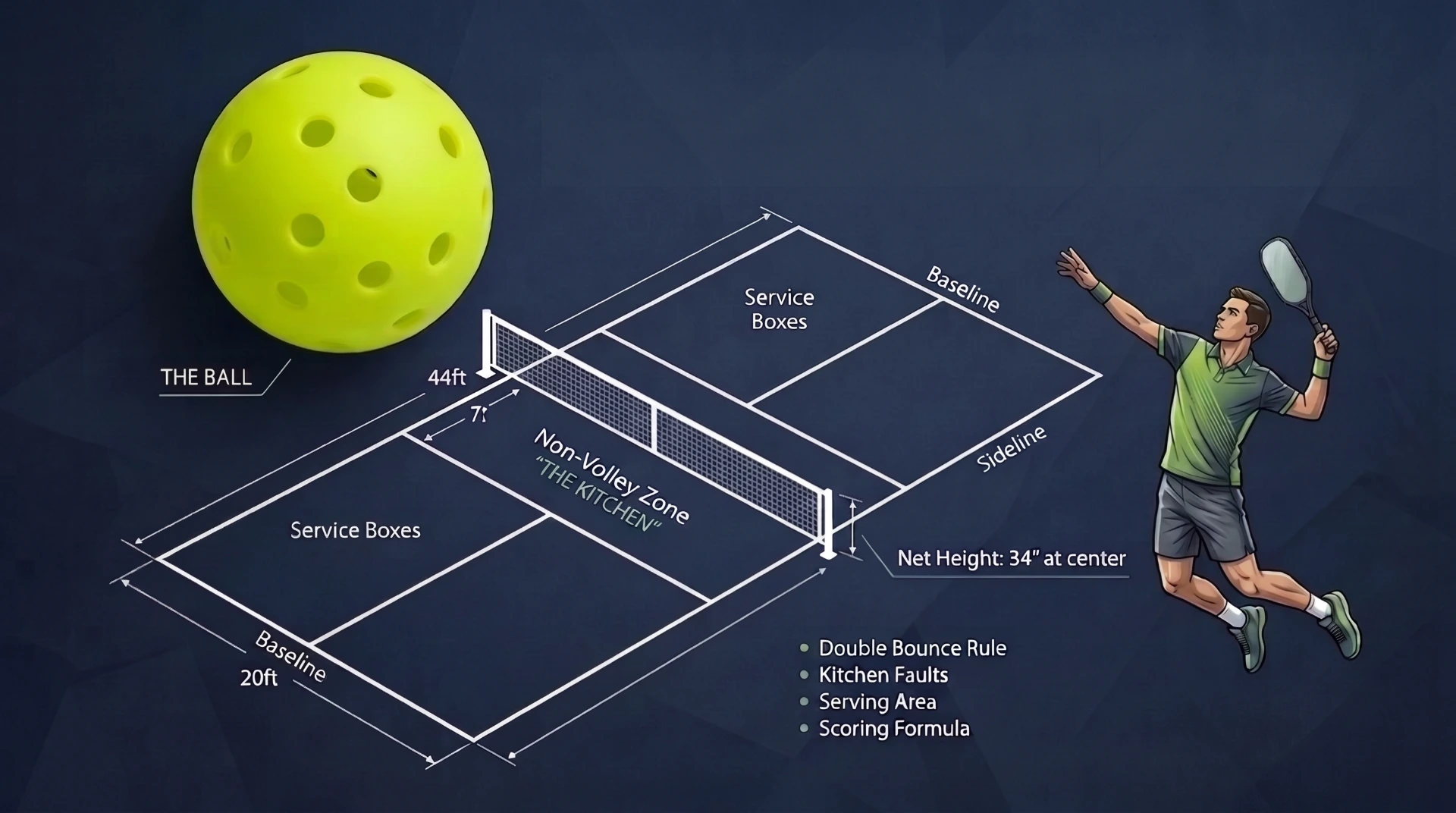
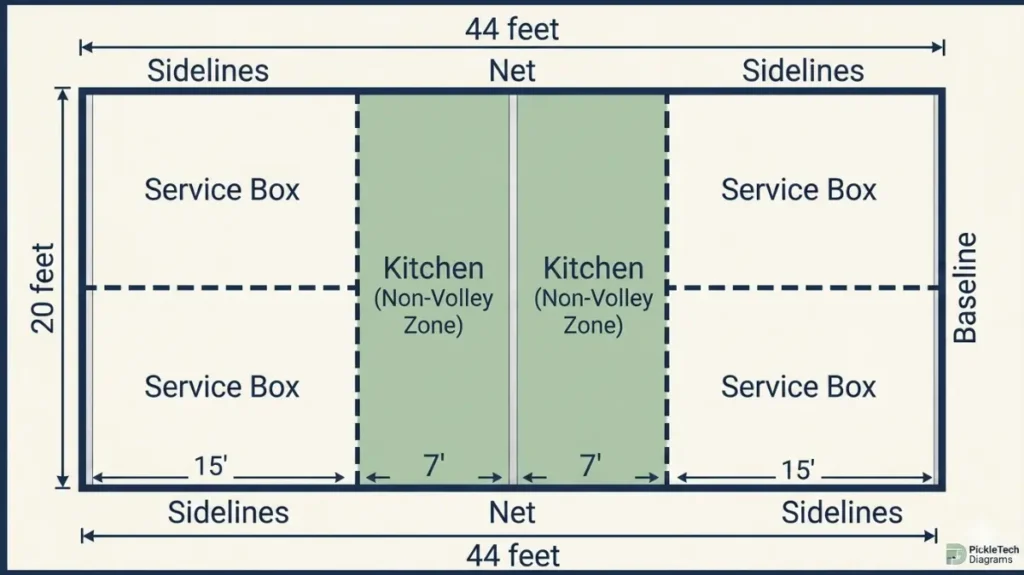
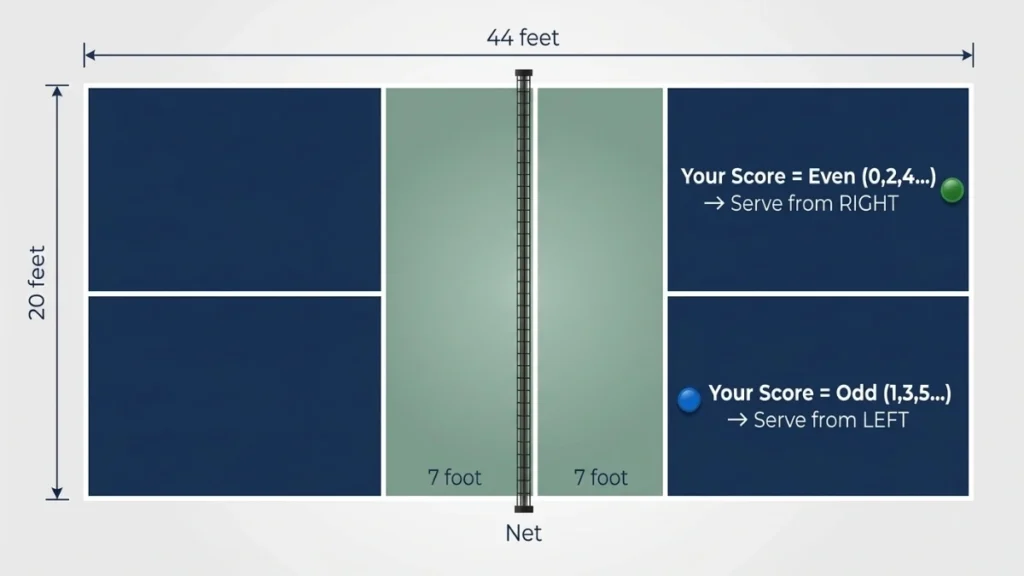
The court is 20 feet wide and 44 feet long. It has a non‑volley zone near the net. That zone is called “the kitchen.” You cannot step into the kitchen to hit a volley.
How to Choose Your First Paddle & Ball (Beginner Buying Guide)
Pick a paddle that feels light. Start with a graphite or composite paddle, and avoid cheap wooden paddles for serious play. For indoor play, pick a ball with 26 larger holes. For outdoor play, choose a ball with 40 smaller holes. Ask your local club for recommendations.
Core Rules (How to Play)
Basic Pickleball Rules (USA Pickleball)
Games are played to 11 points. You must win by 2 points. Only the serving side can score points.
Starting the Game
A coin toss decides who serves first. The server stands behind the baseline, and the serve must go cross‑court into the opponent’s service box. This serve must be underhand. Your paddle must hit the ball below your waist. The ball cannot bounce before you hit it. You get one serve attempt – no second chance.
Serving Sequence
Singles: Serve from the right side when your score is even. Serve from the left side when your score is odd.
Doubles: Both partners serve before the serve passes to the other team. The first server of the game starts from the right side.
The Two‑Bounce Pickleball Rule
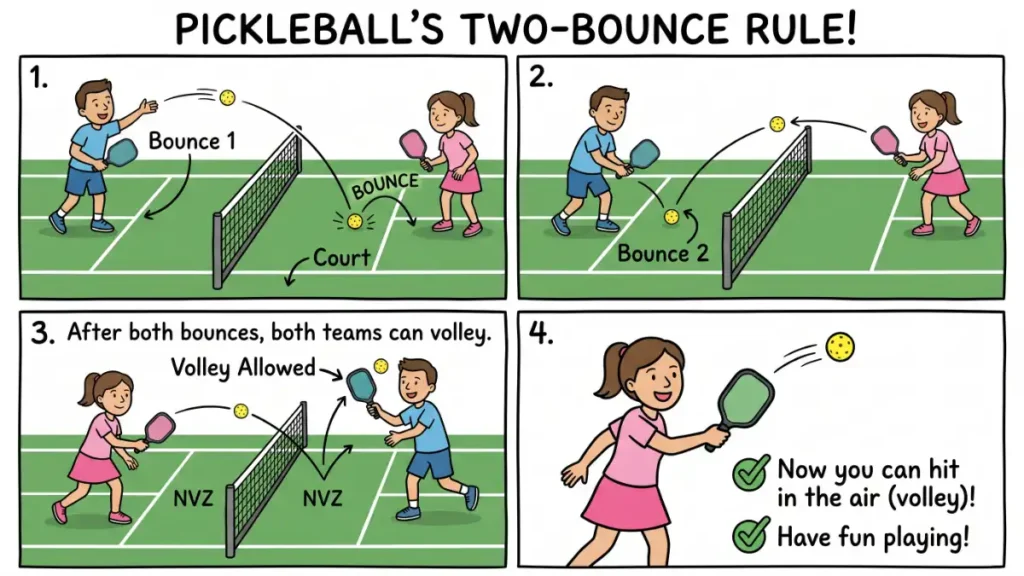
After the serve, the ball must bounce once on each side. That means:
- The returner lets it bounce.
- Then the server’s team lets it bounce.
- After two bounces, players can volley (hit in the air).
This rule stops “serve and volley” attacks. It makes rallies longer.
Determining Serving Team
In doubles, the team that wins the coin toss chooses to serve or receive. The other team chooses the side.
Pickleball Singles Rules (Key Differences from Doubles)
Singles pickleball follows the same core rules (kitchen, two‑bounce, underhand serve). However, there are three important differences you need to know:
- No Second Server: In doubles, each side gets two servers per side-out. In singles, there is only one server per side. When you fault, the serve goes straight to your opponent.
- Serving Position Depends on Your Score: You serve from the right side when your score is even (0, 2, 4, 6…). You serve from the left side when your score is odd (1, 3, 5, 7…). There is no “server number” called out because you don’t have a partner.
- Court Coverage & Boundaries: The physical court dimensions (20 feet wide × 44 feet long) and boundary lines remain exactly identical to doubles. There are no “singles alleys”—meaning you have to cover the entire 20-foot width of the court completely alone.
Why this matters: When you play singles, you don’t have a partner to cover the court. Serving rotation is simpler (only one server per side, and only two numbers to call). While the basic foundations match, understanding the specific singles rules and positioning will completely change how you approach the game. For now, just remember: the core rules are identical—only the serving order, score calling, and court coverage strategies change.
The Non‑Volley Zone (Kitchen) & Line Calls
The Non‑Volley Zone Faults
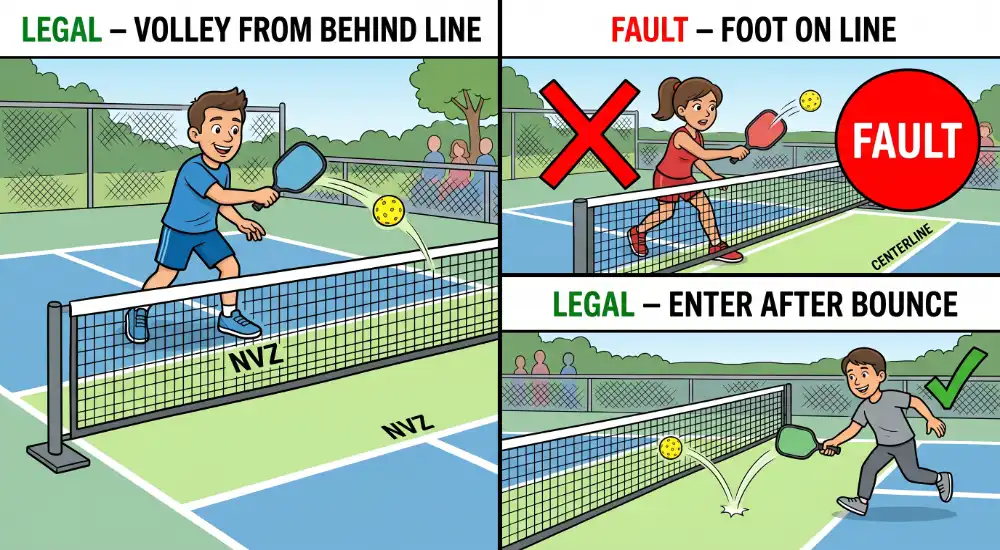
You cannot volley while standing in the kitchen. “Volley” means hitting the ball before it bounces. Your feet cannot touch the kitchen line or the kitchen area during a volley.
What happens if you do? It’s a fault. You lose the rally.
The Kitchen Rule (Explained Simply)
Imagine the kitchen is lava. You can step into it only after the ball bounces. You can also stand there to hit a groundstroke. But you cannot jump from outside, volley, and land inside. That is also a fault.
Momentum rule detail: The momentum fault applies to anything connected to you – your body, paddle, clothing, hat, or jewelry. If your hat falls into the kitchen after a volley, it is a fault.
Line Calls
A ball that touches any part of the line is “in.” Only the players make line calls in casual games. In tournaments, line judges help. Always be honest.
Scoring & Faults
While we cover the essentials here, you can dive deeper into the pickleball scoring system in our dedicated guide.
Points
In traditional side-out scoring, only the serving team can score points. You win a point when the opposing team commits a fault. (Note: Some leagues now use rally scoring, where either team can score a point on any rally. However, the game-winning point must be won by the serving team).
Scoring (Numbers)
Standard games are played to 11 points (must win by 2). In doubles, the score is called using three numbers:
- Server’s score – Opponent’s score – Server number (1 or 2)
- Example: “4 – 2 – 1” means the serving team has 4 points, the opponents have 2 points, and this is the team’s first server.
Calling the Score
The server must call the score loudly before hitting the serve. Do not serve until the receiver is ready. Crucial Rule: If you call the wrong score, any player may stop play before the return of serve to correct it. However, if you stop play after the return of serve to challenge a score, it is a fault and you lose the rally.
Common Faults
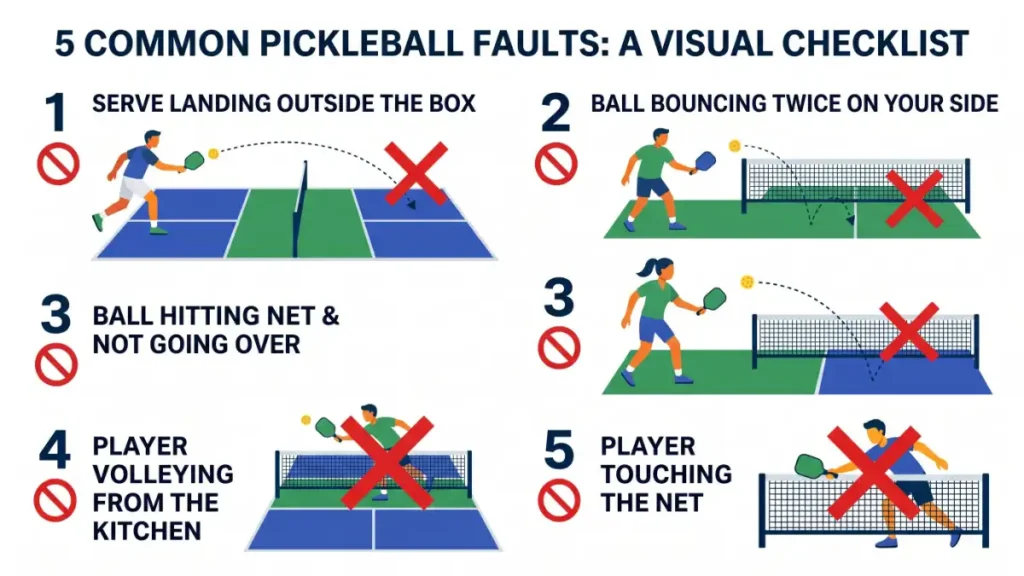
A fault immediately ends the rally. The most common faults include:
- Serve landing outside the correct service court.
- Ball hitting the net and failing to cross over.
- Ball bouncing twice on your side of the court.
- Volleying while stepping into or touching the non-volley zone (kitchen).
- Touching the net or posts with your body, paddle, or clothing.
- Your momentum carrying you into the kitchen after a volley (momentum fault).
Special Rules (Server switching)
After winning a point, the server switches sides (left to right or vice versa) to execute the next serve. The receiving team never switches sides; they stay in their current positions.
Pickleball Myths vs. Facts (With Rulebook Citations)
Myth 1: You can never step in the kitchen.
Fact: You can step in the kitchen after the ball bounces. You can even stand there. You just cannot volley from there.
(Rulebook: 9.B)
Myth 2: The ball can hit the net and still be good.
Fact: On a serve (since 2024) the ball is live if it hits the net and lands in the service box. During a rally, a net cord that lands in is playable.
(Rulebook: 11.L)
Myth 3: You must keep one foot on the ground when serving.
Fact: You can jump or lift a foot, but the paddle must contact the ball below your waist.
(Rulebook: 4.A.5)
Myth 4: Doubles partners can switch positions anytime.
Fact: You must stay in your service order. You cannot switch serving sides unless you win a point as the server.
(Rulebook: 4.B)
Myth 5: A ball that hits you is always a fault.
Fact: If you are standing out of bounds and the ball hits you, it is your opponent’s point. If you are in bounds and the ball hits you before bouncing, it is your fault.
(Rulebook: 7.H)
The 5 Pickleball Rules You Must Know Before Your First Game (Priority List)
You don’t need to memorize all 50 rules. Focus on these five first:
- The two‑bounce rule – After serve, let the ball bounce once on each side before anyone can volley.
- The kitchen rule – No volleying while standing in or stepping into the kitchen. You can enter only after the ball bounces.
- Serving underhand – Paddle contact below the waist. One serve attempt.
- Only the server can score – If you are receiving, you cannot win a point on that rally.
- Line calls – Any part of the ball on the line is “in.” Call it immediately.
Master these five, and you can play any casual game without looking lost.
2026 Pickleball Rule Changes (What’s New This Year)
Here are the official 2026 updates. Note: “No let serves” has been the rule since 2024 – not new for 2026.
| Old Rule (2025) | New Rule (2026) | Effective Date |
|---|---|---|
| The serve drop rule focused on release method. | The ball must drop from a natural (unassisted) height. No finger‑spinning during release. | Jan 1, 2026 |
| In officiated matches, borderline serves often got benefit of doubt. | If a serve is borderline or too close to call, referees must rule it a fault. | Jan 1, 2026 |
| “Let serves” were replayed (before 2024). | No change in 2026 – already removed in 2024. | |
| Teams could only score match‑winning point while serving. | Either serving or receiving team can now score the game‑winning point in rally scoring. | Jan 1, 2026 |
| Players could wait to call “out” until seeing partner’s return. | “Out” calls must be made immediately. If you wait, the ball is considered “in.” | Jan 1, 2026 |
| Player could ask spectators for line call help (“should not”). | Players must not consult spectators. Violation may receive warning or penalty. | Jan 1, 2026 |
| Adaptive players followed two‑bounce rule like everyone else. | New Adaptive Standing Division – eligible players can let ball bounce twice before returning. | Jan 1, 2026 |
| If a second ball fell from your pocket, often not called a fault. | If a second ball falls from your pocket during a rally, it is a fault. | Jan 1, 2026 |
| Referees could only issue warnings after match started. | Referees can issue verbal warnings or technical fouls before match begins (including warm‑up). | Jan 1, 2026 |
Additional 2026 Rule Changes Your Opponents Won’t Tell You About
- Prompt Line Calls – You must call “out” immediately. If you wait even one second to see where your partner’s return lands, the ball is considered “in.” No more hesitation.
- No Spectator Help – Players “must not” ask spectators for line‑call help. The old rule said “should not.” Now, asking a spectator can lead to a warning or a point penalty.
- Adaptive Standing Division – A new division for players with certain disabilities. Eligible players may let the ball bounce twice on their side before returning it. This is different from wheelchair rules.
- Second Ball Fault – If a second ball falls out of your pocket or clothing during a rally, it is now a fault. The rally ends, and you lose the point.
- Pre‑Match Referee Authority – Referees can now give verbal warnings or even technical fouls before the match starts – including during warm‑up. Unsportsmanlike conduct early can cost you.
- Finger‑Spinning the Ball Banned – When releasing the ball for a serve, you cannot use your fingers to add spin. The drop must be clean and natural. Any added spin is a fault.
What Really Happens When You Fault (From Warning to Forfeit)
Many beginners worry about punishment. Here is the real breakdown:
In casual recreation play:
- Most faults = just lose the rally. Say “my fault” and move on.
- Repeated kitchen violations = maybe a friendly reminder.
- No one keeps official penalty cards. You will never be thrown out unless you are aggressive or angry.
In league or tournament play (progressive penalties):
| Violation | Penalty |
|---|---|
| First unsportsmanlike act | Verbal warning |
| Second | Point penalty (loss of one point) |
| Third | Loss of rally / serve change |
| Fourth | Forfeiture of the game |
| Fifth | Forfeiture of the match |
What counts as a violation? Arguing with referee, foul language, paddle slamming, deliberate delay of game.
Takeaway: If you accidentally foot fault on a serve or step into the kitchen after a volley, you simply lose that rally. No big deal. Do not be scared – just learn and improve.
Recreational Pickleball Rules vs. Tournament Rules
Most casual games use house rules. Tournaments use strict USA Pickleball rules. Here is the difference:
| Aspect | Recreational / House Rules | Tournament Rules |
|---|---|---|
| Scoring | Often rally scoring (point on every rally) or no‑ad scoring | Side‑out scoring (only server can score) |
| Kitchen violations | Often ignored or warned | Strict fault – loss of rally |
| Line calls | Players decide; “benefit to opponent” optional | Line judges or referee decides |
| Serve faults | One serve allowed; you get a second try sometimes | One serve only – no redo |
| Time between points | No limit | 10 seconds maximum |
| Coaching | Allowed anytime | Not allowed during point play |
Why this matters: If you learn only house rules, you will be confused at a tournament. Always ask before you join a new group.
Professional Pickleball Rules (UPA / PPA / MLP) vs. USA Pickleball
Professional pickleball uses different rules. The top leagues are UPA (United Pickleball Association), PPA (Professional Pickleball Association), and MLP (Major League Pickleball). They do not follow USA Pickleball exactly.
| Rule | USA Pickleball (Amateur) | UPA / PPA / MLP (Pro) |
|---|---|---|
| Serve type | Any legal underhand serve | No drop serve – only volley serve allowed |
| Serve height | Below waist | Below waist, plus ball must be visible to opponent |
| Time violation | 10 seconds after score is called | 7 seconds – shot clock |
| Player challenges | None (only referee overrule) | Two challenges per set (if correct, challenge retained) |
| Card system | No cards | Yellow card = warning, Red card = point penalty |
| Scoring | Side‑out to 11, win by 2 | Side‑out to 11, win by 2 (but MLP uses rally scoring to 21) |
| Non‑volley zone | Classic kitchen rule | Same, but pro referees enforce momentum faults strictly |
Pro tip: If you watch pro matches on TV, know that they are playing a slightly different game. Do not copy everything you see – stick to USA Pickleball rules for local leagues.
Drop Serve vs. Volley Serve (Clear Comparison for Beginners)
Both serves are legal in USA Pickleball. Here is the difference:
| Volley Serve | Drop Serve |
|---|---|
| You toss the ball and hit it before it bounces. | You drop the ball from any height and let it bounce once. Then you hit it. |
| The paddle must contact the ball below your waist. | No waist restriction – you can hit the ball after the bounce at any height. |
| You cannot add spin or toss the ball with extra rotation. | You also cannot spin the ball on release (same rule). |
| Easier for advanced players to add power. | Easier for beginners to learn. |
Which one should you use?
Beginners: start with the drop serve. It is simpler and has fewer rules. Advanced players: the volley serve gives you more control.
International Rule Variations (Canada vs. USA vs. Europe)
Pickleball is growing worldwide. Different countries adopt local changes. Most countries follow the Official Rulebook – International Edition, which harmonizes with USA Pickleball rules. Major differences are rare at the official level.
| Country / Body | Main Rule Differences from USA Pickleball |
|---|---|
| Canada (Pickleball Canada) | Follows USAP rules 95%. Only change: Recommended paddle list differs (some USAP‑approved paddles not allowed in Canada). |
| Europe (IPF – International Pickleball Federation) | Allows rally scoring in tournaments (optional). Server can choose to serve from either side on even points (unlike USAP fixed right/left). |
| Australia | Uses USAP rules exactly, but smaller court sizes for beginners (junior courts). |
| UK (UK Pickleball Association) | No drop serve allowed in official tournaments – volley serve only. Also, let serves are replayed (same as old USAP rule). |
What to remember: If you travel or play online with international friends, ask which rule set they use. Most casual players still follow USAP, but Europe is different.
Wheelchair Pickleball Rules (Quick Overview)
Wheelchair pickleball follows most USA Pickleball rules, with three important changes:
- Two‑bounce rule modified – The ball may bounce twice on your side before you hit it. It only becomes a fault if it bounces three times.
- Non‑volley zone adaptation – Your wheelchair wheels can touch the kitchen line or even cross into the kitchen as long as your chair is stationary and you do not volley. But you cannot volley while any wheel is on or over the kitchen line.
- Serving – The rear wheels must stay behind the baseline and within the court’s imaginary sideline and centerline extensions.
These rules are official for USA Pickleball sanctioned wheelchair events.
Tips, Skills, & Strategy
Mastering the Serve
Keep your serve low and deep. Aim for the back third of the service box. Avoid short serves – they let your opponent attack.
Defensive Play
When your opponent hits hard, take a step back. Block the ball softly. Try to land the ball in the kitchen. That forces them to hit up.
Skills to Practice
- Dinking (soft shot into the kitchen)
- Third‑shot drop (soft shot after the two bounces)
- Lobbing (high, deep shot to push opponent back)
Solo Drills to Lock in the Pickleball Rules (No Partner Needed)
Practice these drills alone to build muscle memory:
Drill 1: Serve footwork – Mark a line 2 feet behind the baseline. Practice serving without stepping on or over that imaginary line. Do 20 serves.
Drill 2: Kitchen boundary awareness – Place a towel on the kitchen line. Practice volleying while standing behind the towel. If your foot touches the towel, start over.
Drill 3: Score calling out loud – Use a random number generator (or dice) to simulate points. Call the score as “3 – 1 – 2” for doubles or “5 – 2” for singles. Do this for 5 minutes a day.
Drill 4: Two‑bounce rule visualization – Toss a ball against a wall. Let it bounce twice before you hit it. Then pretend to volley. Repeat 10 times. This builds the habit.
Do these drills for 10 minutes before each practice. You will stop thinking about rules and just play.
Equipment Rules (Approved Paddles & Balls)
Approved Paddles and Balls
USA Pickleball maintains a list of approved paddles and balls. You must use an approved paddle in any official tournament. Unapproved paddles can be banned mid‑tournament.
PCO/USA Pickleball Paddle List
Search “USAP approved paddle list” online. Paddles are tested for:
- Surface friction (ASTM D1894-14 standard: dynamic friction coefficient must be 0.1875 or lower)
- Deflection (how much the ball bounces off)
- Dimensions: Combined length + width cannot exceed 24 inches, and maximum length is 17 inches.
PCO/USA Pickleball Approved Tournament Balls
Outdoor balls must be yellow or neon green. Indoor balls are typically white or orange. Only brands like Dura Fast 40, Franklin X‑40, and Onix are tournament‑legal.
Printable Quick‑Reference Rules (One‑Page PDF)
Want to keep these rules handy during your next match? We’ve got you covered. You can view the updated court layouts instantly, or simply download our printable pickleball rules cheat sheet to save a quick-reference copy on your device so you never look lost on the court again.
Referee Hand Signals & Tournament Code of Conduct
Referee Hand Signals
In tournaments, referees use hand signals:
- Fault: Arm raised straight up
- Out: Arm extended sideways with palm down
- In: Point down with one finger
- Service foot fault: Point to the server’s foot
- Time violation: Tap wrist (like a watch)
Code of Conduct – Progressive Penalties
Tournaments follow a clear step‑by‑step penalty system (already detailed in “What Really Happens When You Fault” above).
How to Disagree About a Rule Without Fighting (Polite Scripts)
You will face someone who calls a wrong rule. Here are safe scripts:
When they say you cannot step in the kitchen at all:
“I think the rule is you can step in after the bounce. Want to check the USA Pickleball rulebook together?”
When they claim a serve that hits the net is dead:
“Since 2024, net serves that land in are live. I can show you the rule if you like.”
When they argue about a line call:
“I saw it as in. But you had the better view – I trust your call.” (Then move on.)
General principle: Never yell. Offer to look it up after the game. If they refuse, just say: “Let’s play this one your way and check later. No hard feelings.”
This keeps the game friendly and protects your reputation.
How to Submit a Rule Change (Pro Tip)
USA Pickleball accepts rule change requests once per year. The current deadline is June 1st, 2026 for changes that would take effect in 2027. If you find a rule that is unclear or unfair, you can submit a formal request online at usapickleball.org/rules/change‑request.
Your request must include:
- The current rule number
- Your suggested new wording
- A short reason why it improves the game
Anyone can submit – you do not need to be a tournament player.
Etiquette & League Rules
Pickleball Etiquette
Proper pickleball etiquette rules are just as important as knowing the score. To keep the game friendly and competitive, always remember to:
- Call lines fairly and give the benefit of the doubt to your opponent.
- Maintain a positive attitude and never argue aggressively on the court.
- Say “nice shot” to acknowledge great plays from both sides.
- Wait for slower players or stray balls to completely clear the area before executing your serve.
Code of Conduct & League Rules
In structured recreational leagues like ZogSports, specific rules govern the pace and outcome of matches:
Playoff Adjustments: While regular season games follow standard formats, playoff matches are often extended to 15 points (must win by 2), utilizing the same baseline rules.
Zero Tolerance: No aggressive behavior or unsportsmanlike conduct is allowed.
Forfeit Windows: A formal forfeit happens if a team does not have the minimum required players within 10 to 15 minutes of the scheduled game time.
Forfeit Scoring: Official league forfeits are recorded as an 11–0 loss against the missing team..
Quick Takeaways (One‑Minute Recap)
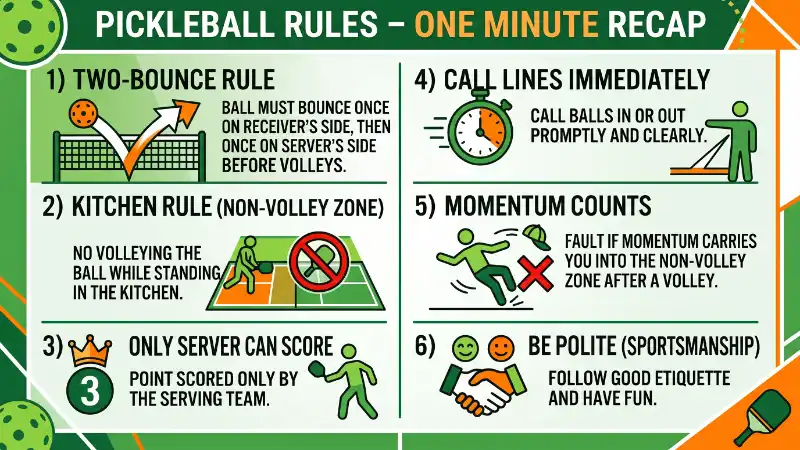
- The two most important rules: Two‑bounce rule + kitchen rule. Master these first.
- Only the server can score. If you’re receiving, you cannot win the point on that rally.
- Call lines immediately – hesitation means the ball is “in.”
- Momentum counts. If your hat falls into the kitchen after a volley, it’s a fault.
- Recreational rules differ from tournament rules. Always ask before joining a new group.
- When in doubt, be polite. Use the scripts from this article – don’t lose friends over a line call.
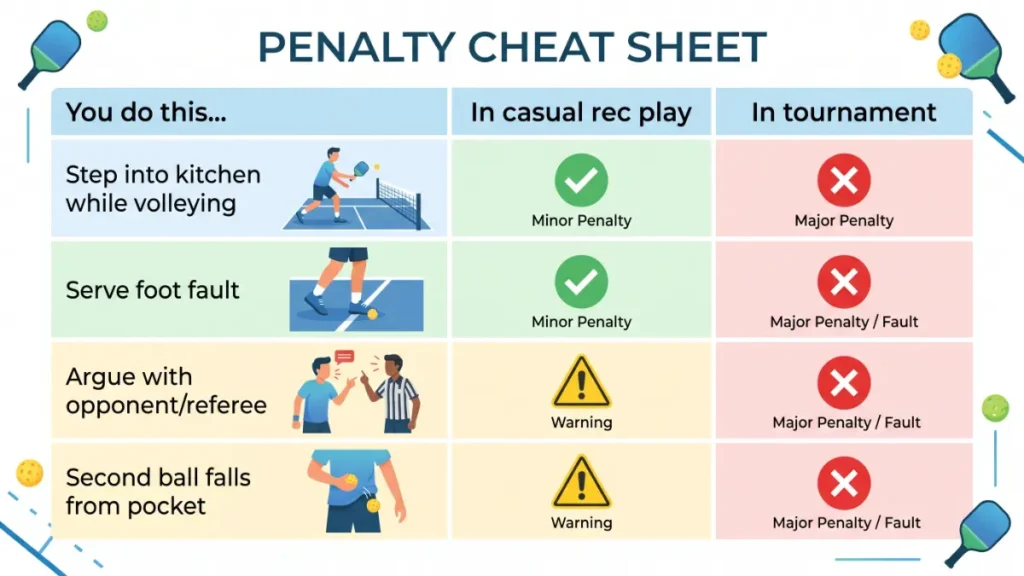
Penalty Cheat Sheet (What Happens When…)
| You do this… | In casual rec play | In tournament |
|---|---|---|
| Step into kitchen while volleying | Loss of rally, friendly reminder | Loss of rally, possible warning |
| Serve foot fault | Re‑serve (usually) or loss of serve | Fault – loss of serve |
| Argue with opponent/referee | Game stops, tension | Verbal warning → point penalty |
| Second ball falls from pocket | Often ignored – but should be fault | Fault – loss of rally |
| Hit a “let serve” that lands in | Play continues (since 2024) | Same |
Common Pickleball Rules Questions (FAQ)
Q: Can I step into the kitchen after I hit a volley?
A: No. If you volley, you cannot step into the kitchen afterward, even if the ball is dead. Your momentum must stop outside.
Q: How many times can the ball bounce?
A: Before the two‑bounce rule, each side gets one bounce. After that, you can volley or let it bounce once per side.
Q: Can the ball hit the net and still be in play?
A: On a serve (since 2024) – yes, as long as it lands in the service box. During a rally – yes, as long as it lands in.
Q: What is a “carry” or “catch”?
A: You cannot scoop or catch the ball on your paddle. The hit must be clean and immediate.
Q: Do I need to say the score loudly?
A: Yes, your opponents must be able to hear it. However, if they cannot hear you, they must call for a score correction before the serve is struck. Once the ball is served, play cannot be stopped mid-rally to challenge the score.
Q: Can I switch hands during a rally?
A: Yes. But you cannot switch paddles. You can hit with your non‑dominant hand if you hold the same paddle.
Q: What is the “momentum rule” in simple terms?
A: After you volley, you cannot let any part of your body or clothing touch the kitchen – even if the ball is already dead.
Q: Can I ask a spectator if a ball was in or out?
A: No. The 2026 rule says players “must not” ask spectators. Doing so may bring a penalty.
📚 Official Rulebook References (Verify Here)
For absolute legal clarity, always refer to the primary sources:
Conclusion
I still remember the knot in my stomach before my first tournament. I had read the official rulebook twice. But when the referee called “0‑0‑2,” I froze. My serve went into the net. That was five years ago. Today, I have refereed over 50 matches and helped hundreds of beginners learn the rules in under an hour. Here is what I learned from personal experience: the rules are not there to punish you. They are there to make the game fair and fun. Every fault is a learning moment. You do not need to memorize everything at once. Focus on the five rules from the priority list, then add one new rule each week. The social part matters more than the rulebook – I have seen players win arguments but lose friends. Use the polite scripts I gave you. They work.
Keep this guide open on your phone during your first few games. I still do that when I play in a new league with different house rules. My expertise comes from making mistakes – and from studying the USA Pickleball rulebook inside out. I update this article every January when new rules come out. You can trust that what you read here is current and tested on real courts. Now go play. Make mistakes. Laugh about them. Download the one‑page PDF below. You have got this. 👉 Printable Cheat Sheet (PDF)
