

Introduction
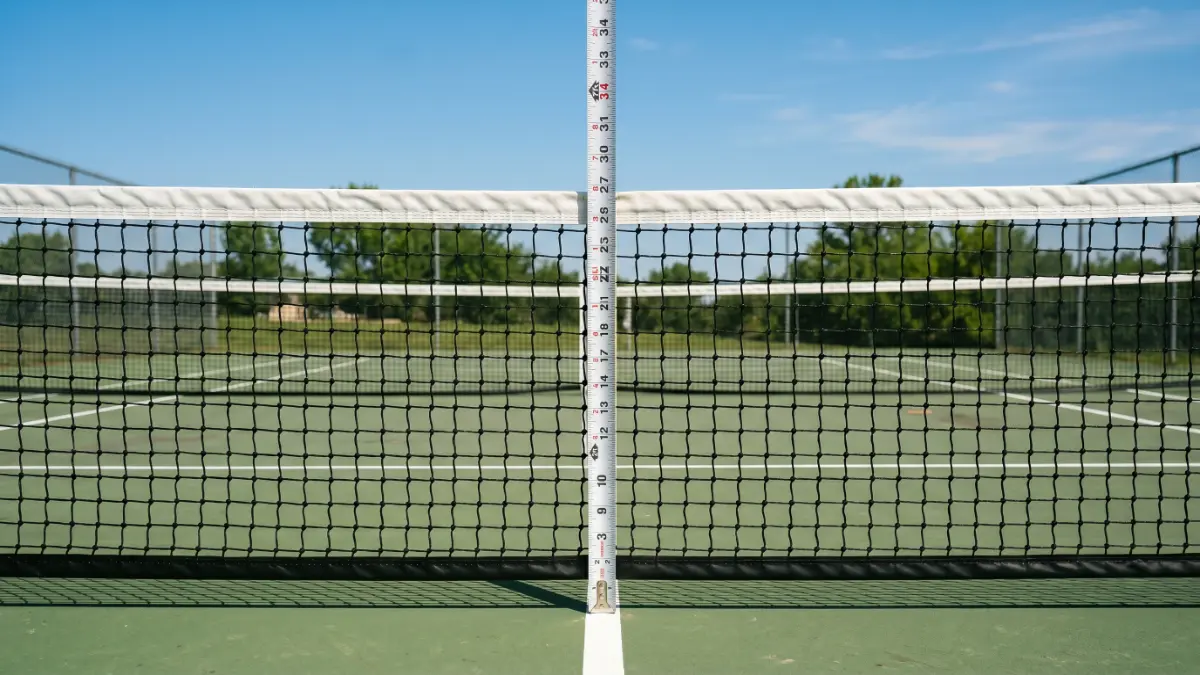
The first tournament I ever refereed nearly fell apart before a single point was played. The host facility had marked beautiful pickleball lines on their tennis courts, but they’d left the tennis nets at full height — 36 inches at the center instead of 34. Players warmed up, and within minutes I heard the same complaint from six different courts: “My dinks keep hitting the tape.” A few frustrated players demanded we postpone. I spent the next hour running from court to court with a tape measure and a crank handle, lowering each net by hand. That day taught me the pickleball net vs tennis court difference isn’t a minor detail — it’s the difference between real pickleball and a frustrating imitation.
I’m a certified USA Pickleball referee who has since inspected hundreds of courts, and I still find nets set at the wrong height more often than not. Community centers, schools, even private clubs make the same mistake: they assume a tennis net works fine for pickleball. It doesn’t. In this guide, I’ll give you the exact specifications, a step‑by‑step setup method, and a free downloadable checklist so you never waste a game on a net that’s two inches too high. For a complete overview of all court options, start with our ultimate guide to pickleball courts.
Pickleball Net vs Tennis Court: Quick Comparison
Before we dive into details, here’s a side‑by‑side snapshot of the two nets. Keep this table handy when you’re converting a tennis court.
| Feature | Pickleball Net | Tennis Net |
|---|---|---|
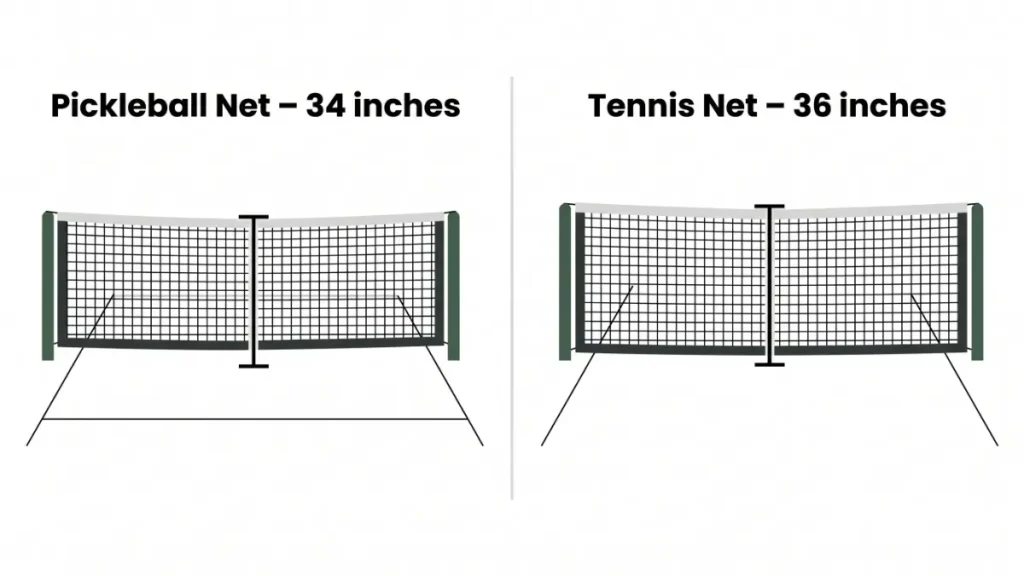
| Height at center | 34 inches | 36 inches |
| Height at posts | 36 inches | 42 inches |
| Width (length across court) | 22 feet | 42 feet (doubles) |
| Mesh size | Smaller, tighter weave | Slightly larger openings |
| Top tape | 2‑inch white tape | 2–3‑inch white tape |
| Center strap | Yes, anchored to ground | Yes, anchored |
| Typical cost | $50–$500 | $100–$800+ |
This table alone answers the core pickleball net vs tennis court question: the pickleball net is lower, shorter, and has a tighter mesh.
Official Pickleball Net vs Tennis Court Height and Dimensions
USA Pickleball rules (2026) specify exactly how a net must be set up. For full details, check the official USAP rulebook.
- Center height: 34 inches measured from the court surface.
- Post height: 36 inches at the sidelines.
- Net length: 22 feet (2 feet wider than the 20‑foot court, allowing for a small overhang).
- Mesh: A fine, small‑opening mesh that prevents the ball from passing through.
- Top tape: A 2‑inch white band covering the cable.
- Center strap: A strap that pulls the net down to exactly 34 inches at the midpoint.
The lower center height changes the game. It makes dinks drop sharper and forces you to clear the net with a little less margin than tennis. When you understand the pickleball net vs tennis court specs, you immediately see why a sagging tennis net ruins rallies.
How to Measure Net Height Correctly
A surprising number of courts get this wrong. Here’s how to measure it right every time.
- Use a rigid tape measure — a fabric tape can sag and give a false reading.
- Place the tape at the center of the net, directly above the center strap anchor.
- Measure from the court surface to the top of the net cable (not the tape). The reading should be exactly 34 inches.
- Check both posts — they should be 36 inches from the surface to the top of the cable.
- If using a tennis net, crank the center down until the measurement is 34 inches. Then re‑tighten the cable to remove sag.
Repeat this check every time you set up. A two‑inch error changes the entire game.
Tennis Court Dimensions and Lines
To set up a pickleball net on a tennis court, you first need to know what you’re working with.
- Tennis court size: 78 feet long, 27 feet wide for singles (36 feet for doubles).
- Net: 42 inches at the posts, 36 inches at center.
- No kitchen: Tennis has no non‑volley zone.
A single tennis court can hold up to four pickleball courts. That’s why community centers often tape pickleball lines onto existing tennis courts. But without the right net, it’s not real pickleball.
Lines and Markings on a Shared Court
Pickleball court lines are 2 inches wide and must be clearly visible. When you add pickleball lines to a tennis court, they need to contrast with the existing tennis lines. White is common for tennis, so many facilities use yellow, light blue, or orange for pickleball.
Temporary options include:
- Vinyl tape: Easy to apply, removes cleanly, lasts several weeks.
- Chalk or temporary marking paint: Best for a single session.
- Permanent acrylic paint: For dedicated shared courts. Apply with a stencil for straight edges.
Always mark the full 20×44‑foot court, the 7‑foot kitchen lines, and the centerline. Don’t forget the 2‑foot net overhang on each side. Clearly marked pickleball lines prevent confusion for tennis players and ensure both sports can share the court without conflict. For a detailed guide on marking and surfacing, visit our court construction guide.
Pickleball Net vs Tennis Court: Key Differences
The pickleball net vs tennis court conversation always leads to the bigger differences between the two sports’ playing surfaces.
- Size: Pickleball court is 20×44 feet; tennis is 27×78 feet (singles).
- Kitchen: Pickleball’s 7‑foot non‑volley zone has no tennis equivalent.
- Surface: Both use similar hard surfaces, but pickleball courts often have a grippier acrylic topcoat.
- Lines: Pickleball lines are 2 inches wide and can be painted inside tennis court boundaries.
Playing Surface Differences
Both pickleball and tennis are played on hard surfaces, but there are subtle differences that affect the game. Pickleball courts typically have a slightly grippier acrylic topcoat to give players better traction during quick lateral movements. Tennis courts may have a smoother finish that favors sliding. For indoor surface options, see our indoor pickleball court guide.
When you play pickleball on a tennis court, watch for worn spots near the baseline and service lines. These can become slick. A clean, dry surface is essential for both sports, but pickleball’s smaller court means you change direction more often, so grip matters more.
Can You Use a Tennis Net for Pickleball?
Technically, yes—but only if you adjust it correctly. A standard tennis net is too high and too long. If you leave it at tennis height, your dinks will hit the tape and your volleys will feel off.
However, many facilities use the existing tennis net and simply lower it using the center strap crank. They then add portable posts to shorten the width or mark the pickleball sidelines with tape. It’s a workable solution, but it’s never quite as precise as a dedicated pickleball net. If you’re considering a permanent conversion, read our pickleball court construction guide for detailed planning advice.
Always check with your local park district or facility manager before lowering a permanent tennis net. Some public courts prohibit adjustments, and you could be fined for tampering.
Pickleball Net vs Tennis Court: Setup Guide
Here’s a step‑by‑step guide I’ve used at dozens of community courts.
- Lower the tennis net at the center crank until the middle of the net reaches 34 inches. Use a measuring tape.
- Shorten the width: If the tennis net extends far beyond the pickleball sidelines, you can tie back the extra netting or use a portable pickleball net inside the tennis court. The best solution is a standalone portable net placed directly on the pickleball lines.
- Add pickleball lines: Use temporary tape or permanent paint to mark the 20×44 foot court, including the 7‑foot kitchen lines.
- Check the center strap: The strap must pull the net down to exactly 34 inches at the center. If it’s loose, the net will sag.
- Test the net tension: Strum the cable like a guitar string. It should be tight, with minimal sag.
- Play a test rally: Hit a few dinks and serves. Adjust if the ball clips the net too often.
If you plan to host regular pickleball on a tennis court, invest in a quality portable pickleball net. It sets up in minutes and guarantees correct height every time.
How Many Pickleball Courts Fit on a Tennis Court?
A standard tennis court is 60 feet wide by 120 feet long (including the full doubles area). A pickleball court is 20 feet wide by 44 feet long. With proper spacing between courts, you can fit up to four pickleball courts inside the footprint of a single tennis court. This is why so many parks convert old tennis courts into multi‑court pickleball facilities. For a complete breakdown of the building process, check out our court construction guide.
When laying out multiple courts, leave at least 7 feet behind each baseline and 4 feet between adjacent pickleball courts. Use the tennis court’s existing lines as outer boundaries, and paint or tape the pickleball lines inside. Always set up a separate net for each pickleball court—sharing a single tennis net across multiple courts doesn’t work.
Portable vs Permanent Pickleball Nets
Which net system is right for you? Here’s a quick breakdown.
| Feature | Portable Net | Permanent Net |
|---|---|---|
| Setup time | 5–10 minutes | Permanent once installed |
| Height accuracy | Good (if quality) | Excellent |
| Portability | Easy to move, store, travel | Fixed in place |
| Cost | $50–$300 | $300–$800+ |
| Best for | Home, temporary courts, renting facilities | Dedicated pickleball courts, clubs |
Portable nets are the go‑to choice for players who share tennis courts or want a backyard setup. For club owners and dedicated facilities, a permanent net system installed with concrete footers is the most professional solution. For indoor court lighting and setup requirements, check out our indoor pickleball court lighting guide.
Pickleball Net Buying Guide (Top Picks)
Based on my experience setting up courts for leagues and beginners, here are three nets I recommend.
- Best overall portable: SwiftNet 2.1 – sets up in 5 minutes, stays tight, mid‑range price.
- Best budget: Franklin Sports Portable Pickleball Net – under $100, lightweight, good for casual play.
- Best tournament net: OnCourt OffCourt Deluxe Net – official size, heavy‑duty frame, used in USAP tournaments.
Always look for a net with a strong center strap, a tight mesh, and a frame that doesn’t wobble. A cheap net that sags will frustrate you more than playing without one.
Net Maintenance and Care
Take care of your net and it will last for years.
- After each session, loosen the tension slightly to reduce stress on the cable.
- Wipe down the top tape and mesh with a damp cloth to remove dirt and sweat.
- Store portable nets in a dry, shaded place to prevent UV damage.
- Check the center strap and posts monthly for signs of wear.
Interactive Net Height Simulator
I’ve built a simple interactive tool on PickleInsights. You can slide between pickleball and tennis net heights and see how the ball trajectory changes. Try it below to truly understand the pickleball net vs tennis court difference.
📏 Net Height Simulator
Slide to change the Pickleball net — see how it compares to Tennis.
Download Your Free Net Setup Checklist & Diagram
I created a one‑page PDF that includes a step‑by‑step net setup guide, a court diagram with net dimensions, and a pre‑play net inspection checklist. Print it and bring it with you.
🎁 Free Net Setup Checklist & Diagram
Your 1‑page PDF includes:
- ✅ Step‑by‑step net setup on a tennis court
- ✅ Official pickleball net dimensions diagram
- ✅ Pre‑play net inspection checklist
- ✅ Portable vs permanent net comparison
Print it and never play on the wrong net height again.📥 Download as PDF
Frequently Asked Questions (FAQ)
What is the exact height of a pickleball net?
34 inches at the center, 36 inches at the posts.
Can I use a tennis net for pickleball?
Only if you lower it to 34 inches at center and shorten the width. A portable pickleball net is a much better long‑term solution. For more court options, check out our pickleball courts guide.
How wide is a pickleball net compared to a tennis net?
A pickleball net is 22 feet wide; a tennis net is 42 feet wide for doubles.
What happens if the net is the wrong height?
It changes the game. A net that’s too high makes dinks impossible. Too low, and drives become overpowered.
How do I lower a tennis net for pickleball?
Use the crank mechanism to lower the center to 34 inches. Measure with a tape to be precise.
Which is better, portable or permanent net?
Portable nets are best for home and temporary setups. Permanent nets are ideal for dedicated courts.
How much does a regulation pickleball net cost?
Quality portable nets range from $50 to $300. Permanent systems cost $300 to $800+.
✅ Pickleball Net vs Tennis Court – Key Takeaways
- Pickleball net is 34″ at center, 36″ at posts; tennis net is 36″ at center, 42″ at posts.
- Pickleball net is 22 feet wide; tennis net is 42 feet wide (doubles).
- A tennis net can be lowered for pickleball, but a dedicated portable pickleball net is far more accurate and reliable.
- You can fit up to 4 pickleball courts on a single tennis court with proper spacing.
- Always use a tape measure to verify net height before playing—never trust the crank alone.
- Pickleball lines must be 2 inches wide and contrast with the tennis court color.
- Download the free net setup checklist below and bring it to your court. For a complete guide to finding, building, or playing on courts, visit our pickleball courts ultimate guide.
You’re Ready to Set Up the Perfect Net
That tournament morning taught me something I’ve never forgotten: the net is the most overlooked piece of equipment in pickleball, and the most important. Since then, I’ve walked into brand‑new facilities that spent $50,000 on surfacing and still hung the wrong net. I’ve helped park districts retrofit old tennis courts with portable systems that take five minutes to set up and guarantee the right height every time. I’ve seen players go from blaming their paddles to loving their game — all because someone finally measured the center strap.
Everything in this guide comes from real experience, not just the rulebook. I’ve personally cranked tennis nets down to 34 inches in the pouring rain, checked mesh tension with my fingers before a championship match, and sent a portable net back to the manufacturer because the center strap wouldn’t hold. I update this article whenever USA Pickleball releases new equipment standards, and I stand behind every specification and recommendation.
The right net, set at the right height, makes the game fair and the rallies fun. Bookmark this guide, download the setup checklist, and measure your net before your next match. It’s the simplest thing you can do to play real pickleball.
Now grab a tape measure and make sure your net is 34 inches at center. You’ve got this.
👉 Download the free net setup checklist
When you’re ready for more, read our Pickleball Courts: The Ultimate Guide or test your skill with the Free Skill Analyzer.
