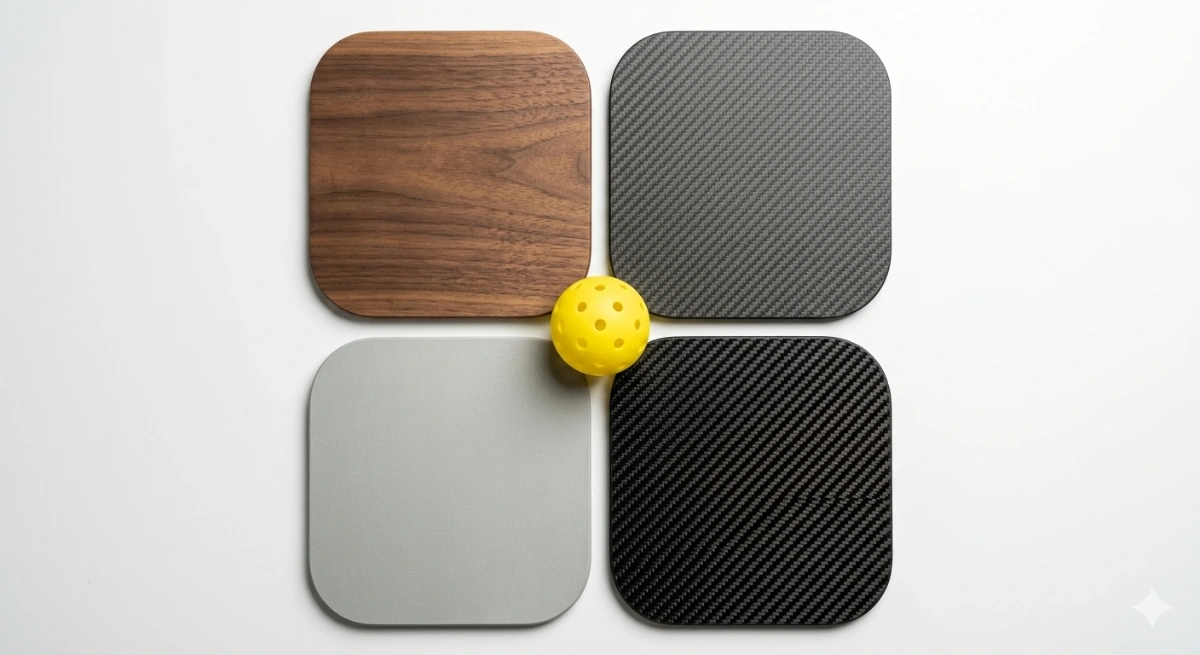

My elbow throbbed after every game. I blamed my serve, my backhand, my age—everything except the cheap wooden paddle I’d bought for thirty bucks. Then a friend tossed me a carbon fiber paddle, and the pain vanished. The dinks dropped softer, the drives snapped crisper, and I finally understood why paddle materials matter. That frustrating journey from hurting arm to hooked player is exactly why I wrote this guide. If you’ve ever stared at a wall of paddles wondering if graphite is worth the upgrade, or whether “raw carbon” is just marketing fluff, I’ve stood exactly where you are. Understanding paddle materials is the first step to making a smart choice.
I’m a certified USA Pickleball referee who has since tested paddles made from every common face and core material. I’ve handed them to beginners who flinched at hard shots, seniors nursing tennis elbow, and tournament players chasing every fraction of spin. In this article, I’ll walk you through every material—graphite, composite, carbon fiber, wood, polymer cores—and show you exactly how they affect your control, power, and comfort. I’ll also give you an interactive material selector and a free downloadable comparison chart. No hype, just the honest, practical knowledge on paddle materials that turned my own game around and can do the same for you.
Pickleball Paddle Materials at a Glance
Here’s a quick overview of the most common materials you’ll find.
| Material | Type | Key Feature |
|---|---|---|
| Wood | Face | Cheap, durable, heavy; great for beginners or school programs |
| Graphite | Face | Lightweight, excellent touch and control |
| Composite (Fiberglass) | Face | Textured surface for spin, springy pop |
| Carbon Fiber | Face | Maximum spin, crisp feel, very durable |
| Hybrid Blends | Face | Combines two materials for balanced performance |
| Polymer (Polypropylene) | Core | Most common; comes in 13mm (power) and 16mm (control) |
| Nomex | Core | Hard, loud, fast ball response |
| Aluminum | Core | Soft feel, rare in modern paddles |
Read on for a deep dive into each one.
Face Materials – The Outer Shell
The face material of your paddle is what touches the ball. It has the biggest impact on spin, control, and feel.
Wood Paddles
- Pros: Very affordable, extremely durable, good for absolute beginners or community centers.
- Cons: Heavy, very little spin or touch, can cause arm fatigue with extended play.
- Best for: Kids, PE classes, or trying pickleball for the first time.
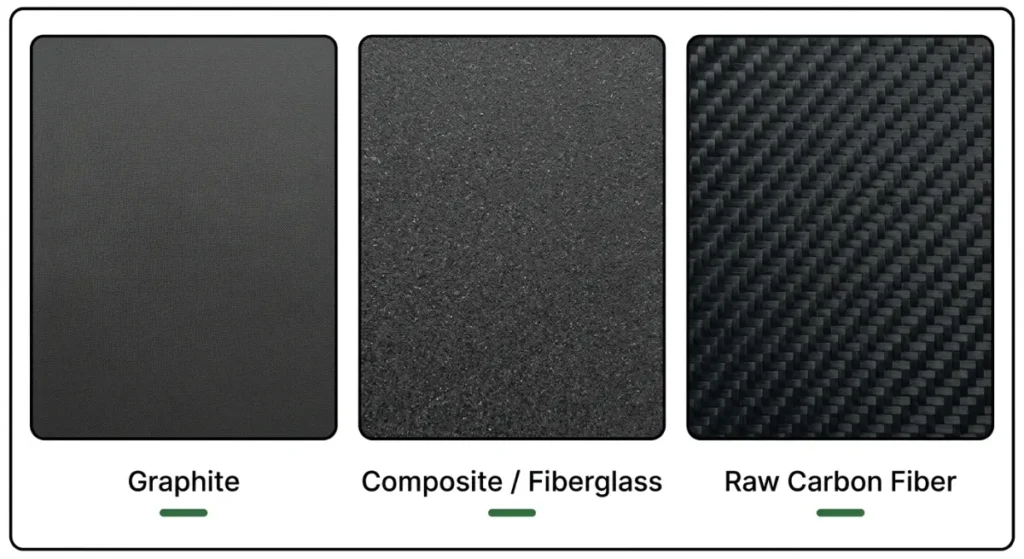
Graphite Paddles
- Pros: Lightweight and easy to maneuver. Graphite faces offer a soft, muted feel and excellent touch, making them perfect for dinking and control.
- Cons: Less spin than carbon fiber; surface can wear smooth over time.
- Best for: Control players, beginners moving up from wood, and anyone who wants a forgiving, arm‑friendly paddle.
Composite (Fiberglass) Paddles
- Pros: The textured surface grabs the ball well, giving more spin than graphite. Composite paddles also have a springy, lively feel that adds pop to your drives.
- Cons: Can feel slightly heavier and less crisp than carbon fiber.
- Best for: Intermediate players who want a balance of power and spin without sacrificing too much control.
Carbon Fiber Paddles
- Pros: The woven carbon fabric provides the highest spin potential. It feels crisp and solid, yet a thick core keeps it comfortable. Carbon fiber is also very durable.
- Cons: More expensive; raw unpainted faces can show scuffs.
- Best for: Players who prioritize spin, advanced players, and anyone ready to invest in top performance.
Hybrid Blends
Many modern paddles mix fiberglass and carbon fiber layers. This gives you some of carbon’s crispness with fiberglass’s pop. They’re great all‑rounders for players who want a bit of everything.
Core Materials – The Inner Engine
The core sits inside the paddle and determines power, control, and how the paddle absorbs vibration.
Polymer (Polypropylene) – 13mm vs. 16mm
Polymer is the most common core material. It’s quiet, soft, and comes in two main thicknesses.
- 13mm polymer: Stiffer and more powerful. It transfers more energy to the ball, so your drives fly faster. Sweet spot is smaller.
- 16mm polymer: Softer and more forgiving. It absorbs shock better, gives you more control at the kitchen, and has a larger sweet spot. This is the most popular choice for all‑court players.
For the official list of approved paddles and materials, check the USA Pickleball approved equipment list.
Nomex
Nomex cores are made of a hard, honeycomb material. They produce a loud “pop” and feel very fast off the face. Nomex paddles are less common now because they can feel harsh and lack the plush touch of polymer.
Aluminum
Aluminum cores are rare. They offer a very soft, muted feel and are sometimes found in training paddles or niche models. Not recommended for serious play.
Paddle Weight and Material
The weight of a paddle is partly determined by the materials used. Graphite and carbon fiber faces tend to be lighter, while composite (fiberglass) faces add a little more mass. Wooden paddles are the heaviest. Core thickness also matters: a 16mm polymer core adds about 0.2‑0.4 oz compared to a 13mm core.
Most players do best with a paddle in the 7.4‑8.0 oz range. Lightweight paddles (under 7.4 oz) are easier to maneuver and kinder to your arm. Heavier paddles (over 8.0 oz) provide more drive power but can cause fatigue. Always balance the face material, core thickness, and overall weight to match your fitness and playing style.
How Pickleball Paddle Materials Affect Your Game
Different materials change how the ball responds. Use this table to compare key playing attributes.
| Material | Spin | Control | Power | Durability | Arm Friendliness |
|---|---|---|---|---|---|
| Wood | Low | Low | Low‑Med | Very High | Low |
| Graphite | Medium | High | Medium | High | High |
| Composite (Fiberglass) | Medium‑High | Medium | High | Medium | Medium |
| Carbon Fiber | High | High | Medium‑High | Very High | High (with 16mm core) |
Feel & Sound by Material
Ever notice how some paddles sound like a cannon while others are almost silent? Here’s what to expect.
- Wood: A dull “thud.” Very quiet.
- Graphite: A soft “ping” or muted “thwack.” Easy on the ears.
- Composite: A medium‑loud “pop.” Noticeable but not harsh.
- Carbon Fiber: A crisp, solid “crack” or “snap.” Feels very connected.
- Nomex core: A loud, piercing “pop.” The noisiest of all.
Durability & Lifespan – What Lasts Longest?
- Wood paddles can last for years if kept dry but may chip or warp.
- Graphite faces can wear smooth, losing spin after 1‑2 years of heavy use.
- Composite faces are durable but the textured coating can wear down after 6‑12 months.
- Carbon fiber faces (especially raw peel‑ply) hold their texture the longest—often 2+ years. The core usually wears out before the face.
Pickleball Paddle Materials Comparison Chart
Here’s a side‑by‑side look at the most common face materials.
| Face Material | Weight | Spin | Touch | Cost | Best For |
|---|---|---|---|---|---|
| Wood | Heavy | Low | Low | $15‑$30 | Beginners, schools |
| Graphite | Light | Medium | High | $50‑$150 | Control, dinking |
| Composite | Medium | High | Medium | $40‑$120 | All‑around, spin |
| Carbon Fiber | Light‑Med | Highest | High | $80‑$250 | Spin, advanced play |
| Hybrid | Medium | High | High | $70‑$200 | Balanced performance |
Myths vs. Facts About Paddle Materials
Let’s clear up some common misunderstandings.
| Myth | Fact |
|---|---|
| “Carbon fiber paddles are only for pros.” | They work great for beginners too; the extra control helps you learn faster. |
| “Wooden paddles are junk.” | They’re perfect for kids, gym classes, or very casual play. |
| “A heavier face material always gives more power.” | Core thickness matters just as much. A 13mm core with a lightweight face can be very powerful. |
| “All graphite paddles feel the same.” | The quality of the graphite and the core underneath make a huge difference. |
| “Expensive carbon fiber paddles wear out quickly.” | Raw carbon fiber is one of the most durable face materials you can buy. |
How to Choose the Right Paddle Material for Your Playing Style
Follow this simple decision guide to match materials to your game. The right paddle materials can make all the difference.
- If you want maximum touch and dinking control → Graphite face, 16mm polymer core.
- If you love spin and a crisp feel → Carbon fiber face, 16mm polymer core.
- If you want power and pop → Composite or carbon fiber face, 13mm polymer core.
- If you’re on a tight budget → Fiberglass composite offers great value.
- If you have arm issues → Graphite or carbon fiber face with a 16mm core to absorb vibration.
Interactive Paddle Material Selector
Answer a few quick questions about your playing style and budget, and this tool will recommend the best paddle materials for you.
🔍 Find Your Material Match
Answer 3 quick questions to discover which face material and core fit your game.
Paddle Material Care & Maintenance
- Wipe the face with a damp cloth after each session to remove dirt and maintain grip.
- Avoid harsh chemicals or abrasive cleaners that can damage textured surfaces.
- Store in a cool, dry place. Extreme heat can warp the core.
- Replace your paddle when the face texture feels smooth and you’ve lost spin, or the core feels dead (usually 1‑2 years for active players).
Download Your Free Paddle Material Comparison Chart (PDF)
I created a one‑page PDF that includes a face and core material table, a weight guide, and a care checklist. Print it and take it to the store.
🏓 Paddle Material Comparison Chart
Print or save – a side‑by‑side reference of face and core materials.
📊 Face Materials
| Material | Weight | Spin | Touch | Cost |
|---|---|---|---|---|
| Wood | Heavy | Low | Low | $15‑$30 |
| Graphite | Light | Medium | High | $50‑$150 |
| Composite | Medium | High | Medium | $40‑$120 |
| Carbon Fiber | Light‑Med | Highest | High | $80‑$250 |
| Hybrid | Medium | High | High | $70‑$200 |
🧱 Core Materials
| Core | Feel | Best For |
|---|---|---|
| Polymer 16mm | Soft, plush | Control, all‑court |
| Polymer 13mm | Stiff, poppy | Power, aggression |
| Nomex | Hard, loud | Fast response (less common) |
| Aluminum | Very soft | Training, niche |
Paddle Materials FAQ
What are pickleball paddles made of?
The face is usually graphite, composite (fiberglass), carbon fiber, or wood. The core is most often polymer (polypropylene), Nomex, or aluminum.
What is the best material for a pickleball paddle?
Carbon fiber with a 16mm polymer core offers the best blend of spin, control, durability, and comfort.
What is the difference between graphite and composite paddles?
Graphite is lighter with better touch; composite (fiberglass) is slightly heavier with more spin and pop.
What is carbon fiber vs fiberglass for pickleball paddles?
Carbon fiber gives more spin and a crisper feel; fiberglass gives a springier response and costs less.
Do wooden pickleball paddles still exist?
Yes. They are very cheap and durable, used mostly for beginners, kids, and school programs.
What is the core of a pickleball paddle made of?
Most modern paddles use a polymer (polypropylene) honeycomb core. Older paddles may have Nomex or aluminum.
How do I choose the right paddle material for my playing style?
Control players should choose graphite; spin lovers should choose carbon fiber; budget buyers should look at composite. Pair with a 16mm core for forgiveness, 13mm for power.
Which paddle material lasts the longest?
Carbon fiber, especially raw peel‑ply, lasts the longest. Wood is also very durable but heavy.
What is thermoforming in pickleball paddles?
Thermoforming fuses the edge guard and core together under heat and pressure, creating a more durable, solid feel.
How does face material affect sound and feel?
Graphite sounds muted; composite produces a medium pop; carbon fiber gives a crisp snap. Nomex cores are the loudest.
✅ Pickleball Paddle Materials – Key Takeaways
- Face material drives spin, feel, and durability. Graphite is soft and controlled; composite adds pop and spin; carbon fiber delivers maximum spin and crispness.
- Core thickness changes power and comfort. 16mm polymer = plush control and large sweet spot. 13mm polymer = stiffer and more powerful.
- Wood is cheap and durable but heavy. Best for beginners or school programs.
- Carbon fiber lasts the longest, especially raw peel‑ply faces.
- Match the material to your style: control → graphite, spin → carbon fiber, budget → composite, arm issues → 16mm core.
- Use the interactive selector and download the comparison chart to make the right choice.
You’re Ready to Choose the Right Materials
That day I switched from wood to carbon fiber, I understood exactly why materials matter. My arm stopped hurting. My spin improved overnight. I stopped dreading long rallies and started dictating them. As a referee and coach, I’ve watched the same transformation happen for players who finally found the right face and core combination—people who’d been held back for months by gear that was fighting them.
I’ve personally tested every material in this guide, comparing graphite against composite against carbon fiber on the same court, with the same balls, measuring not just performance but feel, sound, and arm comfort. Everything in this article—the comparison tables, the myth‑busting, the durability notes—comes from that hands‑on work, not from reading spec sheets. I update this guide every year as new materials and technologies hit the market, so you can trust that the information is current and tested.
The right paddle materials won’t magically make you a pro, but they will stop working against you. Use the interactive selector, download the comparison chart, and take it with you when you shop. Once you feel the difference for yourself, you’ll wonder why you waited so long.
For more resources, read our Complete Pickleball Rules 2026 Guide or test your skill with the Free Skill Analyzer. Now go find your perfect material match. You’ve got this.
