

Introduction
The first time I tried singles, I jogged to the right side to serve, opened my mouth, and nothing came out. I had no partner to whisper “What’s the score?” or “Am I on the right side?” My brain screamed the three‑number doubles call while my feet felt glued to the wrong box. I served out of turn, lost track of the score within four points, and spent the rest of the match praying my opponent wouldn’t notice I had no idea what I was doing. That lonely, hot‑faced panic is exactly why I wrote this guide. If you’re searching how to play pickleball singles because you want to walk onto a court alone and actually know what you’re doing, I’ve been in your shoes.
I’m a certified USA Pickleball referee who has coached over 200 players, and I’ve seen that same deer‑in‑the‑headlights look on countless faces—players who are perfectly fine in doubles but freeze the moment they have to cover the whole court by themselves. The beautiful truth is, singles rules are simpler than doubles. You just need someone to lay them out clearly, without the jargon. In this article, I’ll teach you the rules, how to serve and score, where to stand, basic strategy, solo drills, and I’ll even give you a free interactive score tracker and a downloadable playbook. No fluff—just the practical, tested advice on how to play pickleball singles that I wish I’d had when I started. If you’re looking for professional guidance, our pickleball lessons guide can help you find the right coach.
Singles vs. Doubles: What’s Different?
Before we dive into the details, here’s a quick snapshot of how singles differs from doubles.
| Feature | Singles | Doubles |
|---|---|---|
| Players | 1 vs. 1 | 2 vs. 2 |
| Court width | 20 ft (inner sidelines) | 20 ft (outer sidelines) |
| Serve attempts | 1 per side | 2 per side (except first turn) |
| Score call | Two numbers (e.g., “3‑2”) | Three numbers (e.g., “3‑2‑1”) |
| Server rotation | No partner; side‑out after a fault | Partner serves after fault |
| Switching sides | Server switches after each point won | Same |
| Kitchen & faults | Same as doubles | Same |
The game is the same—just simpler rules and a whole lot more running.
How to Play Pickleball Singles: Rules in 60 Seconds
You don’t need to memorize a rulebook. Start with these five essentials. To understand where your singles skill stands, check out our pickleball rating guide.
- Serve underhand – Paddle contact below your waist. Only one serve attempt.
- Serve from the right if your score is even, left if odd – That’s the memory trick.
- Call a two‑number score – Your points first, then your opponent’s. Example: “3‑1.”
- Only the server can score – If you’re receiving, you can’t win a point.
- Play to 11, win by 2 – Kitchen and line rules are exactly the same as doubles.
That’s it. Now let’s break down each part.
How to Serve in Singles
The serve in singles follows the same core rules as doubles, but you only get one chance. If you fault, the serve goes straight to your opponent.
Here’s exactly what to do:
- Stand behind the baseline, between the centerline and the inner sideline.
- Use an underhand motion: paddle head stays below your wrist, contact below your waist. For a complete breakdown of the proper pickleball grip, check out our guide.
- Aim cross‑court into the opponent’s right or left service box, depending on your score.
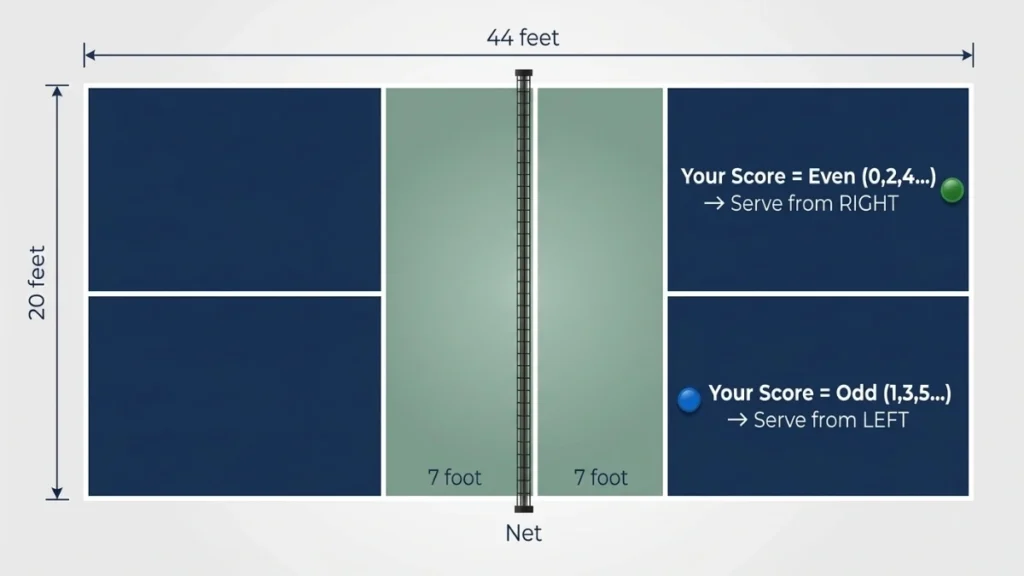
Where to serve from?
- Your score is even (0, 2, 4…): Serve from the right service box.
- Your score is odd (1, 3, 5…): Serve from the left service box.
Memory trick: Start on the right at 0‑0 (even), and switch sides each time you win a point as the server. The receiver never switches.
How to Score in Singles
Scoring in singles is actually easier than doubles. There’s no server number. You call only two numbers: your score – opponent’s score.
Example: If you have 3 points and your opponent has 1, you call “3‑1.”
Important scoring rules:
- Only the serving player can score.
- Games go to 11 points, and you must win by 2.
- If the game reaches 10‑10, play continues until someone leads by 2.
Side‑out and rally scoring:
In traditional side‑out scoring, when you lose the rally while serving, the serve goes to your opponent (a side‑out) and no point is scored. A newer option is rally scoring, where a point is scored on every rally regardless of who serves. In rally scoring, games are often played to 21, win by 2. Always confirm with your opponent which system you’re using before you start.
Calling the score aloud: Always say the score before you serve, loud enough for your opponent to hear. If you call the wrong score, stop and correct it before you serve.
Line Calls in Singles
Line call rules do not change for singles. A ball that touches any part of the line is “in.” Since there are no line judges in casual play, you and your opponent make the calls honestly. If you are not sure whether a ball was in or out, it is considered “in.” The 2026 rules require immediate calls—hesitation means the ball is in. Understanding line calls is a fundamental part of learning how to play pickleball singles correctly.
Court Positioning & Movement
Singles demands more movement than doubles because you have to cover the entire court. Here’s where to stand and how to move.
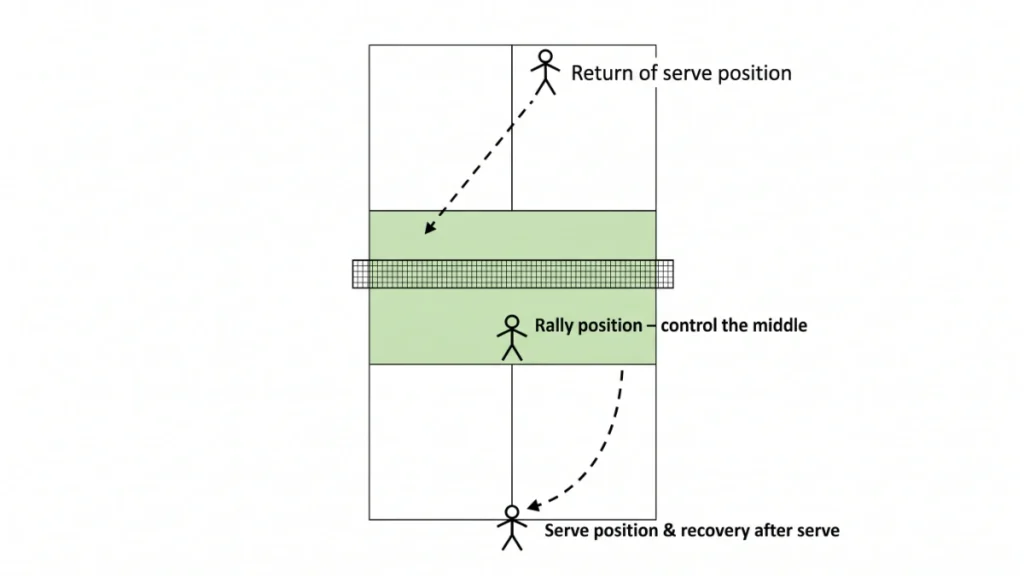
- When serving: Stand near the center of the baseline after your serve so you can cover both sides.
- When returning serve: Stand a step behind the baseline, ready to move forward.
- During the rally: Try to control the middle of the court. Move back to the baseline when you’re on defense, and step into the kitchen when you’re on offense.
- Footwork: Use small, quick steps. Stay on the balls of your feet. Avoid crossing your feet; shuffle or side‑step instead.
A simple rule: after you hit your shot, return to the middle of the court to cut off angles.
Singles Strategy: How to Play Pickleball Singles
Knowing the rules is one thing. Knowing how to win is another. Use these simple strategies to start outsmarting opponents right away.
- Serve deep: A deep serve pushes your opponent back and gives you time to move forward.
- Return deep: A deep return keeps the server back and makes their third shot harder.
- Move your opponent: Hit the ball to the open court. Make them run. Tired opponents make mistakes.
- Control the kitchen: Get to the kitchen line when you can. From there, you can dink, drive, or put the ball away.
- Dink with purpose: A soft dink into the kitchen can pull your opponent forward, then you pass them with a drive. Master this essential skill with our dink pickleball guide.
- Be patient: Singles rallies are longer than doubles. The player who makes fewer unforced errors usually wins.
Shot Selection
In singles, your shot choice depends on your position and your opponent’s position. When you are at the kitchen line, use dinks… From the baseline, drive the ball deep… If you are on the run, hit a high, deep lob… or a soft reset into the kitchen to buy time. Smart shot selection keeps you in control of the rally.
On the mental side, remember that singles is a chess match. Stay calm, focus on one point at a time, and don’t get discouraged if you lose a few points in a row.
Common Singles Mistakes (And How to Fix Them)
I see these errors all the time when players transition from doubles to singles.
| Mistake | Why It Happens | How to Fix It |
|---|---|---|
| Serving from the wrong side | Forgetting the even/odd rule | Check your score before you step to the line. Even → right, odd → left. |
| Calling a three‑number score | Muscle memory from doubles | Remind yourself before every serve: “Only two numbers.” |
| Standing too close to the baseline | Habit from doubles where you have a partner to cover | Step back after your serve; give yourself time to react. |
| Popping up dinks | Swinging too hard, poor touch | Shorten your swing, bend your knees, and lift gently with your legs. Practice these skills with our pickleball drills guide. |
| Not recovering to the middle | Watching your shot instead of moving | After every shot, hustle back to the center of the court. |
Solo Drills to Improve Your Pickleball Singles Game
You can improve your singles game by yourself. Here’s a 15‑minute routine you can do with just a paddle, a ball, and a wall.
1. Wall Dinking (5 min): Stand 3‑4 feet from a wall. Mark a line at 34 inches. Dink softly, aiming for 30 consecutive hits without missing. This builds touch.
2. Shadow Footwork (5 min): Without a ball, move through ladder patterns—side shuffles, crossover steps, forward and backward sprints—on the court. Focus on staying low and balanced. This simple routine is one of the best ways to build confidence when you’re learning how to play pickleball singles.
3. Serve Accuracy (5 min): Set up targets (a towel, cone) in both service boxes. Serve 20 balls—10 to the right box, 10 to the left. Track how many hit the target.
Do this routine three times a week, and you’ll notice better movement and consistency in your matches. For more practice routines, check out our complete pickleball drills guide.
Singles Warm‑Up & Cool‑Down
A proper warm‑up prevents injuries. A cool‑down helps you recover.
5‑Minute Dynamic Warm‑Up
- Jog lightly around the court for 2 minutes.
- Arm circles (forward and backward), 30 seconds each direction.
- High knees and butt kicks, 30 seconds each.
- Shadow swings: 10 dinks, 10 drives, 10 serves.
3‑Minute Cool‑Down
- Walk slowly for a minute while breathing deeply.
- Gently stretch your shoulders, wrists, and lower back.
- Roll your neck and shake out your legs.
Never skip these. Your body will thank you, and your touch will be sharper from the first serve.
Interactive Singles Score Tracker
I’ve built a simple interactive tool right here on PickleInsights that lets you practice calling the score, track points, and even quiz yourself. Use it to build confidence before you step on a real court.
👤 Singles Score Tracker
Track your singles match. Only two numbers to call – and the server switches sides correctly.
Download Your Free Singles Playbook (PDF)
I’ve put together a one‑page PDF that includes a singles rules summary, a strategy cheat sheet, the solo practice routine, and a score‑calling guide. Print it and keep it in your bag.
Frequently Asked Questions (FAQ)
How do you play singles pickleball for beginners?
Start with the basic rules: underhand serve, two‑number score, even/right‑odd/left serving position. Then practice the solo drills in this guide to build touch and movement.
What are the key differences between singles and doubles?
Singles has one serve per side, two‑number score, no partner, and you must cover the whole court. The court boundaries are the same (20 ft wide) but you use the inner sidelines.
How does scoring work in singles pickleball?
Only the serving player can score. Call your score first, then the opponent’s. For example, “3‑1.” Games go to 11, win by 2.
Where do you stand when serving in singles?
Behind the baseline, between the centerline and the inner sideline. Serve from the right if your score is even, from the left if odd.
Strategy & Practice Questions
What are the best strategies for singles pickleball?
Serve deep, return deep, move your opponent around, control the kitchen when you can, and be patient. Let your opponent make unforced errors.
How do you move on the court in singles?
Use small, quick steps. After each shot, recover to the middle of the court. Stay on the balls of your feet and avoid crossing your feet. Once you understand how to play pickleball singles, movement becomes second nature.
Can you play singles pickleball on a doubles court?
Yes, the court dimensions are identical. Just use the inner sidelines and play with one person per side.
What are the most common singles mistakes?
Serving from the wrong side, calling a three‑number score out of habit, standing too close after a serve, popping up dinks, and not recovering to the middle.
How do you practice singles when you’re alone?
Use the solo drill routine in this guide: wall dinking, shadow footwork, and serve accuracy. All you need is a paddle, a ball, and a wall or fence.
What’s the ideal singles warm‑up?
Jog, do dynamic stretches (arm circles, high knees), and take some shadow swings. Follow the 5‑minute warm‑up routine in this guide.
How do you return serve effectively in singles?
Aim to return deep to the server’s baseline. This keeps them back and gives you time to move to the kitchen line.
✅ How to Play Pickleball Singles – Key Takeaways
- One serve only. Fault = side‑out. No second server.
- Serve from the right when your score is even, left when odd.
- Call two numbers: your score – opponent’s score.
- Only the server can score in side‑out scoring.
- Cover the middle. After every shot, recover to the center of the court.
- Practice solo: 15‑min routine of wall dinks, shadow footwork, and serve accuracy.
- Download the playbook and use the interactive score tracker to build confidence. For additional official resources, check the USA Pickleball website.
You’re Ready to Play Singles
I’ll never forget the first singles match I won. I was exhausted, my legs were burning, and I’d made every mistake in this guide. But when I called “11‑9” and shook hands, I felt a sense of accomplishment I’d never had in doubles. Singles taught me to trust my shots, to move with purpose, and to stay calm when every ball seemed to land just out of reach. That victory wasn’t about skill—it was about finally understanding the game I was playing.
Since that day, I’ve watched dozens of my students go through the same transformation. Beginners who couldn’t call a two‑number score without stuttering became confident singles players who actually preferred the solitude of the solo court. I’ve stood on the sideline and coached players through their first tournament match, reminding them to breathe, to recover to the middle, and to let their opponent make the mistakes. The singles court is a tough teacher, but it rewards consistency and courage more than any flashy shot.
Everything in this guide comes from real courts and real coaching sessions—not theory. I update it every year when new rules come out, so you can trust the information is current and tested. Bookmark it, download the playbook, and use the interactive score tracker until calling the score feels as natural as breathing.
Now grab your paddle, find a court, and experience the thrill of singles. You’ve got this.
👉 Download the free singles playbook
When you’re ready for more, read our Complete Pickleball Rules 2026 Guide or test your skill with the Free Skill Analyzer. And if you want to master your dinks, check out our Dink Pickleball Guide.
