
Introduction
Let me tell you about my first pickleball lesson. The coach said, “Try a dink.” I had no idea what that meant. Then she said, “Stay out of the kitchen.” I looked around for an actual kitchen. Then she said, “Don’t step on the NVZ line.” I thought she was speaking a different language. I felt confused and embarrassed. That feeling of being lost is something I have seen in hundreds of new players since then. They hear terms like “Erne,” “ATP,” and “Bert” and have no idea what they mean when learning pickleball terminology. Nodding along pretending to understand is common. Asking questions is avoided because no one wants to look stupid. Feeling like an outsider in a community they desperately want to join is a real fear. If any of this sounds familiar, you are not alone. These are real pain points, and they are exactly why I wrote this guide on pickleball terminology.
A USA Pickleball certified referee (certified since 2015), I have coached over 200 players through their first open play sessions. I have seen the difference between players who know the language and players who do not. Every mistake I could make, I have made—given unsolicited advice, argued a line call I should have let go, and failed to tap paddles after a frustrating loss. The hard way is how I learned. This guide is the one I wish I had before my first lesson. No jargon, no fluff—just clear, simple definitions of pickleball terminology from someone who has been where you are right now.
What Is Pickleball Terminology and Why Does It Matter?
Pickleball terminology is the specialized vocabulary used to describe the game. It includes terms for shots, court zones, rules, scoring, and strategy. Understanding pickleball rules is the foundation of learning the game.
Knowing the pickleball terminology matters for several reasons. It helps you communicate with partners and coaches. Understanding the rules becomes easier. Improving your game is another key benefit. And it helps you feel like you belong on the court.
When you know the language, you can focus on playing. When you do not know it, you feel lost. This guide will fix that. For the most authoritative information, refer to the official USA Pickleball resources.
Beginner Terms (Must-Know Vocabulary)
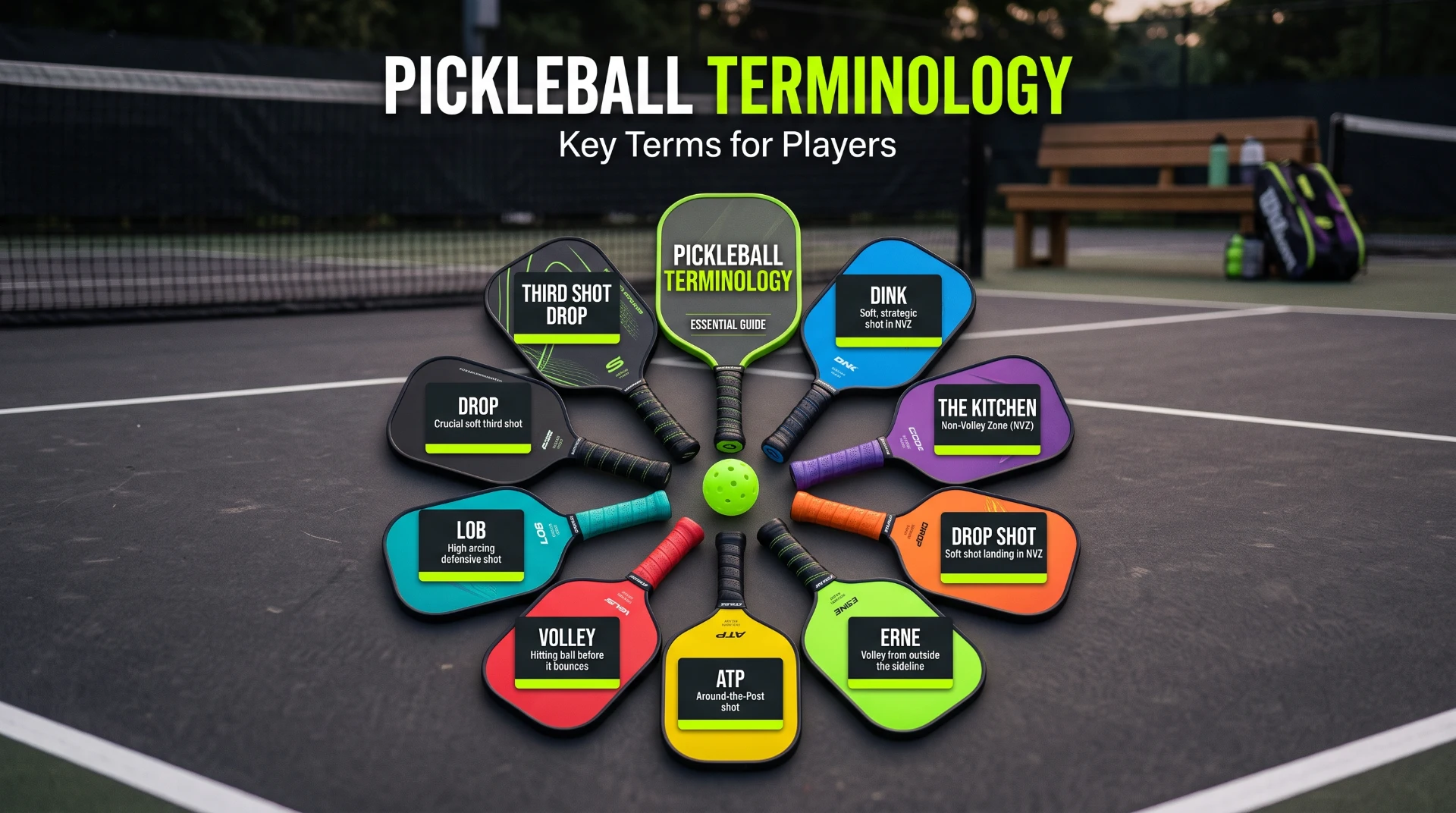
These are the terms every new player needs to know. Master these first. They are the foundation of pickleball terminology.
Ace
A serve that the receiver cannot return. It lands in the service box untouched and wins the point instantly.
Backhand
A shot hit on your non-dominant side. If you are right-handed, your backhand is on your left side. It is usually weaker than a forehand. But it can be a powerful weapon with practice.
Baseline
The line at the far end of the court. You serve from behind it. You stay behind it when returning serves.
Carry
Also called a “catch.” This happens when you let the ball linger on your paddle. It is not a clean hit. The ball is not bounced or volleyed properly. It is a fault.
Crosscourt
A shot that travels diagonally across the court. When you serve, the ball must land crosscourt in the opponent’s service box.
Dink
A soft shot that lands in the opponent’s kitchen. This is not a powerful hit but a strategic shot that forces your opponent to hit up. It is one of the most important shots in pickleball.
Fault
A mistake that stops play. A fault can be a serve that misses the box, stepping into the kitchen on a volley, or a ball that hits the net. When a fault happens, the point ends.
Forehand
A shot hit on your dominant side. If you are right-handed, your forehand is on your right side. This is usually your strongest shot.
Groundstroke
A shot hit after the ball has bounced once. You hit it from the baseline or midcourt. It is not a volley.
Half Volley
A shot hit just after the ball bounces. The paddle meets the ball very close to the ground. It is a difficult shot that requires timing.
Hinder
Anything that interferes with play. It can be a ball rolling onto the court. It can be a stray ball from another court. When a hinder happens, you call for a replay.
Kitchen
This is the non-volley zone. It is the area within 7 feet of the net on both sides. You cannot volley from this zone. You cannot step into the zone and hit a volley.
Let
A serve that hits the net but still lands in the service box. Since 2024, let serves are live. You play them.
Lob
A high, deep shot. It arcs over your opponent’s head. It pushes them back to the baseline.
Non-Volley Zone (NVZ)
This is the official name for the kitchen. It is the area where you cannot volley. The rule exists to prevent players from standing at the net and smashing everything.
Overhead Smash
A powerful shot hit above your head. You use it to attack a high ball. It is like a tennis overhead.
Paddle
The equipment you use to hit the ball. Pickleball paddles are solid, unlike tennis rackets. They do not have strings.
Poach
When a player crosses over to take a shot that belongs to their partner. It is a common strategy in doubles. You do it to surprise opponents.
Rally
A sequence of shots. It starts with the serve. It ends when a fault occurs or a point is won.
Serve
The shot that starts each point. The server hits the ball underhand. The paddle must contact the ball below the waist. The serve must land crosscourt.
Volley
A shot hit before the ball bounces. You hit it out of the air. You cannot volley from the kitchen.
Intermediate Terms
These intermediate pickleball terms will expand your vocabulary. Once you know the basics, it is time to learn these terms. They are used frequently in competitive play and coaching conversations.
Approach Shot
A shot hit as you move toward the net. You hit it from midcourt. It sets you up for a volley or a putaway.
ATP (Around the Post)
A shot hit around the net post. It is a legal shot. The ball does not have to go over the net. It can go around the post. It is a difficult and impressive shot.
Bert
An advanced shot where a player leaps over the kitchen on the opposite side of the court to volley a ball. It is similar to an Erne, but becomes a Bert when the player crosses from the left side of the court to the right sideline or vice versa. Some call it a “poached Erne” because you hit it on your teammate’s side of the court.
Body Bag
A shot that hits an opponent. It is not a fault. The point is won. You can intentionally hit the ball at your opponent.
Double Bounce Rule
The rule that states the ball must bounce once on each side after a serve. It cannot be volleyed until after both bounces.
Drop Shot
A soft shot that lands just over the net. It is hit with backspin. It forces your opponent to run forward.
Drive
A hard, fast shot. Hit with power, this shot is meant to overwhelm your opponent. It is the opposite of a dink.
Erne
A shot hit from outside the court. The player jumps or steps outside the sideline to hit a volley. It is an advanced shot. It is pronounced “ERN” (rhymes with “fern” without the ‘f’).
Falafel
A soft, spinning shot. It is hit short, often with side spin. It is a finesse shot.
Flapjack
A shot that is hit after the bounce but still low. It is similar to a half volley. It is a recovery shot.
Golden Pickle
A game that ends with a score of 11-0. It means one team did not score a single point.
Momentum Rule
The rule that says you cannot step into the kitchen after volleying. Even if the ball is dead, if your momentum carries you into the kitchen, it is a fault.
Nasty Nelson
A serve that hits your opponent before bouncing. It is a legal shot. It is named after a player who popularized it.
Pancake
A shot hit with an open paddle face. The paddle is flat, like a pancake. It is a defensive shot.
Pickled
When your team is shut out. If the final score is 11-0, you have been pickled.
Reset Shot
A shot that stops your opponent’s momentum. It is a soft, controlled dink. It resets the rally to neutral.
Roll Volley
A volley with topspin. You roll your wrist over the ball. It creates a dipping shot.
Scorpion
A shot where a player falls backwards and still hits the ball. It is an athletic, acrobatic shot. It looks like a scorpion sting.
Shake-n-Bake
A shot where one player drives the ball and the other volleys it. It is a fast, aggressive play.
Third Shot Drop
A soft shot hit after the first two bounces. It is a drop shot that lands in the opponent’s kitchen.
Topspin
A shot where the ball rotates forward. It dips down after crossing the net. It is a powerful shot.
Court Terminology
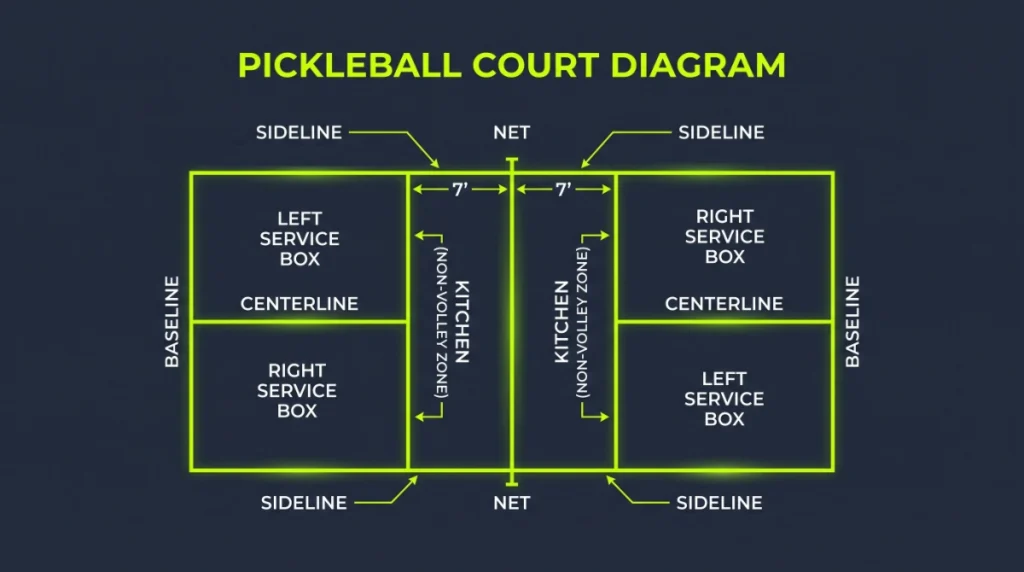
Court pickleball terminology helps you understand where to stand on the court.
Centerline
The line that runs down the middle of each service box. It divides the service boxes.
Non-Volley Zone (NVZ)
The 7-foot area on each side of the net. You cannot volley from it.
Service Box
The area where the serve must land. Each side has two service boxes. The serve must land crosscourt in the opposite service box.
Sidelines
The lines that run along the sides of the court. There are two sidelines for singles and two for doubles.
Scoring & Gameplay Terms
Scoring pickleball terms are essential for keeping track of the game.
Double Bounce Rule
The ball must bounce once on each side after the serve. Then players can volley.
Game Point / Match Point
Game point is the point that wins the game. Match point is the point that wins the match.
Side Out
When the serving team loses the serve. The serve goes to the other team.
Service Sequence
The order of serving in doubles. Player 1 serves from the right side. Player 1 serves from the left side. After that, Player 2 serves from the right side. Finally, Player 2 serves from the left side.
Set
A set of games. In professional pickleball, matches are often best of three sets.
Tournament & Rating Terms
Tournament pickleball terminology is key for competitive players. These terms are for players who compete in tournaments or watch professional pickleball.
APP (Association of Pickleball Professionals)
One of the main professional pickleball tours. They host amateur and pro events across the country.
Dream Ticket
A ticket earned by winning a MiLP Regional Showdown. It gives you entry to the MiLP Championships.
DUPR (Dynamic Universal Pickleball Rating)
The leading rating system in pickleball. It rates players on a scale of 2.000 to 8.000. To get your official rating, you can sign up at the DUPR website.
Golden Ticket
A ticket earned by winning a USA Pickleball Golden Ticket tournament. It gives you priority registration for the National Championships.
MLP (Major League Pickleball)
The professional team league. It features team competitions with a unique format.
PPA (Professional Pickleball Association)
One of the main professional pickleball tours. They host events across the United States.
UTPR (USA Pickleball Tournament Player Rating)
The official rating system from USA Pickleball. It is based on your performance in sanctioned tournaments.
Pickleball Slang
Slang is the fun side of pickleball terminology. These are fun, informal terms used by players. Knowing them helps you feel like part of the community.
Banger
A player who hits hard shots. They rely on power instead of finesse.
Dinker
A player who loves to dink. They rely on soft shots and placement.
Kitchen
The non-volley zone. “Stay out of the kitchen!”
Kitchen Court
A player who is good at dinking and rallying. They are comfortable in the kitchen.
New Terms to Add
These new pickleball terms are emerging in the pickleball vocabulary. They are part of the evolving pickleball terminology landscape.
Backspin (Slice)
A reverse rotation applied to the ball. It is generated with a high‑to‑low swing path. The ball spins backward after it bounces.
Blast‑Off
A fun term used when the score is 3‑2‑1. It is said just before letting a serve rip.
Bounce It!
A term used when one player calls a teammate off a shot. It is not considered a hindrance. It is helpful for partner communication.
Champion Shot
A winning shot that bounces twice in the kitchen. It is a decisive point‑ending shot.
Crangle (Crazy‑Angle)
A cross‑court shot with an extreme angle. It can be a volley or a groundstroke.
Dead Ball
The term used to describe the ball after a fault is declared. Play stops and the point is over.
Double Hit
When one side hits the ball twice before returning it over the net. This is a fault.
Drop Shot Volley
A volley designed to “kill” the speed of the ball. It is returned short, near the net.
First Serve
To begin a new game, only one partner from the first serving side is allowed to serve. After the first fault, the serve switches to the opposing side.
Passing Shot
A volley or groundstroke aimed at a distance from the player. It is designed to prevent return of the ball.
Pickle
An 11‑0 shutout victory. If completed without any side outs, it is known as a “Golden Pickle.”
Replay
A rally that is replayed for any reason. No point or side out is awarded.
Second Serve
The condition when a serving team begins the game or subsequently loses the first of its two allocated serves.
Service Court
The area on either side of the centerline. It is bounded by the non‑volley line, the baseline, and the sideline.
Hand Signals in Doubles Play
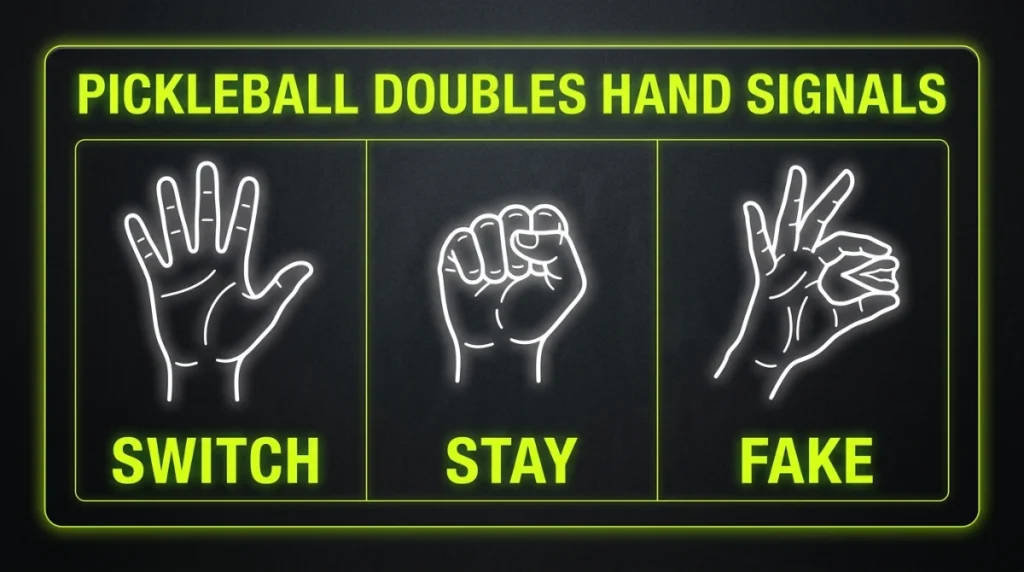
Hand signals are a silent part of pickleball terminology. One of the most important but often overlooked aspects of pickleball terminology is non-verbal communication. In doubles, partners use hand signals behind their backs to coordinate strategy.
Why Use Hand Signals?
- You do not want your opponents to hear your strategy
- They allow for quick, silent communication
- They help you stay coordinated
Common Hand Signals
| Signal | Meaning |
|---|---|
| Open Hand | Switch – Switch sides after the return |
| Closed Fist | Stay – Stay on your current side |
| Talking Hand | Fake – Act like you are switching, then do not switch |
Terms by Difficulty Level
This pickleball glossary is organized by difficulty. Here is a quick reference to help you learn at your own pace. Start with Beginner terms. Once you have mastered those, move to Intermediate. Then tackle Advanced.
Beginner (Must-Know)
Ace, Backhand, Baseline, Dink, Fault, Forehand, Groundstroke, Kitchen, Lob, Non-Volley Zone, Overhead Smash, Paddle, Rally, Serve, Volley
Intermediate
Approach Shot, ATP, Double Bounce Rule, Drop Shot, Drive, Erne, Falafel, Flapjack, Poach, Roll Volley, Third Shot Drop, Topspin
Advanced
Bert, Body Bag, Golden Pickle, Momentum Rule, Nasty Nelson, Pancake, Pickled, Reset Shot, Scorpion, Shake-n-Bake
How to Learn & Use Pickleball Terminology
Learning pickleball terminology is a journey. Learning terms is one thing. Using them is another. Here are some practical tips.
Watch and Listen
Watch professional matches on YouTube. Listen to how announcers use terms. Pay attention to the vocabulary.
Play with Experienced Players
Play with players who know the language. Ask them to explain terms you do not understand. Most players are happy to help.
Use Terms in Your Own Play
Start using terms in your games. Call out “Dink!” when you hit one. Say “Nice volley!” to your partner. The more you use the terms, the more natural they will feel.
Review the Glossary
Keep this glossary handy. Review it before your next game. Over time, the terms will become second nature.
Practice with a Partner
Practice calling out terms with your partner. “I will hit a third shot drop.” “You poach.” “We need a reset.”
Complete A-Z Glossary
This complete pickleball glossary has every term you need.
A
Ace, Approach Shot, ATP
B
Backhand, Backspin (Slice), Banger, Baseline, Bert, Blast‑Off, Bounce It!
C
Carry, Centerline, Champion Shot, Court, Crangle (Crazy‑Angle), Crosscourt
D
Dead Ball, Dink, Dinker, Double Bounce Rule, Double Hit, Drive, Drop Shot, Drop Shot Volley
E
Erne
F
Falafel, Fault, First Serve, Flapjack, Forehand
G
Golden Pickle, Groundstroke
H
Half Volley, Hinder
K
Kitchen
L
Let, Lob
M
Momentum Rule
N
Nasty Nelson, Non‑Volley Zone (NVZ)
O
Open Paddle Face, Overhead Smash
P
Paddle, Pancake, Passing Shot, Pickle, Pickled, Poach, PPA
R
Rally, Replay, Reset Shot, Return of Serve, Roll Volley
S
Scorpion, Second Serve, Serve, Service Box, Service Court, Service Sequence, Shake‑n‑Bake, Sideline, Side Out, Slice
T
Third Shot Drop, Topspin
U
UTPR
V
Volley
Frequently Asked Questions
These are the most common questions about pickleball terminology.
Q: What is the most important pickleball term for beginners?
A: The kitchen (non-volley zone). It is the most important rule in pickleball.
Q: What is a dink?
A: A soft shot that lands in the opponent’s kitchen. It is one of the most important shots in pickleball.
Q: What is an Erne?
A: A shot hit from outside the court. The player jumps or steps outside the sideline to hit a volley. It is pronounced “ERN.”
Q: What is an ATP shot?
A: Around the post. A shot hit around the net post. It does not have to go over the net.
Q: What is a Golden Pickle?
A: A game that ends with a score of 11-0.
Q: What is DUPR?
A: Dynamic Universal Pickleball Rating. It is the leading rating system in pickleball.
Q: What is a let serve?
A: A serve that hits the net but still lands in the service box. Since 2024, it is live.
Q: What is the difference between a volley and a groundstroke?
A: A volley is hit before the ball bounces. A groundstroke is hit after the ball bounces.
Q: What is a third shot drop?
A: A soft shot hit after the first two bounces. It lands in the opponent’s kitchen.
Q: What is a Bert?
A: An advanced shot where a player leaps over the kitchen on the opposite side of the court to volley a ball. It is similar to an Erne but hit on your teammate’s side.
Q: What is a crangle?
A: A cross-court shot with an extreme angle.
Q: What is the difference between a pickle and a Golden Pickle?
A: A pickle is an 11-0 victory. A Golden Pickle is an 11-0 victory with no side outs.
Q: What hand signals do doubles partners use?
A: Open hand means switch. Closed fist means stay. Talking hand means fake a switch.
Q: How do I learn pickleball terminology quickly?
A: Start with the Beginner terms. Use them in your games. Watch professional matches. Practice with a partner. Review this glossary regularly.
Final Checklist – Pickleball Terminology Mastery
Check off these pickleball terms as you learn them.
| Term | Know It? | Use It? |
|---|---|---|
| Kitchen | ☐ | ☐ |
| Dink | ☐ | ☐ |
| Volley | ☐ | ☐ |
| Serve | ☐ | ☐ |
| Fault | ☐ | ☐ |
| Rally | ☐ | ☐ |
| Poach | ☐ | ☐ |
| Erne | ☐ | ☐ |
| ATP | ☐ | ☐ |
| DUPR | ☐ | ☐ |
| Golden Ticket | ☐ | ☐ |
| Third Shot Drop | ☐ | ☐ |
| Hand Signals | ☐ | ☐ |
| Bert | ☐ | ☐ |
| Crangle | ☐ | ☐ |
| Pickle / Golden Pickle | ☐ | ☐ |
Conclusion
I still remember the relief when I finally understood the terms. No more confusion. No more embarrassment. Talking to my coach became easy. Communicating with my partner was no longer a struggle. Watching matches and understanding what was happening felt natural. I had a student named Lisa, a beginner who was terrified of sounding clueless. She would avoid asking questions in open play because she was afraid of being judged. We worked through the basics, one term at a time. A few weeks later, she messaged me: “I finally understood what my partner was saying today. I felt like I actually belonged on the court.” That moment—seeing a player go from insecure to confident—is exactly why I keep coaching and writing these guides.
Mastering pickleball terminology gives you confidence. Everything in this guide comes from real courts and real feedback from the players I have coached—from nervous beginners to seasoned veterans. I personally use every term in this guide, and I update it every year as new slang and terms emerge. You can trust that what you read here is current, practical, and based on hands-on experience. Bookmark it. Use the checklist. And most importantly, walk onto that court with confidence. You have got this.
