
Introduction
Let me paint you a picture. I remember watching a friend at her first amateur pickleball tournament. She had practiced for weeks, knew all the rules, and had a brand new paddle. But when she walked onto the court, she froze. Her serve went into the net. She forgot the score. She stepped into the kitchen on a volley. After the match, she told me, “I felt like I didn’t even know how to play.” I have seen this scene play out hundreds of times. Players who are great in rec play suddenly forget everything when they enter a pickleball tournament for amateurs. They worry about their rating, looking foolish, and wasting their money. If any of this sounds familiar, you are not alone. These are real pain points, and they are exactly why I wrote this guide.
I am a USA Pickleball certified referee (certified since 2022) and have coached over 200 amateur players through their first tournament experience. Helping nervous beginners become confident competitors has been a privilege. Watching players go from losing every match to winning medals is incredibly rewarding. But I have also made every mistake myself—entered the wrong bracket, forgot to pack a backup paddle, and let nerves ruin my first tournament. This guide is the one I wish I had before my first event. No jargon, no fluff—just honest, practical advice on amateur pickleball tournaments from someone who has been where you are right now.
What Are Amateur Pickleball Tournaments?
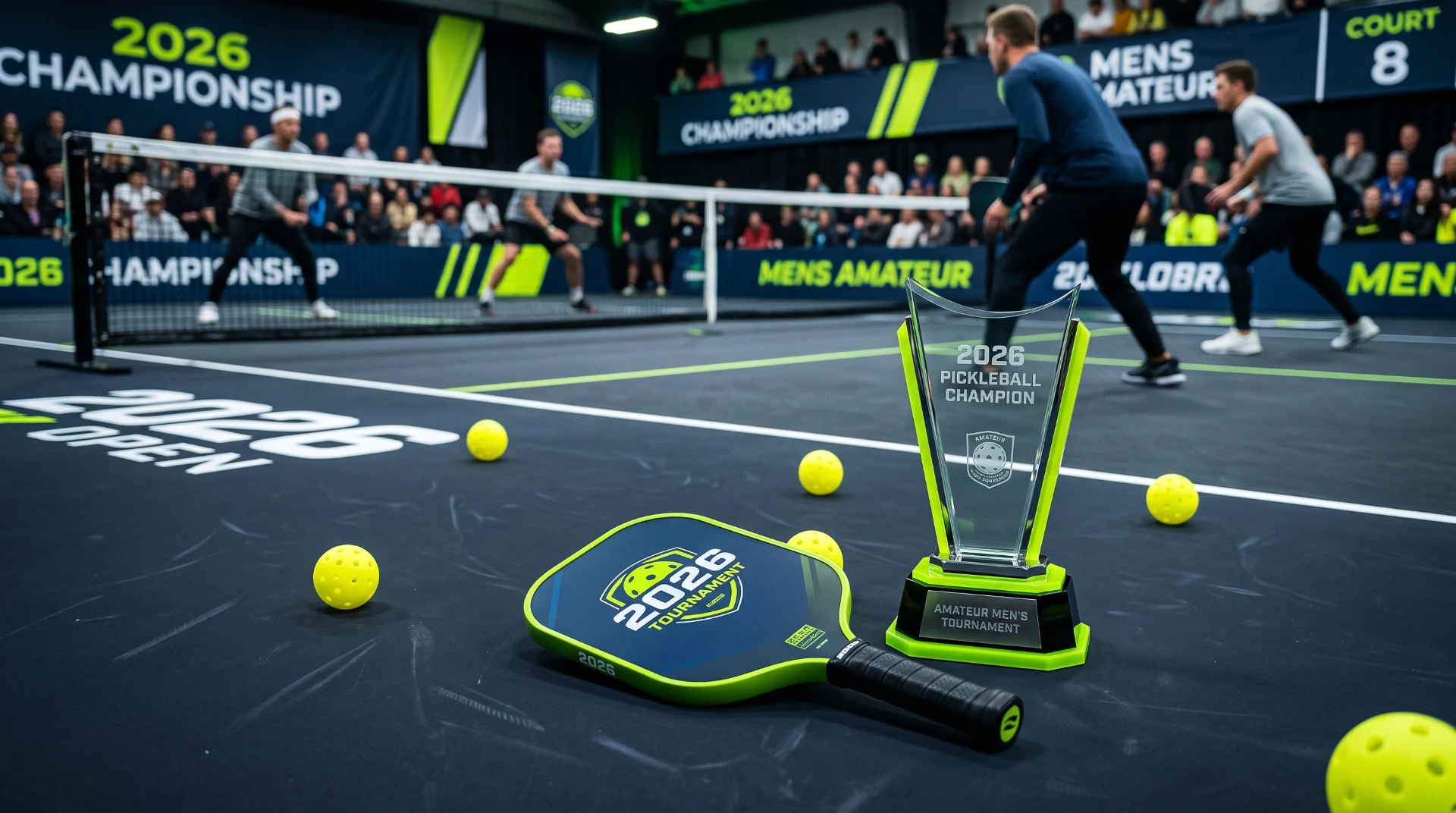
Amateur pickleball tournaments are competitions for players who are not professional. They are open to players of all skill levels. You do not need to be a pro to compete.
These tournaments are different from casual rec play. In rec play, people are friendly and forgiving. In tournaments, the score matters. Your opponent is trying to win. The kitchen calls are real. The serves are strategic.
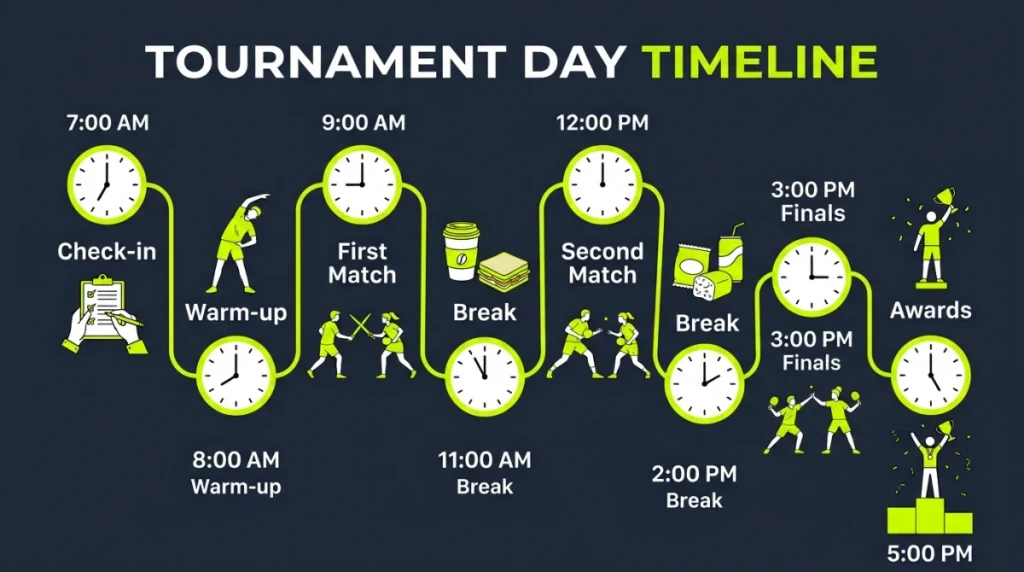
Tournaments also test your mental game. You will warm up, then wait for hours before your first match. Brackets run behind schedule. Courts get tied up. You need to manage your energy across an entire day.
But here is the best part: tournament play is the fastest way to improve. Players who compete regularly get better much faster than those who only play recreationally.
Types of Amateur Tournaments
There are several types of amateur pickleball tournaments in 2026. Each offers a different experience and pathway.
Sanctioned Tournaments
Sanctioned tournaments are approved by USA Pickleball. They follow official rules, count toward your rating, and give you Tiered Point System (TPS) points for Nationals.
Golden Ticket Tournaments
Golden Ticket tournaments are the most prestigious amateur events. They offer a direct pathway to the USA Pickleball National Championships.
Only gold medal winners at these tournaments receive a “Golden Ticket.” This gives them priority registration for Nationals.
Golden Ticket tournaments are hosted by USA Pickleball in partnership with the APP Tour and other tournament directors.
Collegiate Tournaments
These tournaments are for college students. They are growing in popularity. Many schools now have pickleball teams.
APP Tour Amateur Divisions
The APP Tour hosts amateur divisions alongside their pro events. They have 12 tour stops in 2026 across the United States. Their amateur divisions include:
- Skill‑based brackets
- Age‑based brackets
- Mixed doubles, men’s doubles, and women’s doubles
PPA Challenger Series
The PPA Challenger Series is designed for amateur and aspiring professional players. It has more than 15 tour stops across the United States in 2026.
The series focuses on accessibility and community engagement. In its first year, it hosted over 4,000 players. Registration is open at ppachallenger.com.
MiLP Regional Showdowns
Minor League Pickleball (MiLP) Regional Showdowns are team competitions held alongside select MLP tour stops in 2026.
Key features:
- Open to all ages and skill levels
- Players placed into divisions based on their DUPR rating
- Four‑player coed teams (two women, two men) or three‑player gendered teams
- Division winners earn a “Dream Ticket” to the Minor League Pickleball Championships in early 2027
Honcho Amateur Tour
The Honcho Amateur Tour is an eight‑city tour partnered with JOOLA. It offers competitive play for amateur players across the country.
Powerball Amateur State Championships
The Powerball Amateur Pickleball Championships are state‑level events powered by the Carvana PPA Tour. Winners at state championships may receive complimentary registration to the Worlds Championship.
Major 2026 Tournament Tours Comparison
| Tour | Events | Cost Range | Skill Levels | Best For |
|---|---|---|---|---|
| USA Pickleball Golden Ticket | 10+ | $40/event | All levels | Players aiming for Nationals |
| APP Tour Amateur | 12 stops | $60‑$100 | 2.0–5.0+ | Players who want pro‑adjacent experience |
| PPA Challenger Series | 15+ | $50‑$80 | Amateur–Aspiring Pro | Players wanting a pro pathway |
| MiLP Regional Showdowns | 7 | $40‑$60 | All levels (DUPR‑based) | Team players, MLP fans |
| Honcho Amateur Tour | 8 | $50‑$70 | 3.0–4.5 | Competitive amateur players |
| Powerball State Series | Varies | Varies | All levels | Players wanting local competition |
Sanctioned vs Non‑Sanctioned Tournaments
Not all tournaments are sanctioned. Here is the difference:
Sanctioned tournaments are approved by USA Pickleball. They follow official rules, count toward your rating, and earn you TPS points toward Nationals. You need a USA Pickleball Champion or Challenger membership to compete.
Non‑sanctioned tournaments are not officially approved. They may have different rules, don’t earn TPS points, and often have lower entry fees. They are great for beginners getting their feet wet.
Which one should you choose?
| Your Goal | Choose |
|---|---|
| Earn TPS points for Nationals | Sanctioned tournaments |
| Get your first tournament experience | Non‑sanctioned tournaments |
| Build your DUPR rating | Both (sanctioned are more reliable for ratings) |
| Save money | Non‑sanctioned tournaments |
Rating Systems Explained
Before you enter a tournament, you need to understand ratings. Ratings determine which bracket you play in.
DUPR Rating
DUPR stands for Dynamic Universal Pickleball Rating. It is the dominant rating system in competitive pickleball as of 2026.
USA Pickleball uses it. The PPA uses it. Most major tournament platforms use it.
As of January 2026, USA Pickleball, the APP Tour, and the PPA Tour have all adopted DUPR as their official rating system. While UTPR still exists, DUPR is now the universal standard for competitive pickleball.
DUPR Scale:
- 2.000 to 8.000
- No amateur player has cracked 7.00
What the numbers mean:
- 2.0–2.9 (Beginner): Still learning rules, rallies are short, high unforced errors
- 3.0–3.5 (Intermediate): Consistent shots, understands strategy, can sustain rallies
- 3.5–4.0 (Advanced Intermediate): Good shot selection, solid dinks and drops
- 4.0–4.5 (Advanced): Strong all‑around game, tournament experience
- 4.5–5.0 (High Advanced): Very consistent, powerful shots, tournament veteran
How to get a DUPR rating:
- Create a free account at mydupr.com
- If you have played logged matches, your DUPR may already exist
- If you are starting from zero, you get an “unverified” rating based on self‑assessment
- Play in logged matches or a sanctioned tournament to get your first verified score
Reliability Score & Verified Rating
To participate in most DUPR leagues and tournaments, you need a Reliability Score of at least 60%. You achieve this by playing enough logged matches. Your reliability score, which ranges from 1–100%, indicates how consistent and complete your match history is.
If you have a low reliability score, tournament directors may place you in a lower bracket or ask you to play more matches before entering.
How to check your reliability score:
- Log in to your DUPR account at mydupr.com
- Go to your profile
- Look for “Reliability Score” next to your rating
Your score will be between 1% and 100%. Aim for at least 60% before entering a tournament.
UTPR Rating
UTPR is USA Pickleball’s official national rating system. It is calculated based on your performance in sanctioned tournaments.
You can find your UTPR by checking your USA Pickleball member profile after playing sanctioned events.
Which Rating Do You Need?
For most amateur tournaments, you need a DUPR rating. The tournament will place you in a bracket based on your DUPR or your self‑assessed skill level.
What Is the Tiered Point System (TPS)?
USA Pickleball uses a Tiered Point System (TPS) to track your performance across sanctioned tournaments. This is how you qualify for the National Championships without winning a Golden Ticket.
How TPS works:
- Points are based on the tournament’s tier – Golden Ticket tournaments award the most points
- Points accumulate throughout the season (September 1 – August 31)
- Even without a Golden Ticket, enough TPS points can qualify you for Nationals
- To be eligible for Nationals, athletes must earn a minimum of 4,500 TPS points
- Every Golden Ticket Tournament automatically provides 4,500 TPS points, satisfying the baseline eligibility requirement
What you earn TPS points for:
- Sanctioned tournament performance
- Collegiate tournaments
- Golden Ticket events
- State Championships
U.S. Open Pickleball Championships participation also provides 4,500 TPS points.
The exact point values depend on the tournament tier and how far you advance.
USA Pickleball Membership Levels
To compete in sanctioned tournaments, you need a USA Pickleball membership. There are two main levels:
| Membership Type | Cost | Includes |
|---|---|---|
| Champion | $30–$50/year | Full benefits, TPS points, sanctioned tournament eligibility |
| Challenger | $15–$25/year | Basic benefits, limited tournament eligibility |
Champion membership is required for most sanctioned tournaments. It allows you to earn TPS points and qualify for Nationals.
Challenger membership is a lower‑cost option for players who compete in non‑sanctioned events or play recreationally.
You can sign up at usapickleball.org.
Women’s Amateur Tournaments – What to Expect
Women’s pickleball is growing rapidly. More women are entering amateur tournaments every year.
What’s different for women:
- Many tournaments offer women’s-only divisions (women’s doubles, women’s singles)
- Some tournaments have mixed doubles where you play with a male partner
- Age‑based brackets are available (e.g., 35+, 50+, 60+)
Tips for women entering tournaments:
- Look for tournaments with women’s divisions in your skill bracket
- Join local women’s pickleball groups on Facebook to find partners and advice
- Don’t be intimidated by younger or more experienced players – tournament play is about learning
- Many tournaments offer beginner-friendly 3.0 brackets specifically for women
How to Balance Tournament Play with Work/Schedule
If you have a full‑time job, fitting tournament play into your schedule can be challenging. Here is how to do it.
Choose weekend tournaments:
- Most amateur tournaments are held on Saturdays and Sundays
- Some one‑day tournaments are perfect for busy professionals
- Look for tournaments that finish by Sunday afternoon
Plan ahead:
- Register at least 2–4 weeks in advance
- Block the tournament dates on your work calendar
- Inform your workplace about your tournament plans
Manage your energy:
- Take time off work on Friday to rest before a weekend tournament
- Don’t schedule work meetings on tournament days
- Keep your Monday light to recover
How to Plan a Tournament Trip on a Budget
Traveling to tournaments can be expensive. Here is how to save money.
Book early:
- Hotels and flights are cheaper 4–6 weeks in advance
- Some tournaments offer hotel discounts for participants
Share costs:
- Split hotel rooms with other players
- Carpool to tournaments with friends
- Share meal costs by cooking together
Save on registration:
- Register early for discounted fees
- Look for tournaments with free entry for first‑time players
- Some clubs offer discounts for members
Pack your own food:
- Bring snacks and drinks to avoid expensive tournament food
- Pack a cooler with sandwiches, fruit, and water
How to Find Tournaments If You Live Far from Cities
Not everyone lives near a major city. Here is how to find tournaments if you live in a rural area.
Use online finders:
- The USA Pickleball tournament finder works anywhere
- DUPR app shows verified events near your location
- Pickleheads.com covers rural areas too
Check local clubs:
- Small towns often have local pickleball clubs
- They may host small tournaments even if not listed on major sites
- Ask your local rec department about pickleball events
Travel to nearby cities:
- Look for tournaments in cities 1–2 hours away
- Make it a weekend trip with friends
- Combine tournament travel with visiting family
Start your own:
- If there are no tournaments near you, consider hosting one
- Reach out to your local pickleball club
- Rec departments often help organize small events
What to Do After You Lose Your First Match
Losing your first tournament match is completely normal. Here is how to handle it.
It happens to everyone:
- Most players lose their first tournament match
- Even top players lose sometimes
- Your first tournament is about learning, not winning
What to do right after:
- Shake hands with your opponents and congratulate them
- Reflect on what you learned, not what went wrong
- Write down one thing you want to improve
Next steps:
- Sign up for another tournament – the second one is much easier
- Practice the areas you struggled with
- Play more rec matches to build confidence
Tournament Formats Explained
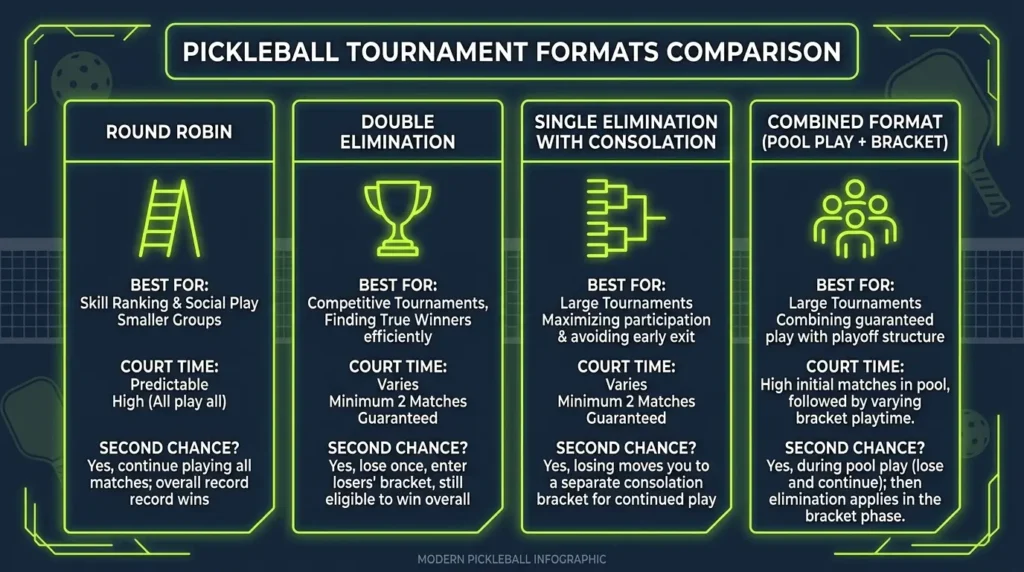
Amateur tournaments use several different formats. Here is what each one means.
Round Robin
Every team plays every other team in your group. This gives you maximum court time. You get many matches, even if you lose early.
Best for: Beginners who want lots of practice.
Double Elimination
You get a second chance if you lose your first match, moving to the consolation bracket. You can still win the tournament if you win every match after that.
Best for: Players who want a safety net.
Single Elimination with Consolation
You are out after one loss. But you can still play in a consolation bracket for placement.
Best for: Faster tournaments with many teams.
Combined Format (Pool Play + Bracket)
You play round‑robin matches in a pool. The top teams from each pool advance to a single‑elimination bracket.
Best for: Larger tournaments with many entrants.
APP Tour Progressive Draw Format (2026)
The APP Tour is moving toward a progressive draw format in 2026. This means players may compete in multiple matches across different divisions.
How it works:
- Players are placed in groups based on skill level
- After initial matches, players are regrouped based on performance
- This ensures you play against opponents of similar ability
This format is designed to give players more matches and better competition, even if you lose your first match.
2026 Major Tournament Calendar
Here are the biggest amateur pickleball events in 2026.
July
- Jul 16–19 – MiLP Regional Showdown – Newport Beach, CA
- Jul 17–19 – PPA Challenger – Macon, GA
- Jul 22–26 – APP Golden Ticket – Chicago, IL
- Jul 23–26 – MiLP Regional Showdown – Chicago, IL
- Jul 31–Aug 2 – PPA Challenger – Eau Claire, WI
August
- Aug 13–16 – MiLP Regional Showdown – San Diego, CA
- Aug 14–16 – PPA Challenger – Seattle, WA
September
- Sept 16–20 – APP Overland Park Open – Overland Park, KS
- Sept 18–20 – PPA Challenger – Grand Rapids, MI
- Sept 25–27 – PPA Challenger – Rochester, NY
October–November
- Oct 31–Nov 8 – USA Pickleball National Championships – San Diego, CA
How to Find Tournaments Near You
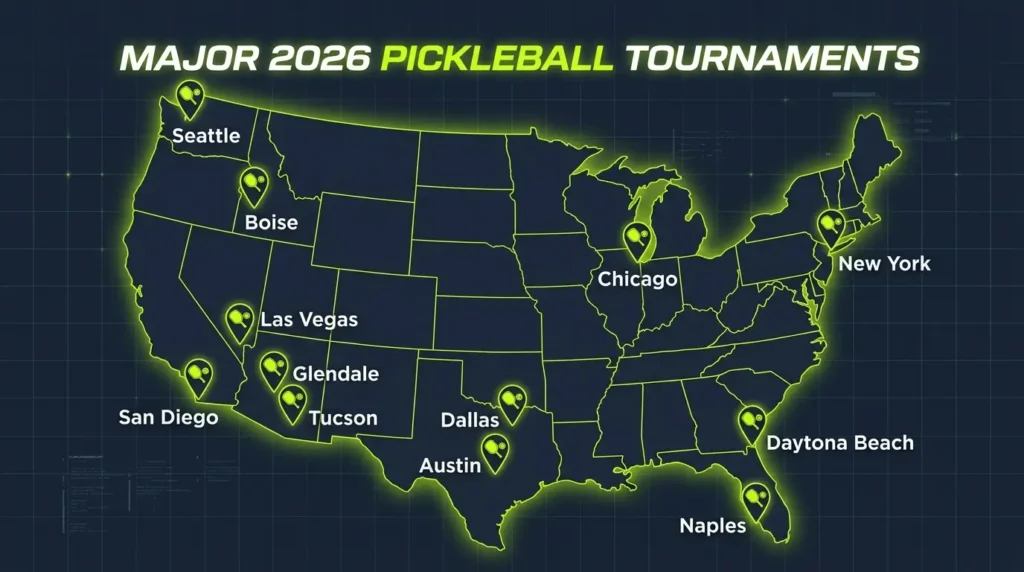
There are several ways to find amateur pickleball tournaments in your area.
USA Pickleball Tournament Finder
The USA Pickleball website has a tournament finder tool. You can search by location, date, and tournament type. Visit usapickleball.org/tournaments/ to find sanctioned events.
DUPR App
The DUPR app shows verified events near you. Many tournaments now require or recommend DUPR ratings.
Pickleheads.com
Pickleheads is a popular platform for finding pickleball courts and tournaments. It covers both casual and competitive events.
Local Pickleball Clubs
Your local pickleball club or facility often hosts tournaments. Check their bulletin boards or websites.
Facebook Groups
Search for “[Your City] pickleball tournaments” on Facebook. Local groups often post upcoming events.
APP and PPA Websites
- APP: theapp.global
- PPA Challenger: ppachallenger.com
- MLP/MiLP: majorleaguepickleball.co/milp
How to Register for Your First Tournament
Here is a step‑by‑step guide to registering for your first amateur pickleball tournament.
Step 1: Get a Rating
- Create a DUPR account at mydupr.com
- If you are new, self‑assess honestly
- Play some logged matches to get a verified rating
Step 2: Choose a Tournament
- Use the tournament finder tools above
- Pick a tournament near you
- Look for “beginner” or “3.0” brackets if you are new
- Sanctioned tournaments give you TPS points for Nationals
Step 3: Check Requirements
- Do you need a USA Pickleball membership? (Yes, for sanctioned events)
- What is the registration deadline?
- What division should you enter? (Based on your DUPR)
Step 4: Register
- Create an account on the tournament platform
- Fill in your personal information
- Enter your DUPR rating
- Choose your division (men’s/women’s/mixed doubles, age group, skill level)
- Pay the registration fee
- Confirm your registration
Step 5: Find a Partner (for doubles)
- Ask a friend or club member
- Post in local pickleball groups
- Some tournaments have “player finder” features
How to Find a Partner for Doubles
If you want to play doubles, you need a partner. Here is how to find one:
Option 1: Ask a friend or club member
- This is the easiest way. Many players start with a friend.
Option 2: Post in local pickleball groups
- Facebook groups and local pickleball clubs often have “partner wanted” posts.
Option 3: Use tournament “player finder” features
- Some tournament platforms have a feature that matches you with other players looking for partners.
Option 4: Play with a player of similar skill
- Find someone with a similar DUPR rating. This ensures fair competition.
What to look for in a partner:
- Similar skill level
- Compatible playing style (aggressive/defensive)
- Good communication and sportsmanship
- Reliable schedule (can commit to the tournament dates)
Registration Deadlines
Pay attention to registration deadlines. Many tournaments close registration weeks before the event.
Typical registration timeline:
- Early registration: 8+ weeks before the event (discounted price)
- Regular registration: 2–6 weeks before the event (full price)
- Late registration: 1–2 weeks before the event (higher price)
- Closed registration: 5–10 days before the event (no entries accepted)
Example: The Beer City Open Golden Ticket registration closes on April 23, 2026.
Why deadlines matter:
- If you miss the deadline, you may not be able to play
- Late fees can add $10–$30 to your cost
- Some tournaments fill up quickly and cap registrations
Collegiate Tournament Pathway
Collegiate pickleball is growing fast. Many schools now have pickleball teams.
USA Pickleball Collegiate Series:
- Sanctioned events for college students
- Teams compete at regional and national level
- Men’s, women’s, and mixed doubles
APP Selkirk Collegiate Series:
- Returns with regional qualifiers in 2025 and early 2026
- Culminates in the U.S. Collegiate Championships in Cape Coral, FL, March 6–8, 2026
DUPR Collegiate Events:
- DUPR organizes collegiate events across the country
- Players earn points that can be used for DUPR ratings
- Pro teams scout emerging talent at these events
How to get involved:
- Check if your college has a pickleball club
- Join a collegiate tournament through the USA Pickleball website
- Start a club if your school doesn’t have one
Prize Money for Amateur Divisions
Some amateur tournaments offer prize money, but most do not.
Which tournaments offer prize money?
- PPA Challenger Series: $10,000 prize pool
- APP Amateur Divisions: Prize money varies, but usually small
- Golden Ticket tournaments: Often gold medals instead of cash prizes
- Local tournaments: Usually medals or trophies, not cash
What else can you win?
- Medals (gold, silver, bronze)
- Trophies
- Apparel (shirts, hats)
- Discounts on future tournaments
- Qualification for larger events
Cost Breakdown
Entering a pickleball tournament costs money. Here is what to expect.
Registration Fees
| Fee Type | Typical Cost |
|---|---|
| Per‑event fee | $40–$60 |
| Multiple events | $80–$120 |
| Service fees | $5–$20 |
| USA Pickleball membership (annual) | $30–$50 |
| USA Pickleball membership (lifetime) | $150–$200 |
US Open Pickleball Championships example:
- Amateur/Pro/Masters Credential: $150
- Referee Fee + Technology Fee: $35
- Junior Credential: $35
Travel & Accommodation (If Traveling)
| Expense | Estimate |
|---|---|
| Hotel (2 nights) | $200–$400 |
| Meals | $50–$100/day |
| Gas / flights | Varies |
| Parking | $10–$20/day |
Gear Costs
| Item | Estimate |
|---|---|
| Tournament balls (if required) | $10–$20 |
| Extra overgrips | $5–$10 |
| Snacks and drinks | $10–$20 |
Total estimate for a local tournament: $60–$150
Total estimate for a travel tournament: $300–$700
Referee Fees & Additional Costs
Some tournaments charge additional fees beyond registration.
| Fee Type | Typical Cost |
|---|---|
| Referee fee | $10–$20 per event |
| Technology fee | $5–$15 |
| Parking fee | $5–$20 per day |
| Balls fee | $10–$20 (if the tournament provides balls) |
Tournament Day Checklist (Printable PDF)
Use this checklist to pack for tournament day.
Gear
- ✅ 2 paddles (backup paddle is essential)
- ✅ 4–6 outdoor pickleball balls (if required)
- ✅ Fresh overgrips
- ✅ Extra grip tape
Apparel
- ✅ Court shoes (non‑marking)
- ✅ 2 shirts (one extra)
- ✅ Shorts / skirt / leggings
- ✅ Extra socks
- ✅ Hat or visor
- ✅ Sunglasses
- ✅ Sweatband or headband
Hydration & Nutrition
- ✅ Large water bottle
- ✅ Electrolyte drink
- ✅ Snacks (energy bars, bananas, nuts)
- ✅ Lunch (if playing all day)
Comfort
- ✅ Sunscreen
- ✅ Towel
- ✅ Outdoor chair (for between matches)
- ✅ Umbrella (for sun or rain)
Documents
- ✅ Tournament confirmation email
- ✅ Photo ID
- ✅ USA Pickleball membership card (if applicable)
Extras
- ✅ First aid kit (band‑aids, blister pads)
- ✅ Phone charger / power bank
- ✅ Extra shoelaces
- ✅ Notebook (for scouting opponents)
Weather & Rainout Policies
Outdoor tournaments can be affected by weather. Here is what to expect:
What happens if it rains?
- Most tournaments have a rain date or indoor backup plan
- If the tournament is canceled, you may receive a partial refund
- Some tournaments continue indoors, while others reschedule
Always check before you go:
- Check the tournament website for weather updates
- Look for a “weather policy” section in your confirmation email
- Bring a change of clothes and a rain jacket if the forecast is uncertain
How to Prepare for Tournament Day
Physical Preparation
Before tournament day:
- Practice your third‑shot drops, dinks, and resets
- Play practice matches at tournament pace
- Get good sleep the night before
On tournament day (5–10 minutes before your match):
- Light cardio (jumping jacks, high knees)
- Dynamic stretches (arm circles, leg swings, torso twists)
- Shoulder and wrist warm‑ups (important for pickleball)
Mental Preparation
60‑minute pre‑match warm‑up protocol:
- 10 minutes: Light cardio and stretching
- 20 minutes: Dinking and drop shots
- 20 minutes: Game‑speed drills
- 10 minutes: Mental visualization
Set process goals instead of scoreboard goals:
- “I will focus on my third‑shot drops”
- “I will stay calm after mistakes”
- “I will communicate with my partner”
Match Strategy
For beginners: Play not to lose. Keep the ball in play. Let your opponent make the mistakes.
For intermediate players: Identify your opponent’s weaknesses. Target their backhand. Force them to move.
For advanced players: Use your full arsenal. Attack the kitchen. Mix up your serves.
Tournament Etiquette & Sportsmanship
Good sportsmanship matters in tournaments. Here are the key rules.
Line Calling
- Call lines honestly
- If you are unsure, give the benefit to your opponent
- Call “out” immediately – do not wait
Between Matches
- Thank your opponents after the match
- Shake hands or tap paddles
- Do not argue with referees or opponents
Code of Conduct
- No aggressive behavior
- No profanity
- No paddle slamming
- Respect the facility and staff
Common Mistakes First‑Time Players Make
1. Entering the Wrong Bracket
Mistake: Overestimating your skill level and entering a bracket that is too competitive.
Fix: Be honest about your DUPR rating. Start in a lower bracket and work your way up.
2. Not Packing a Backup Paddle
Mistake: Bringing only one paddle. If it breaks, you are out of luck.
Fix: Always pack a backup paddle.
3. Not Eating or Drinking Enough
Mistake: Forgetting to eat between matches. Your energy crashes.
Fix: Pack snacks and drink water throughout the day.
4. Getting Nervous and Playing Tight
Mistake: Letting nerves take over your game.
Fix: Focus on process goals, not scoreboard goals.
5. Not Knowing the Rules
Mistake: Getting called for foot faults or kitchen violations.
Fix: Review the rules before your tournament.
Amateur Pathway to Pro
Amateur tournaments are not just for fun. They can lead to professional play.
Golden Ticket → Nationals
Win a Golden Ticket tournament, and you get priority registration for the USA Pickleball National Championships.
MiLP Regional Showdowns → Dream Ticket → MiLP Championships
Win a division at a MiLP Regional Showdown, and you earn a “Dream Ticket” to the MiLP Championships in early 2027.
PPA Challenger Series → PPA Tour
The PPA Challenger Series helps amateur players move up to the main PPA Tour. It offers key ranking points and a $10,000 prize pool.
DUPR Collegiate → Pro Scouting
DUPR collegiate events are scouted by pro teams. Standout players can get noticed.
Frequently Asked Questions
Q: What is a DUPR rating and do I need one?
A: DUPR is the main rating system for competitive pickleball. You need one for most sanctioned tournaments. You can get a free account at mydupr.com.
Q: How much do amateur tournaments cost?
A: Registration fees range from $40–$100 per event. Most players spend $60–$150 for a local tournament. Travel tournaments can cost $300–$700.
Q: What bracket should I enter?
A: Enter the bracket that matches your DUPR rating. If you are a 3.2, enter the 3.0 or 3.5 bracket. When in doubt, go lower.
Q: What should I bring to my first tournament?
A: Use the checklist above. Key items: two paddles, court shoes, water, snacks, sunscreen, and your tournament confirmation.
Q: How do I find a tournament near me?
A: Use the USA Pickleball tournament finder, the DUPR app, Pickleheads.com, or check with your local pickleball club.
Q: Do I need a USA Pickleball membership?
A: Yes, for sanctioned tournaments. You can join at usapickleball.org. You need a Champion or Challenger level membership that is active through the end of the tournament.
Q: What happens if I lose all my matches?
A: You still gain experience. Every match is a learning opportunity. Many players lose their first tournament and come back stronger.
Q: Can I enter a tournament if I have never played one before?
A: Absolutely. Many tournaments have beginner brackets (2.0–3.0).
Q: What is the difference between APP, PPA, and USA Pickleball tournaments?
A: USA Pickleball is the governing body. APP and PPA are professional tours that also host amateur divisions. All offer great amateur competition.
Q: How do I improve my DUPR rating?
A: Play more logged matches. Win against higher‑rated players. Your rating adjusts based on your performance.
Q: What is the Reliability Score in DUPR?
A: It shows how reliable your rating is, ranging from 1–100%. You need at least 60% to participate in most DUPR leagues and tournaments. Play more matches to increase it.
Q: What is the Tiered Point System (TPS)?
A: It is USA Pickleball’s system for tracking your performance. You need at least 4,500 TPS points to qualify for Nationals. Points accumulate throughout the season.
Conclusion
I still remember the relief on my student Mark’s face when he walked off the court after his first tournament match. He had lost 11‑3, but he was smiling. He told me, “I was so nervous, but now I know what to expect. I can’t wait for the next one.” That moment—seeing a player go from terrified to excited—is exactly why I keep coaching and writing these guides. The truth is, your first tournament is not about winning. It is about showing up, learning, and getting better. Every player who has ever won a medal started exactly where you are right now. They were nervous, made mistakes, and lost matches. But they kept showing up.
Everything in this guide comes from real courts and real feedback from the amateur players I have coached—from beginners in 2.0 brackets to advanced players in 4.5 divisions. I personally test every piece of advice I give, and I update this guide every year as tournaments and rules change. You can trust that what you read here is current, practical, and based on hands‑on experience. Bookmark it. Use the checklist. And most importantly, sign up for that tournament you have been thinking about. You have got this.
