

Introduction
I played my first six months of pickleball with a grip that was two sizes too small. My elbow ached after every session. My paddle twisted in my hand on off‑center hits. I thought it was just part of the game. Then a coach watched me for thirty seconds, handed me a properly sized paddle, and the pain disappeared within a week. That small change—the right pickleball grip—transformed my control, my comfort, and my confidence. If you’ve ever wondered why your hand slips, your arm hurts, or you just can’t seem to get enough spin, this guide is for you. Once your grip is dialed in, master the soft game with our ultimate guide to the dink shot – the two go hand in hand.
I’m a certified USA Pickleball referee who has helped hundreds of players find the perfect grip size, learn the continental hold, and choose the right overgrip. In this article, I’ll walk you through every grip type, show you how to measure your hand, explain grip pressure for every shot, and even give you a free interactive size finder and a printable cheat sheet. No jargon—just clear, practical advice on mastering your pickleball grip.
What Is the Pickleball Grip? (Quick Definition)
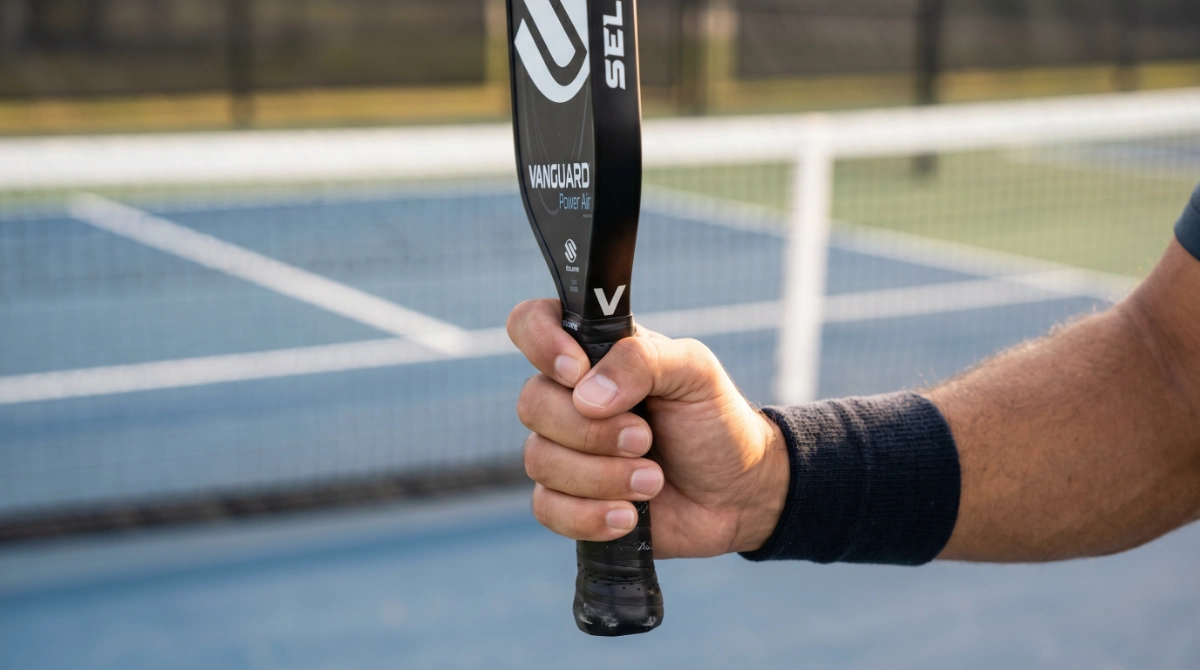
The pickleball grip is how you hold the paddle. The most common and recommended hold for beginners is the continental grip—often called the “shake hands” grip. It lets you hit forehands and backhands without changing your hand position. Getting your grip size, type, and pressure right is essential for control, spin, and injury prevention.
Types of Pickleball Grips (Continental, Eastern, Western & Semi‑Western)
There are four main pickleball grip styles. Each one affects your shot angle, spin, and power.
The Continental Grip (Best for All‑Around Play)
- Hold the paddle like you’re shaking hands with it.
- The “V” between your thumb and index finger sits on the top bevel of the handle.
- Allows quick transitions between forehand and backhand without regripping.
- Best for beginners, dinking, volleys, and most players.
The Eastern Grip
- Slightly rotate your hand clockwise from continental (for right‑handers).
- The V‑shape moves toward the back bevel.
- Adds more topspin to forehands, but makes backhand preparation a little slower.
- Good for intermediate players who want extra spin on drives.
The Western Grip
- Rotate your hand further clockwise so the V‑shape points toward the side bevel.
- Creates extreme topspin but can be tough to flatten out for dinks.
- Rarely used for full games; some pros use it for forehand returns and drives.
The Semi‑Western Grip
- A middle ground between eastern and western.
- Gives good topspin while still allowing a relatively quick switch to backhand.
- Popular among aggressive baseline players who hit heavy topspin.
When to use each grip: Most players should start with the continental grip and only experiment with others once they have solid consistency. You can switch grips between shots as you advance, but it takes practice.
🎾 Pickleball Grip Types
Top view of the paddle handle – the V‑shape shows where thumb and index finger meet. Fingers wrap around the back.
Pickleball Grip Technique: How to Hold the Paddle
Let’s break down the correct way to hold a pickleball paddle.
The Shake Hands Method
- Hold the paddle face perpendicular to the ground.
- Reach out as if you’re shaking hands with the handle.
- Wrap your fingers around the grip naturally. Your thumb should rest against the back of the handle.
- The V‑shaped groove between your thumb and index finger should point toward the top edge of the paddle.
Finger Placement
- Keep your fingers relaxed, not squeezed.
- Your index finger can be slightly separated for stability, but don’t extend it up the paddle face.
- Your pinky and ring fingers should wrap fully around the handle.
Pickleball Grip Pressure Guide (Dinks, Volleys, Drives & Serves)
How tightly you hold the paddle changes with every shot. Here’s a simple pressure scale of 1‑10 (10 = white‑knuckle tight).
| Shot Type | Recommended Grip Pressure | Why |
|---|---|---|
| Dinks & soft game | 2‑3 (light) | A soft grip absorbs pace and gives better touch. |
| Volleys | 4‑5 (medium) | Enough control to angle the ball, but not so tight you lose feel. |
| Drives & put‑aways | 6‑7 (firm) | A firm grip transfers more power to the ball. |
| Serves | 5‑6 (medium‑firm) | Enough grip to snap through the ball without straining. |
Many beginners hold the paddle too tight, which leads to elbow pain and poor touch. Keep your grip relaxed and tighten only at the moment of contact.
How to Find Your Pickleball Grip Size
Using the correct grip size prevents injury and improves control. Here are two simple methods you can do at home.
Method 1: The Ruler Test
- Extend your dominant hand, palm up.
- Measure from the middle crease of your palm to the tip of your ring finger.
- The distance in inches is your ideal grip circumference.
| Measurement | Recommended Grip Size |
|---|---|
| Under 4 inches | Small (4.0″) |
| 4.0 – 4.5 inches | Medium (4.25″) |
| Over 4.5 inches | Large (4.5″+) |
Method 2: The Finger Test
- Grip the paddle in your usual continental hold.
- Slide the index finger of your non‑dominant hand between your fingers and palm.
- If it fits snugly, the size is right. If there’s a big gap, the grip is too large. If you can’t fit your finger, it’s too small.
Overgrip vs. Replacement Grip – What’s the Difference?
Many new players confuse these two. Here’s a quick comparison.
| Feature | Overgrip | Replacement Grip |
|---|---|---|
| Purpose | Adds tackiness and sweat absorption over the existing grip | Replaces the worn‑out factory grip |
| Thickness | Thin (0.4‑0.6mm) | Thicker (1.5‑2.5mm) |
| When to use | Anytime your grip feels slippery | When the original grip is completely worn or you want a size change |
| How often to change | Every 1‑4 weeks of regular play | Every 3‑6 months |
Pro tip: Many players add an overgrip on top of a new replacement grip for maximum comfort and control.
How to Wrap an Overgrip (Step‑by‑Step)
- Remove the old overgrip and any residue.
- Unroll the new overgrip and identify the tapered end.
- Peel off the backing and wrap the tapered end at the bottom of the handle.
- Overlap each wrap by about half the width of the tape.
- Continue wrapping up the handle with even tension.
- When you reach the top, cut off the excess and secure it with the finishing tape provided.
- Press firmly along the whole grip to ensure it adheres.
Take your time—a neatly wrapped overgrip feels better and lasts longer.
Grip Maintenance & When to Replace
- Clean your grip: Wipe it with a damp cloth after each session.
- Inspect for wear: If the grip is smooth, shiny, or crumbling, it’s time to replace it.
- Overgrip: Replace when it loses its tackiness or starts to feel slick.
- Replacement grip: Replace when the cushioning compresses or the surface peels.
A fresh grip improves your feel and can even prevent blisters and calluses.
Common Pickleball Grip Mistakes & How to Fix Them
I see these errors all the time with new players.
| Mistake | Why It Happens | How to Fix It |
|---|---|---|
| Gripping too tightly | Nervousness, trying to control the ball too much | Relax your hand. On a scale of 1‑10, hold at 3‑4 and only tighten on contact. |
| Wrong grip size | Using a friend’s paddle or not measuring | Measure your hand using the ruler or finger test. Don’t guess. |
| Holding the paddle too low | Feels natural, but reduces reach | Slide your hand up so the bottom of your palm is near the edge of the handle. |
| Not using an overgrip | Don’t know what it is | An overgrip adds tackiness and absorbs sweat. Start with a thin, tacky overgrip. |
| Finger extended up the paddle face | Trying to get more control | Keep your index finger curled comfortably with the rest of your hand. Understanding your overall skill level helps you prioritize which grip mistakes to fix first. Take our pickleball levels guide to self-assess where you stand. |
When to Use Each Pickleball Grip & Switching Between Them
As you advance, you might want to change your pickleball grip for specific shots. Here’s a quick guide.
| Situation | Recommended Grip |
|---|---|
| Dinks & volleys | Continental |
| Forehand drives with spin | Eastern or Semi‑Western |
| Backhand slice | Continental (open face) |
| Extreme topspin forehands | Western |
To switch grips smoothly, use your non‑dominant hand to rotate the paddle between points. Practice the change slowly before using it in a match. Grip switching is especially critical in singles where you cover the whole court. Read our complete guide to how to play pickleball singles for tactical tips.
Practicing Grip Changes
Switching grips smoothly takes practice. Start by standing at the baseline without a ball. Shadow swing five forehands with the eastern grip, then switch to continental for five backhands. Repeat the cycle for two minutes. Once the hand motion feels natural, add slow feed balls from a partner. The goal is to make the change automatic so you can focus on the point, not your hand position. For a full library of solo and partner drills to lock in your new grip, check out our ultimate pickleball drills guide.
Interactive Grip Size Finder
Answer a few quick questions, and this tool will recommend your ideal grip size based on your hand measurements and playing style.
📏 Grip Size Finder 🔍
Slide to your hand measurement and see your ideal grip size.
Download Your Free Grip Guide & Sizing Chart (PDF)
I created a one‑page PDF that includes a grip types summary, a sizing chart, a pressure guide, and an overgrip wrapping checklist. Print it and keep it in your bag.
Pickleball Grip FAQ
How do you hold a pickleball paddle?
Use the continental (shake hands) grip. It’s the most versatile and recommended for beginners.
What are the different types of pickleball grips?
Continental, eastern, western, and semi‑western. Continental is best for all‑around play.
How do I know my pickleball grip size?
Measure from the middle crease of your palm to the tip of your ring finger. Most adults use a 4.25″ (medium) grip.
What is the difference between continental and eastern grip?
Continental keeps the V‑shape on the top bevel; eastern rotates slightly for more topspin on forehands.
How tight should I hold the pickleball paddle?
Hold it lightly (2‑3 out of 10) for dinks, medium (4‑5) for volleys, and firm (6‑7) for drives.
What is an overgrip, and do I need one?
An overgrip is a thin wrap that adds tackiness and absorbs sweat. It’s not required but highly recommended.
How often should I replace my pickleball grip?
Overgrips every 1‑4 weeks; replacement grips every 3‑6 months, depending on play frequency.
Can I use a tennis grip on a pickleball paddle?
Technically yes, but pickleball grips are sized differently. A tennis grip may be too thick.
What is the best grip for spin?
The eastern or semi‑western grip allows more topspin than the continental.
How does grip pressure affect my shots?
Too tight = less touch and more arm strain. Too loose = paddle twists on contact.
✅ Pickleball Grip – Key Takeaways
- Start with the continental grip. It's the most versatile and recommended for beginners.
- Measure your grip size. Use the ruler test or finger test—most adults need a 4.25″ (medium) grip.
- Hold lightly for dinks (2‑3/10), firmer for drives (6‑7/10). Tighten only at contact.
- Add an overgrip for better tackiness and sweat absorption. Replace it every 1‑4 weeks.
- Don't ignore elbow pain or slipping. These are signs your grip size or pressure is wrong.
- Download the free grip guide and use the interactive size finder to get your perfect fit. Perfect your grip, then pair it with the ultimate dink shot guide to become a complete player at the net.
You’re Ready to Master Your Grip
That elbow pain I played through for months vanished the day I found my correct pickleball grip size. Since then, I’ve helped dozens of players measure their hands, wrap their first overgrip, and discover how much easier the game feels when your paddle actually fits your hand.
Everything in this guide comes from real courts and real coaching sessions. I update it each year when new equipment standards come out, so you can trust it’s current and tested. Bookmark it, download the cheat sheet, and use the interactive size finder. Then hit the court with a grip that finally feels like an extension of your arm.
Download the printable grip cheat sheet (PDF)
For more resources, read our Complete Pickleball Rules 2026 Guide or test your skill with the Free Skill Analyzer. Now go get a grip. You’ve got this.
