


Introduction
I remember exactly where I stood the first time I had to call the score. My partner had just won the rally, I shuffled to the left service box, and every single number fell out of my head. I opened my mouth, nothing came out, and a stranger on the other side of the net shouted, “Three‑two‑one!” for me. I wanted to disappear. That hot‑faced panic—the feeling that everyone knew I didn’t belong—is burned into my memory. (If you’re completely new to the court, you might want to start with our comprehensive what is pickleball rules guide for absolute beginners). But if you’ve already been playing and just want to stop freezing when someone yells “0‑0‑2,” or serving from the wrong side while praying nobody notices—I wrote this scoring breakdown specifically for you.
Pickleball scoring looks like a secret code when you’re new with its three numbers, strange rules about who can score, and a “kitchen” that has nothing to do with cooking. Having coached over 200 beginners, I can tell you that scoring is the #1 pain point they share—even more than learning a dink or a third‑shot drop. But the good news is that it becomes second nature with a clear system. As a certified USA Pickleball referee for over five years, I still remember the exact moment the lightbulb went on for me, and that’s what I want for you. No fluff, no shame, just a simple walk‑through that will have you calling the score like a regular by the end of this article.
What Is Pickleball Scoring?
Pickleball scoring is a system where only the serving team can earn points. In doubles, the score has three numbers: your team’s score, the other team’s score, and whether you’re the first or second server. Games are usually played to 11 points, and you must win by 2. For the full breakdown of every official rule, read our Complete Pickleball Rules Guide.
If you are looking for the quickest explanation: Only the serving team scores. In doubles, call three numbers: your score – opponent’s score – server number. Example: “4‑2‑1.” First to 11, win by 2.
Why Does Pickleball Scoring Feel So Confusing?
New players struggle because most sports don’t use a three‑number system. You’re used to hearing “15‑30” in tennis or “2‑1” in basketball. Suddenly, someone yells “0‑0‑2,” and your brain shuts down. But here’s the truth: the third number just tells you which server is up. Once you understand that simple logic, pickleball scoring stops being a code and becomes a rhythm. The confusion disappears.
The Three Numbers Explained (Doubles Pickleball Scoring)
In doubles pickleball, the score is three numbers. Let’s break each one down.
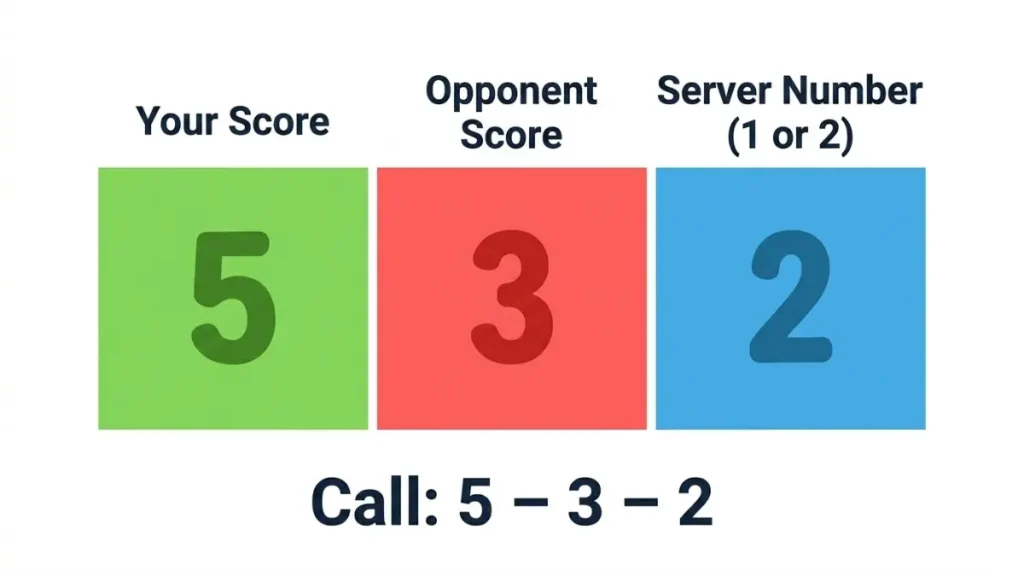
- First number: Your team’s score.
- Second number: The opponent’s score.
- Third number: Which server is serving – 1 for the first server, 2 for the second server.
Example: “5‑3‑2” means your team has 5 points, the opponent has 3, and you are the second server on your team.
When the game starts, the very first server is designated as server number 2 because only one partner on the starting team gets to serve before the service passes to the opponents. This gives only one serve to the starting team so they don’t have an unfair advantage.
Serving position rule: For both singles and doubles, the server stands on the right side of the court when their score is even (0, 2, 4, etc.), and on the left side when their score is odd (1, 3, 5, etc.). This is how you always know where to stand.
🧭 Where to Serve – Quick Look
| Your Score | Serve From |
|---|---|
| Even (0, 2, 4, 6…) | Right Side |
| Odd (1, 3, 5, 7…) | Left Side |
How to Call the Score (With Phonetic Examples)
Always call the score loudly before you serve. Pause between numbers so everyone hears them.
| Score | Say This |
|---|---|
| 0‑0‑2 | “Zero – zero – two” |
| 3‑1‑1 | “Three – one – one” |
| 4‑4‑2 | “Four – four – two” |
| 6‑5‑1 | “Six – five – one” |
Memory trick for server number: Normally, when your team gets the serve back (after the initial possession of the game), the first player to serve is server 1, and your partner is server 2. Only at the very beginning of the game, the first server is called server 2 (so your team only gets one serve). Every other time you get the serve, it goes 1 then 2.
Doubles Pickleball Scoring – The Full Sequence
Here’s how a typical doubles game flows:
- The game starts: Server 2 (the first server) calls “0‑0‑2” and serves from the right‑hand box (since 0 is even).
- Point Won: If they win the point, they switch to the left box and call “1‑0‑2.” They keep switching sides and scoring.
- The Start Exception: When Server 2 loses a rally at the very start of the game, no partner gets to serve. It is an immediate side‑out, and the serve goes to the other team.
- Opponent Serve: The opposing team’s first server starts from the right side and calls “0‑1‑1” (their score is 0, opponents have 1, and they are Server 1). If they lose, the serve goes to their partner, who calls “0‑1‑2” (Server 2). Once Server 2 loses, it’s a side-out again.
Singles Scoring – Key Differences
Singles pickleball scoring is simpler, and you can learn all the specific rules in our complete guide to singles pickleball. There is no third number because you don’t have a partner.
- You call only two numbers: your score – opponent’s score. Example: “3‑2.”
- You serve from the right when your score is even, and from the left when your score is odd.
- When you lose the rally, it’s a side‑out. The other player serves.
That’s it. Everything else—two‑bounce rule, kitchen, faults—stays the same.
Side‑Out Scoring vs. Rally Scoring
There are two scoring systems in pickleball. Most recreational and tournament play uses side‑out scoring. A newer option is rally scoring, which has been provisionally approved for 2026 tournaments. Some leagues use it, and major pro events (MLP) use rally scoring. Always confirm before playing.
| Aspect | Side‑Out Scoring | Rally Scoring |
|---|---|---|
| Who scores? | Only the serving team | Either team on every rally |
| Game length | To 11, win by 2 (or 15, 21) | Often to 21, win by 2 |
| Server rotation | Partner serves after a fault | Server changes after each point lost |
| Complexity | Familiar to most players | Faster games, simpler to call |
2026 Rule Update: In rally scoring, either team can now score the game‑winning point, even if they’re receiving. This removes the previous ‘freeze’ rule where only the serving team could win at game point. This was not the case before. Always confirm before a match which scoring system you’re using.
Serving Position After a Side‑Out
When a side‑out happens, the new serving team starts from the right side if their score is even, or the left side if their score is odd. The server number resets: the first player to serve for that team becomes server 1.
🤔 Am I Server 1 or 2? (After a Side‑Out)
Did we just win a side‑out?
⬇️
First server = Server 1
(starts on the right if score even)
Partner = Server 2
🔁 The only exception: the very first server of the game calls themselves “Server 2” (so the team gets only one serve to start).
Common Scoring Mistakes (And How to Fix Them)
Beginners make predictable mistakes. Here are the top ones and how to handle them like a pro.
- Calling the wrong score – If you realize the score is wrong, stop and say it correctly before you serve. The receiver can also ask to correct the score. Always fix it before the serve happens.
- Serving out of order / wrong side – If the wrong server serves or serves from the wrong side, and you catch it before the next serve, it is a fault. Any point won on that incorrect serve does not count, and the serve passes (to your partner as Server 2, or results in a side-out). If the mistake is only noticed after the next serve has been made, the point stands and the game continues.
- Forgetting to switch sides as server – After winning a point, the server must switch service boxes. If you forget and play the rally, the point counts, but correct the position for the next serve.
- Not calling the score at all – Always call it. If you don’t, the receiver can ask you to call it. Failure to call the score may result in a warning or delay‑of‑game fault in officiated play. Under the 2026 rules, referees can now issue warnings or technical penalties even before the match officially starts. Any fault by the serving team results in loss of rally (side‑out or second server). Any fault by the receiving team gives the serving team a point.
Avoiding these scoring mistakes keeps the game friendly and fair. Brush up on court manners with our complete guide to pickleball etiquette.
Interactive Scoring Practice (Free Tool)
The best way to learn is by doing. I built a Match Score Tracker right here on PickleInsights. You can click to add points, see the three numbers change, and practice calling the score as if you were on the court.
🔢 Scoring Practice Tool
Practice calling the score. Tap the buttons below as if you’re on the court.
Download Your Free Pickleball Scoring Cheat Sheet
I created a one‑page PDF with a scoring flowchart, call‑out examples, and the 2026 rule update. Print it and keep it in your bag.
🎁 Free Scoring Cheat Sheet
Your 1‑page PDF includes:
- ✅ The three numbers explained with diagrams
- ✅ Side‑out vs rally scoring comparison
- ✅ Calling the score cheat table
- ✅ 2026 rule update summary
Print it and never forget who’s serving again.📥 Download the Cheat Sheet (PDF)
Frequently Asked Questions (FAQ)
Q: Why does pickleball start at 0‑0‑2?
A: So the first team only gets one serve, not two. It makes the start fair.
Q: How do I remember if I’m server 1 or 2?
A: Normally, the first player to serve on your team’s turn is server 1, the second is server 2. Only at the very start of the game is the first server called server 2.
Q: What happens if I call the wrong score?
A: Correct it before you serve. If the rally already started and no one objected, the point stands. Always try to fix it before the serve.
Q: Does the score change when we switch sides?
A: The serving player switches sides after winning a point. The score changes because a point was added. The receiving team never switches.
Q: Can you win a point when you’re not serving?
A: In side‑out scoring, no. You must be serving to score. In rally scoring, yes, either team can score.
Q: How many points to win in pickleball?
A: Usually 11, win by 2. Some tournaments play to 15 or 21.
Q: What is a side‑out?
A: When the serving team loses the rally and the serve goes to the other team.
Q: Is rally scoring used in tournaments?
A: It’s optional. Some leagues use it. Major pro events (MLP) use rally scoring. Always confirm before playing.
Key Takeaways
Here is a quick summary of the most important pickleball scoring rules.
- Only the serving team scores (in side‑out scoring).
- Doubles uses three numbers: your score – their score – server number (1 or 2).
- Start the game with “0‑0‑2.”
- Singles uses two numbers, no server number.
- Serve from the right when your score is even, left when odd.
- Fix wrong scores before the serve; if missed, rules protect the flow.
- The 2026 update allows either team to score the game‑winning point in rally scoring.
Once you master scoring, make sure you understand the full rulebook. Our Complete Pickleball Rules 2026 Guide covers everything from the kitchen to line calls. For the official rules, check the USA Pickleball rulebook.
You’re Ready to Keep Score
Scoring was the thing that terrified me most as a beginner—and now it’s the first topic I teach in my coaching sessions. I’ve stood on courts where experienced players argued about the server number, and I’ve watched brand‑new players freeze exactly like I did. What I’ve learned from refereeing over 50 matches and teaching hundreds of beginners is simple: the rules aren’t there to trick you. They’re a consistent, fair system that protects the game. When you learn to call “Zero‑zero‑two” with confidence, you’re not just keeping score—you’re claiming your spot on the court.
I personally update this guide every January as soon as the new rulebook drops. The 2026 rally scoring adjustment for game‑winning points is already included, and everything here is tested on real courts with real beginners who started just like you. Keep the cheat sheet on your phone; I still glance at mine when I play in a new league with house rules. Mistakes will happen, and they’re easy to fix. The important thing is to step up, call the numbers loud, and keep playing.
Now go be the person in your group who always knows the score. You’ve got this.
👉 Download the free scoring cheat sheet
When you’re ready for more, dive into our Complete Pickleball Rules 2026 Guide or discover your skill level with the Free Skill Analyzer Tool.
