
Introduction
My student Sarah kept rolling her ankle. Three times in two months. She thought she was clumsy. The real culprit? Her running shoes. They lacked lateral support, so her foot slid sideways and her ankle gave out. I have seen this hundreds of times. Women show up in running shoes or old tennis shoes, thinking any athletic shoe will work. The truth is, pickleball shoes for women are designed differently. They provide lateral support, heel stability, and cushioning that running shoes lack. The “shrink and pink” problem makes matters worse – many women’s shoes are just shrunk men’s shoes that don’t fit women’s feet. If this sounds familiar, you are not alone. These pain points are exactly why I wrote this guide on pickleball shoes for women.
A USA Pickleball certified referee (certified since 2015), I have coached over 200 players. The difference between players who wear proper pickleball shoes for women and those who wear running shoes is stark. Proper shoes prevent injuries; running shoes cause them. I have made every mistake – worn the wrong shoes, ignored signs of wear, and played through foot pain until I could barely walk. I learned the hard way. This guide is the one I wish I had before my first injury. No jargon. No fluff. Just clear, practical advice on pickleball shoes for women from someone who has been where you are right now.
Why Women Need Specific Pickleball Shoes
Pickleball shoes are different from other athletic shoes. Here is why.
The Pickleball Court is Unforgiving
You play on hard surfaces. Concrete. Asphalt. Hardwood. These surfaces do not absorb shock. Your body absorbs it. Poor shoes transfer that shock to your joints. Good shoes absorb it.
Pickleball Requires Multi-Directional Movement
Running shoes are designed for one thing: moving forward. Pickleball requires:
- Lateral movements (side to side)
- Quick stops and starts
- Sudden pivots
- Backward movement
- Jumping (for overhead smashes)
Pickleball shoes are designed for all these movements.
Women’s Feet Are Different
Women’s feet are different from men’s feet. On average, women have:
- Narrower heels
- Wider forefeet
- Higher arches
- Lighter body weight
- A different Q-angle (hip-to-knee alignment)
These differences matter. A shoe designed for a man’s foot may not fit a woman’s foot properly. It may not provide the right support.
The “Shrink and Pink” Problem
Many brands make a men’s shoe, shrink it, and make it pink. They call it a women’s shoe. This does not work. Women’s feet are shaped differently. They need shoes designed for women’s feet, not shrunk men’s shoes. Women’s shoes should feature narrower heel cups and a different arch structure to better support the natural motion of a woman’s foot. This is why many top brands now offer women-specific lasts.
Injury Prevention
The right pickleball shoe prevents injuries. The wrong one causes them. Common pickleball injuries from poor shoes include:
- Ankle sprains
- Plantar fasciitis
- Achilles tendonitis
- Knee pain
- Foot pain
Women’s Foot Anatomy & Biomechanics
Understanding your feet helps you choose the right shoe.
The Q-Angle Factor
Women have a wider pelvis than men. This creates a larger Q-angle. The Q-angle is the angle between your hip and your knee. A larger Q-angle means your knees are angled inward. This affects how you move and where you put pressure on your feet.
What this means for shoes:
- You need good arch support
- You need shoes that control overpronation
- You need shoes with good medial (inner) support
Narrower Heels
Women’s heels are narrower than men’s heels. A shoe with a wide heel cup will cause heel slippage. Your heel will lift up when you move. This causes blisters and instability.
What this means for shoes:
- Look for shoes with a narrow heel cup
- Use heel lock lacing to secure your heel
- Choose shoes with a women-specific last (the shape of the shoe)
Wider Forefeet
Women’s forefeet are wider than men’s forefeet relative to their heel. A shoe that fits your heel may pinch your toes. A shoe that fits your toes may be too loose in the heel.
What this means for shoes:
- Look for shoes with a wider toe box
- Choose brands that offer women-specific widths
- Try shoes on with your game socks
Higher Arches
Women tend to have higher arches than men. High arches need support. Without support, you can get plantar fasciitis or foot pain.
What this means for shoes:
- Look for shoes with good arch support
- Consider shoes with removable insoles (so you can add custom orthotics)
- Choose shoes with anatomical insoles
Pickleball Shoes vs Tennis Shoes
Many women wonder if they can use tennis shoes for pickleball. The answer is: it depends.
The Movement Pattern Distinction
Tennis involves more forward and backward movement. Pickleball involves more side-to-side movement. Tennis shoes are designed for forward motion. Pickleball shoes are designed for multi-directional movement.
Sole Design and Traction Patterns
Tennis shoes have different tread patterns. They are designed for hard courts. Pickleball shoes have specific tread patterns for indoor and outdoor courts.
Cushioning and Support Philosophy
Tennis shoes have more forefoot cushioning for forward movement. Pickleball shoes have more lateral support for side-to-side movement.
Durability Considerations
Tennis shoes are built for hard courts. Pickleball shoes are built for both hard and soft courts. The right shoe depends on where you play.
When Tennis Shoes Work for Pickleball
If you already own tennis shoes, you can use them for casual play. But if you play regularly, invest in pickleball shoes. They are designed for the specific movements of the game.
Understanding Your Foot Type
Your foot type affects which shoe is right for you.
High-Arched Feet
Characteristics: High arches, supination (foot rolls outward).
Symptoms: Foot pain, calluses, ankle instability.
What to look for:
- Good arch support
- Plush cushioning
- A shoe with a curved last
- A slight heel-to-toe drop
- A roomy toe box
Flat Feet and Overpronation
Characteristics: Low arches, overpronation (foot rolls inward).
Symptoms: Arch pain, heel pain, knee pain.
What to look for:
- Firm arch support
- Stability features
- A shoe with a straight or slightly curved last
- A wide base
- Supportive heel cup
Neutral Feet
Characteristics: Normal arches, balanced foot strike.
Symptoms: Minimal foot issues.
What to look for:
- Balanced support
- Moderate cushioning
- A shoe with a semi-curved last
Best Shoes for Flat Feet
Flat feet are a common condition for women. The arches are low or non-existent. This can cause overpronation, where the foot rolls inward.
Symptoms of flat feet:
- Pain in the arch or heel
- Feet tire easily
- Knee or hip pain
What to look for in a shoe:
- Firm arch support – Provides stability
- Stability features – Prevents overpronation
- A straight or slightly curved last – Better for flat feet
- A wide base – Prevents rollover
- Supportive heel cup – Keeps the heel in place
Recommended brands for flat feet:
- ASICS – Good stability options
- New Balance – Wide options with stability features
- Brooks – Known for stability shoes
Best Shoes for High Arches
High arches are common in women. The arch is higher than average, which can cause issues.
Symptoms of high arches:
- Foot pain, especially in the heel
- Calluses or blisters
- Supination (foot rolls outward)
What to look for in a shoe:
- Good arch support – Supports the natural arch
- A curved last – Better for high arches
- Plush cushioning – Absorbs shock
- A slight heel‑to‑toe drop – Reduces strain
- A roomy toe box – Prevents cramping
Recommended brands for high arches:
- New Balance – Good arch support options
- ASICS – Known for supportive shoes
- Skechers – Plush cushioning options
Best Shoes for Narrow Feet
Some women have narrow feet (AA width). Most shoes are designed for B width (medium). Narrow feet slide around inside the shoe. This causes blisters and instability. Note: Skechers Viper Court Pro 2.0 uses Relaxed Fit® which provides a wider forefoot, ideal for wide feet but problematic for narrow feet who want a locked-down feel.
Symptoms of shoes being too wide:
- Heel slippage
- Blisters
- Feeling unstable
What to look for in a shoe:
- Narrow width options – AA width
- Adjustable lacing – Creates a snug fit
- A supportive upper – Wraps the foot securely
Recommended brands for narrow feet:
- Nike – Runs slightly narrow
- Babolat – Runs slightly narrow
- ASICS – Narrow options available
Key Features to Look For
When choosing pickleball shoes for women, pay attention to these key features.
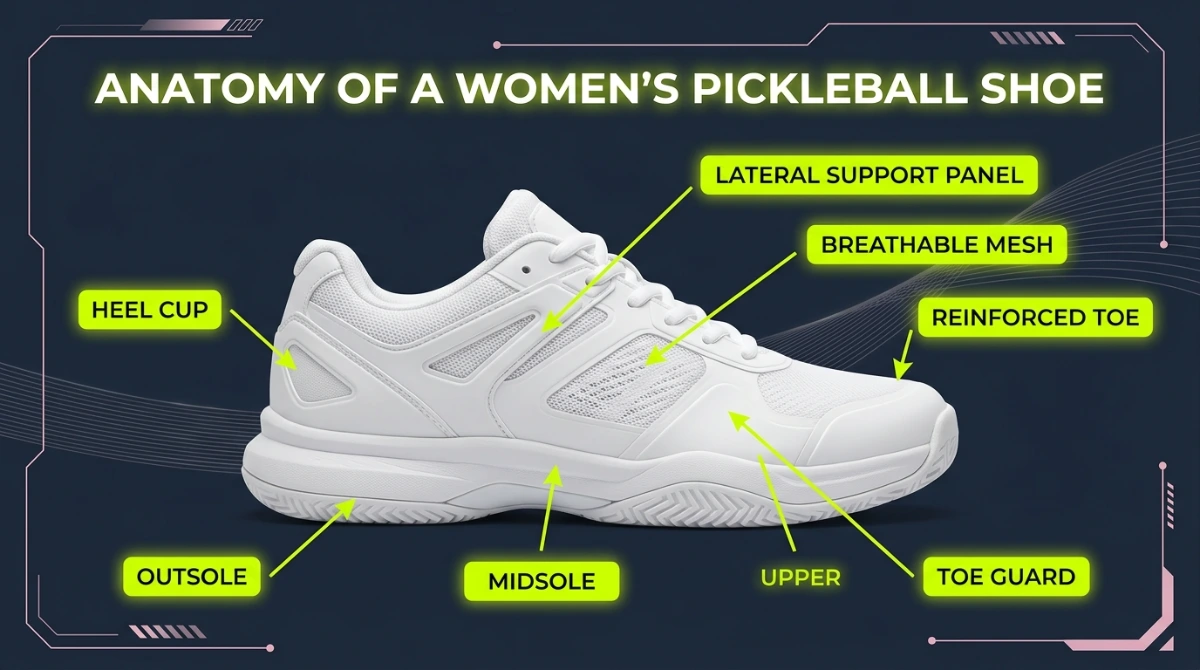
Outsole Grip
The outsole is the bottom of the shoe. The pattern on the outsole is called the tread. This is what grips the court surface.
| Tread Type | Best For | How It Works |
|---|---|---|
| Herringbone | Outdoor courts | Deep zigzag pattern provides excellent grip on rough surfaces |
| Modified Herringbone | Both surfaces | Versatile grip for indoor and outdoor play |
| Gum Rubber | Indoor courts | Softer rubber provides excellent grip on smooth surfaces |
What to look for: Choose the tread pattern based on where you play most often. If you play on multiple surfaces, choose a versatile pattern. The best outdoor pickleball shoes share a few characteristics: a reinforced toe cap, a thick and durable herringbone outsole, and enough lateral support.
USA Pickleball Shoe Rule – Non-Marking Soles
According to the official USA Pickleball equipment rules, shoes must have non-marking soles.” This is an official rule.
Always choose non-marking soles for indoor play. If you play indoors on wood or tile, non-marking gum rubber outsoles are required. Marking the court surface is a violation.
For outdoor concrete or asphalt, you can choose any outsole material. But for indoor play, always check the sole before buying.
Shank Stability – What It Is and Why It Matters
A shank is a stiff piece of material built into the midsole of a shoe. It runs from the heel to the midfoot.
Why it matters:
- Prevents your foot from twisting during side‑to‑side movements
- Provides stability during quick pivots
- Reduces the risk of mid‑foot injuries
What to look for:
- Shoes with a torsion bar or stability shank
- Shoes with a wide base that prevents rollover
- Shoes with firm midfoot support
Without a shank, your foot can roll during lateral movement. This can cause injuries.
Reinforced Toe Guards
Pickleball involves a lot of stopping and starting. Your toes drag on the court. Over time, this wears out the toe area of your shoe.
What to look for:
- Reinforced toe guards – Extra material at the front of the shoe
- Rubber toe caps – Protect against toe dragging
- Durable overlays – Prevent tears and wear
Shoes without toe guards wear out quickly. Toe guards extend the life of your shoe by protecting the most vulnerable area.
Machine Washable Shoes
Some pickleball shoes are machine washable. This is a convenient feature for players who play frequently.
Brands that offer machine washable shoes:
- Skechers – Some models are washable
- Certain athletic brands – Check the label before washing
How to wash:
- Remove the insoles
- Use cold water
- Air dry — never put them in a dryer
Caution: Not all shoes are machine washable. Check the manufacturer’s instructions before washing.
Midsole Cushioning
The midsole is the middle layer of the shoe. It provides cushioning. It absorbs shock when you land.
The best shoe for you depends on how much cushioning you prefer.
| Cushioning Type | Feel | Best For |
|---|---|---|
| EVA | Firm, responsive | Players who want a “court feel” |
| ETPU | Bouncy, energetic | Players who want energy return |
| GEL | Plush, shock-absorbing | Players with joint issues |
| Boost | Energetic, responsive | Players who want both comfort and response |
ETPU vs EVA – The Science
ETPU (Expanded TPU) offers significantly more impact absorption than traditional compressed EVA. If you play frequently or have joint issues, ETPU is worth the investment. It provides better shock absorption and lasts longer than EVA.
Other Cushioning Technologies
Several brands use proprietary cushioning technologies. Here are the most common:
| Technology | Brand | How It Works |
|---|---|---|
| Lightstrike Pro | Adidas | ~20% lighter than BOOST, excellent energy return |
| Power Cushion | Yonex | Claims 28% more shock absorption than standard EVA |
| HyperBurst | Skechers | CO₂-infused EVA for high rebound |
| Enerzy + Wave Plate | Mizuno | Softer and bouncier than older foams |
Lateral Support
Pickleball requires a lot of side-to-side movement. Without lateral support, your ankle can roll. That causes injury.
Lateral support comes from:
- A supportive upper – The material that wraps your foot
- A stability shank – A stiff piece in the midsole that prevents twisting
- An extended outsole – A wider base that prevents rollover
Upper Construction and Lateral Support
The upper is the part of the shoe that covers your foot. It needs to be supportive but flexible. Look for:
- Reinforced mesh – Provides support without adding weight
- Synthetic overlays – Adds structure and support
- Heel counter – A stiff piece in the heel that locks your foot in place
Heel Counter: The Foundation of Stability
The heel counter is a stiff piece of material in the heel of the shoe. It locks your heel in place. Without it, your heel slips. That causes blisters and instability.
What to look for:
- A firm heel counter
- A heel counter that wraps around your heel
- A heel counter that does not collapse
Midfoot Shank: Controlling Torsional Forces
The midfoot shank is a stiff piece in the midsole. It prevents your foot from twisting. Without it, your foot can roll during lateral movement.
What to look for:
- A torsion bar or stability shank
- A wide base that prevents rollover
- Firm midfoot support
Breathability
Your feet sweat. Without breathability, your feet get hot. They get wet. They get uncomfortable. Blisters form.
Breathability comes from:
- Mesh uppers – Allow air to flow
- Ventilation holes – Allow heat to escape
- Moisture-wicking materials – Pull sweat away from your feet
Weight
Heavier shoes fatigue your legs faster. Lighter shoes allow faster movement. But lighter shoes often have less support. There is a tradeoff.
According to experts, the optimal weight for women’s pickleball shoes is 9-11 oz. K-Swiss Express Light weighs 9.8 oz, Mizuno Wave Exceed Court AC weighs approx. 9.2 oz.
| Weight | Pros | Cons | Best For |
|---|---|---|---|
| Light (under 10 oz) | Fast, agile | Less support | Speed players |
| Optimal (9-11 oz) | Best balance for most women | May feel heavy to some | All-court players |
| Heavy (over 11 oz) | Maximum support, durable | Slower, more fatigue | Power players |
Durability
Pickleball is hard on shoes. The constant stopping and starting wears down the outsole. The lateral movements stress the upper. Good shoes last 50-80 hours of play. Cheap shoes may last half that.
What to look for:
- Reinforced toe – Protects against dragging
- Durable outsole rubber – Resists wear
- Reinforced upper – Prevents tears
Court Surface Considerations
Where you play matters. Different surfaces require different features.
Outdoor Courts (Concrete, Asphalt)
What you need:
- Durable outsole – Hard surfaces wear down shoes quickly
- Herringbone tread – Provides grip on rough surfaces
- Good cushioning – Hard surfaces are unforgiving on joints
Tips:
- Choose shoes with a durable outsole
- Replace shoes more frequently
- Consider shoes with extra toe reinforcement
Indoor Courts (Wood, Gym Floors)
What you need:
- Gum rubber outsole – Provides grip on smooth surfaces without damaging the floor
- Good breathability – Indoor courts can get hot
- Light weight – Indoor play is often faster
Tips:
- Choose shoes with non-marking outsoles
- Look for good ventilation
- Consider lighter shoes for quicker movement
The Gum Rubber Mistake
Gum rubber is great for indoor courts. But it wears down quickly on outdoor courts. If you play outdoors, choose a harder rubber compound.
Women’s Sizing & Fit Guide
Getting the right size is crucial. Too small, and your feet hurt. Too big, and you slide around. Either can cause injury.
Width Options for Women
| Width | Letter | Description |
|---|---|---|
| Narrow | AA | Less common |
| Medium | B | The standard width for women |
| Wide | D | For wider feet |
| Extra Wide | 2E | For very wide feet |
How to Measure Your Feet
- Measure at the end of the day – Feet swell during the day
- Wear your game socks – The socks you wear when you play
- Measure both feet – One foot is often slightly larger
- Use a Brannock device – Or a tape measure and a wall
Brand-Specific Sizing Differences
| Brand | Sizing Note |
| ASICS | Runs true to size, wide options available |
| K-Swiss | Runs true to size, wide options available; built on women-specific lasts |
| Skechers | Runs slightly wide (Relaxed Fit®) |
| Nike | Runs slightly narrow |
| Babolat | Runs slightly narrow |
| New Balance | Runs true to size, excellent wide options |
| Head | Runs slightly wide |
How to Try On Shoes
- Try on at the end of the day – Feet are at their largest
- Wear your game socks
- Check for a thumb’s width – About half an inch of space between your longest toe and the end of the shoe
- Walk, jog, and lunge – Make sure they feel comfortable during movement
- Check for heel slippage – Your heel should not lift
Expert Tips for Trying On and Testing Pickleball Shoes
According to physical therapists and pickleball experts, here are the best practices for trying on shoes:
1. Try on at the right time
- Feet swell during the day, so try on shoes in the afternoon or evening
- This gives you a more accurate fit
2. Wear your game socks
- The socks you wear during play affect the fit
- Bring your thickest pickleball socks to the fitting
3. Perform sport-specific movements
- Walk, jog, and do lateral shuffles in the store
- Make quick stops and starts
- Check for heel slippage during these movements
4. Test both feet
- One foot is often slightly larger
- Fit the larger foot first
5. Check the thumb’s width rule
- About half an inch of space between your longest toe and the end of the shoe
- This prevents “pickleball toe”
Heel Slip & Forefoot Flare – The Two Ways Women’s Shoes Fail
These are the two most common problems for women’s shoes. Understanding them helps you choose the right shoe.
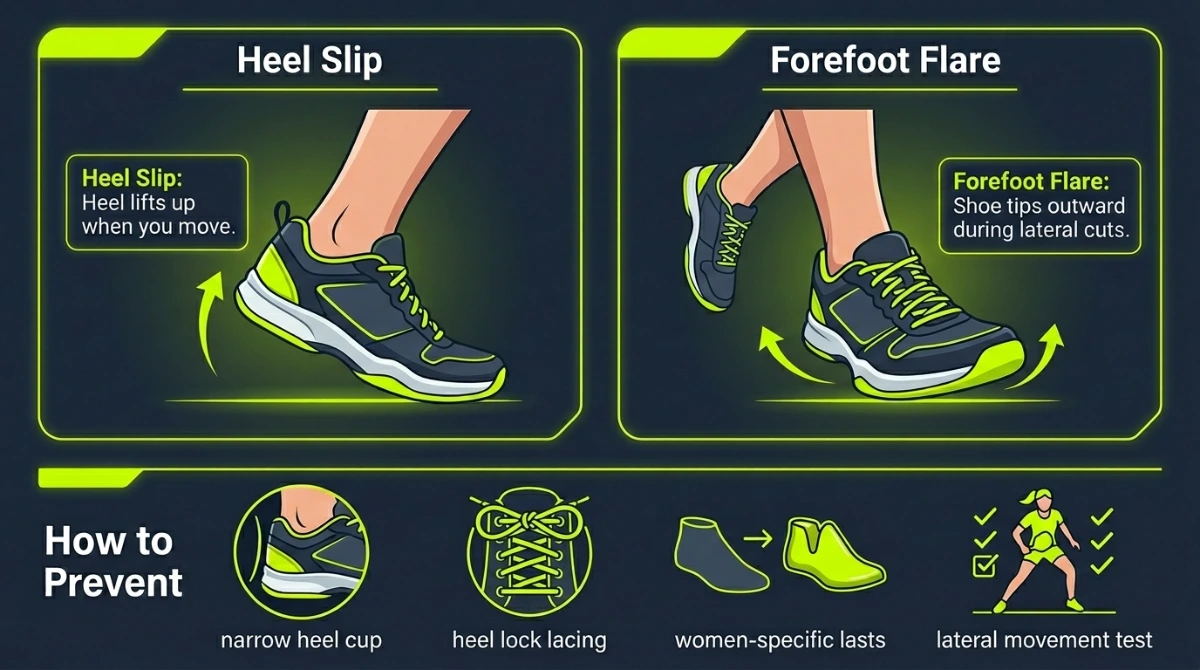
Heel Slip
What it is: Your heel lifts up when you move. The shoe does not lock your heel in place.
Why it happens:
- The heel cup is too wide
- The lacing system is not secure
- The shoe is not designed for women’s narrower heels
How to prevent it:
- Choose shoes with a narrow heel cup
- Use heel lock lacing
- Choose women-specific lasts
Forefoot Flare – The Other Women’s Shoe Problem
What it is: The shoe flares outward at the forefoot, creating a rolling sensation during lateral cuts. The shoe tips outward slightly before your foot connects with the court.
Why it happens:
- High-cushion shoes designed to absorb impact often flare outward at the forefoot
- Women with narrower forefeet and higher arches feel this most
- This can make the shoe feel unstable during side‑to‑side movements
How to prevent it:
- Choose shoes with women‑specific lasts
- Look for models that don’t have excessive flaring
- Test shoes with lateral movements before buying
Note: Skechers Relaxed Fit® provides a wider forefoot – ideal for wide feet but problematic for narrow feet. If you have narrow feet, avoid shoes with a wide forefoot design.
Pro tip: Try making lateral cuts in the store. If the shoe feels like it’s tipping outward, look for a different model.
Solving Pain Points: Knees, Heels, and Toes
The “Pickleball Toe” Phenomenon
What it is: Pain or bruising in your toes from stopping and starting.
What to look for:
- A roomy toe box
- Toe guards
- Reinforced toe caps
Plantar Fasciitis and Knee Pain
What it is: Inflammation of the plantar fascia or pain in the knees.
What to look for:
- Good arch support
- Plush cushioning
- A shoe with a slight heel-to-toe drop
- Shoes with anatomical Ortholite insoles
Recommended shoes for plantar fasciitis:
- ASICS Gel-Renma – Women’s Health top pick
- Women’s DESI Low – ETPU midsole with Blumaka® NonSlip Insole for arch support and heel cupping
- Skechers Viper Court Pro 2.0 – Podiatrist-certified Arch Fit system
Blisters
What it is: Friction between your foot and the shoe.
What to look for:
- Proper fit (not too tight, not too loose)
- Breathable materials
- Moisture-wicking socks
How Long Do Women’s Pickleball Shoes Last?
Pickleball shoes typically last 50-80 hours of play. That is about 3-6 months for a regular player.
Signs You Need to Replace Your Shoes
| Sign | What to Look For |
| Worn outsole | The tread is smooth or worn down |
| Decreased cushioning | Your joints hurt more after playing |
| Upper tears | The material is tearing or separating |
| Uneven wear | One side is worn more than the other |
| Pain or discomfort | Your feet, ankles, or knees hurt |
How to Extend Shoe Life
- Rotate shoes – Wear different pairs on different days
- Air them out – Let them dry between uses
- Clean them – Remove dirt and debris
- Store properly – Keep them away from heat and sunlight
- Use shoe trees – Help them keep their shape
Recovery Footwear – What to Wear After Playing
Your feet need recovery after playing. Rotating between court shoes and recovery footwear is a smart practice.
What is recovery footwear?
- Lightweight, cushioned slides or sandals
- Shoes with good arch support
- Shoes that allow your feet to breathe
Why it matters:
- Reduces foot fatigue
- Prevents blisters from worsening
- Gives your feet a break from the rigid support of court shoes
Recommended recovery footwear:
- Cushioned slides
- Supportive sandals
- Comfortable walking shoes
Maintenance & Care
Taking care of your shoes extends their life. Here is how.
Cleaning
- Use a soft brush to remove dirt and debris
- Wipe with a damp cloth – Do not soak them
- Use a gentle cleaner – Mild soap and water
- Air dry – Never put them in a dryer
Storage
- Keep them away from heat – Heat degrades the materials
- Avoid direct sunlight – Sunlight fades and weakens materials
- Store in a cool, dry place – Moisture causes mold and mildew
- Use shoe trees – Helps maintain the shape
When to Replace
- Replace after 50-80 hours of play
- Replace when the outsole is worn
- Replace when you feel pain
How to Choose Based on Playstyle
Your playstyle affects which shoe is right for you.
Power Player
Characteristics: Hits hard, aggressive, moves forward and backward
What to look for:
- Good cushioning (absorbs impact)
- Durable outsole
- Good lateral support
- Slightly heavier for stability
Speed Player
Characteristics: Quick, agile, moves side to side
What to look for:
- Lightweight (under 10 oz)
- Good traction
- Responsive cushioning
- Low profile for court feel
Finesse Player
Characteristics: Precise, strategic, relies on placement
What to look for:
- Good court feel
- Responsive cushioning
- Lightweight
- Good traction
Price Tier Breakdown
Pickleball shoes are available at every price point. Here is what you get at each level.
| Price Tier | Price Range | What You Get |
| Budget | $50-$80 | Basic features, less cushioning, less durable |
| Mid-Range | $80-$130 | Good features, decent cushioning, moderate durability |
| Premium | $130-$180+ | Excellent features, maximum cushioning, great durability |
Top Brand Comparison
ASICS: The Queen of Stability
- Great for wide feet
- Excellent arch support
- Gel cushioning technology
- Good durability
Nike: The Choice for Speed (and Narrow Feet)
- Lightweight
- Runs slightly narrow
- Good for speed players
- Stylish designs
K-Swiss: The Comfort King
- Comfortable out of the box
- Good cushioning
- Wide options available
- Good durability
- Built on women-specific lasts
Skechers: The Comfort Queen
- Very comfortable
- Plush cushioning
- Good for players with foot issues
- Machine washable options
- Relaxed Fit® provides wider forefoot
New Balance: The Wide-Foot Specialist
- Excellent wide options
- Good support
- Good durability
- Good cushioning
Babolat: The Speed Specialist
- Lightweight
- Good traction
- Runs slightly narrow
- Good breathability
Top Picks by Category
Based on my experience and research, here are some of the best pickleball shoes for women in 2026.
Best Overall
K-Swiss Express Light
- Good traction
- Good cushioning
- Excellent durability
- Weight: 9.8 oz
- Wide options available
- Built on women-specific lasts
Best for Wide Feet
New Balance 806
- Great wide options
- Good support
- Good cushioning
- Good traction
Best for Speed
Babolat Jet Mach 3
- Lightweight
- Great traction
- Good breathability
- Responsive cushioning
Best Traction
Franklin ACV Pro
- Excellent traction with herringbone + pivot point
- Good support
- Good durability
- Very breathable mesh upper
Best for Plantar Fasciitis
ASICS Gel-Renma
- Women’s Health top pick under $100
- Excellent arch support
- Gel cushioning technology
- Designed specifically for court play
Alternative: Women’s DESI Low with ETPU midsole and Blumaka® NonSlip Insole
Best for Comfort
Skechers Viper Court Pro 2.0
- Very comfortable
- Good cushioning
- Good support
- Machine washable
- Best-selling pickleball shoe in the country by unit volume
- Podiatrist-certified Arch Fit system
- Price: $114.95
Best for Narrow Feet
Nike GP Challenge Pro
- Runs slightly narrow
- Good support
- Good traction
Best for Outdoors
K-Swiss Express Light
- Durable outsole
- Good traction
- Good support
- Reinforced toe cap
Best for Indoors
Head Motion Pro
- Gum rubber outsole
- Good breathability
- Lightweight
- Price: $89 (budget pick)
Best Style
JOOLA R4lly
- Great style
- Good performance
- Good cushioning
- Wider toe box for women
- First full run of women’s sizes in 2026
Best for Flat Feet
New Balance 806
- Firm arch support
- Stability features
- Wide options
Best for High Arches
ASICS Gel-Resolution
- Good arch support
- Plush cushioning
- Good support
Expert Quotes
“Pickleball involves explosive side‑to‑side movements, so you need a shoe that provides lateral stability without sacrificing comfort.”
– Physical therapist, quoted by Women’s Health“The ‘shrink and pink’ approach simply doesn’t work because a woman’s foot is shaped differently from a man’s.”
– Pickleball footwear expert“Women’s shoes often feature narrower heel cups and a different arch structure to better support the natural motion of a woman’s foot.”
– Daps.fit“A study found that women improved by 22.92% over barefoot and 17.68% over their usual shoes when wearing proper court shoes.”
– Pickleheads study
Frequently Asked Questions
Q: Can I use running shoes for pickleball?
A: No. Running shoes are not designed for lateral movement. They can cause ankle injuries.
Q: How often should I replace my pickleball shoes?
A: Every 50-80 hours of play. For a regular player, that is about 3-6 months.
Q: Should I buy shoes a half size bigger?
A: No. Buy your true size. You need a thumb’s width of space, not a full size.
Q: Are pickleball shoes the same as tennis shoes?
A: No. Pickleball shoes are lighter, with different tread patterns and more lateral support.
Q: What is the best sole pattern for outdoor courts?
A: Herringbone. The zigzag pattern provides excellent grip on rough surfaces.
Q: What is the best sole pattern for indoor courts?
A: Gum rubber. It provides excellent grip on smooth surfaces without damaging the floor.
Q: How do I know if my shoes are worn out?
A: Check for worn tread, decreased cushioning, upper tears, or pain during play.
Q: Should I buy shoes online or in a store?
A: In a store if possible. You can try them on and test the fit. If you buy online, use a store with free returns.
Q: What is the “shrink and pink” problem?
A: Many brands make a men’s shoe, shrink it, and call it a women’s shoe. Women’s feet are shaped differently. They need shoes designed for women.
Q: What should I look for if I have plantar fasciitis?
A: Good arch support and plush cushioning. Look for shoes with a slight heel-to-toe drop. Top picks include ASICS Gel-Renma and Skechers Viper Court Pro 2.0.
Q: What is heel slip and how do I prevent it?
A: Heel slip is when your heel lifts up in the shoe. Use heel lock lacing and choose shoes with a narrow heel cup.
Q: What is forefoot flare?
A: When the shoe flares outward at the forefoot, creating a rolling sensation during lateral cuts.
Q: Why is forefoot flare a problem for women?
A: Women often have narrower forefeet and higher arches, making them more susceptible to feeling the flare.
Q: What should I wear after playing pickleball?
A: Lightweight, cushioned slides or supportive sandals. This allows your feet to recover.
Q: What is the ideal weight for women’s pickleball shoes?
A: Aim for 9-11 oz per shoe for the best balance of speed and support. Examples: K-Swiss Express Light 9.8 oz, Mizuno Wave Exceed 9.2 oz.
Q: What should I look for if I have flat feet?
A: Firm arch support, stability features, and a shoe with a straight or slightly curved last.
Q: What should I look for if I have high arches?
A: Good arch support, plush cushioning, and a shoe with a curved last.
Q: What should I look for if I have narrow feet?
A: Narrow width options (AA), adjustable lacing, and a supportive upper. Avoid Relaxed Fit® shoes designed for wide feet.
✅ Final Checklist – Are You Wearing the Right Shoes?
| Factor | Yes/No |
|---|---|
| Shoe is made for pickleball (not running or tennis) | ☐ |
| Shoe is designed for women’s feet (not shrunk men’s) | ☐ |
| Outsole matches my playing surface (indoor/outdoor) | ☐ |
| Good lateral support for side-to-side movement | ☐ |
| Proper cushioning for my playing style | ☐ |
| Correct size (thumb’s width of space) | ☐ |
| Correct width (B, D, or 2E if needed) | ☐ |
| Good arch support for my foot type | ☐ |
| Breathable upper for comfort | ☐ |
| No heel slippage | ☐ |
| Roomy toe box (no “pickleball toe”) | ☐ |
| Shoes are less than 50-80 hours of play | ☐ |
| No signs of excessive wear | ☐ |
| Non-marking soles (for indoor play) | ☐ |
Conclusion
I still remember the relief when I finally switched from running shoes to proper women’s pickleball shoes. No more ankle pain. No more knee pain. No more bruised toes. I could move with confidence. Sarah, my student who kept rolling her ankle, finally listened. We switched her to proper women’s pickleball shoes with good lateral support and a narrow heel cup designed for women’s feet. She has not rolled her ankle since. Her game improved because she was no longer afraid of getting injured. That moment—seeing a player go from fearful to confident—is exactly why I keep coaching and writing these guides.
Everything in this guide comes from real courts and real feedback from the women I have coached—from nervous beginners to competitive tournament players. I personally use every piece of advice in this guide, and I update it every year as new shoes and technologies emerge. You can trust that what you read here is current, practical, and based on hands-on experience. Bookmark it. Use the checklist. And most importantly, invest in the right shoes. Your feet will thank you.
