

Introduction
Let me tell you about my first open play session. I walked in, saw a rack of paddles, and froze. I had no idea where to put my paddle, how the queue worked, or when I was supposed to play. Nobody explained the pickleball etiquette system to me. Nobody told me the unwritten rules. That feeling of being lost and awkward is something I have seen in hundreds of new players since then. They struggle with basic pickleball etiquette without even knowing it.
A USA Pickleball certified referee (certified since 2015), I have coached over 200 players through their first open play sessions. The difference between players who are welcome and players who quietly get avoided is stark. Every mistake I could make, I have made—given unsolicited advice, argued a line call I should have let go, and failed to tap paddles after a frustrating loss. The hard way is how I learned. This guide is the one I wish I had before my first open play. If you’re completely new to the sport, start with our what is pickleball guide for absolute beginners before diving into etiquette. No jargon, no fluff—just honest, practical advice on pickleball etiquette from someone who has been where you are right now.
What Is Pickleball Etiquette?
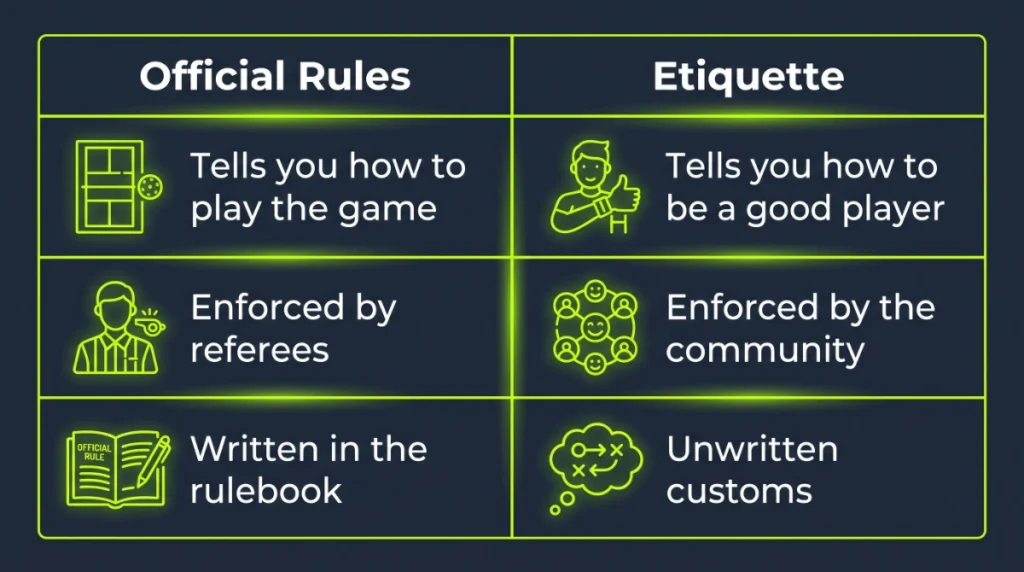
Pickleball etiquette is the set of unwritten rules that govern behavior on and around the court. It is not in the official rulebook. But it is just as important.
Etiquette covers how you treat other players. It covers how you handle line calls, rotate on and off courts, and celebrate or lose with grace.
The official rules tell you how to play the game. Etiquette tells you how to be a good player. USA Pickleball describes it as “the spirit of the game” — conduct consistent with proper etiquette, good sportsmanship, and exemplary behavior.
Pickleball was created to be a fun, competitive, and highly social sport. Etiquette protects that spirit. When players follow etiquette, everyone enjoys the game. When they don’t, tensions rise and the community suffers. Without pickleball etiquette, tensions rise and the community suffers.
The Foundation: Sportsmanship & Respect
Everything in pickleball etiquette starts with one idea: respect. Respect for opponents, partners, officials, staff, and the game itself.
Treat Everyone with Courtesy
USA Pickleball’s Sportsmanship Guide begins with this rule: treat all players, officials, volunteers, staff, and spectators with courtesy and respect. This is not optional. It is the foundation of everything else.
What does this look like in practice?
- Introduce yourself to players you do not know.
- Never use foul language or obscene gestures.
- Never denigrate another person.
- Avoid anger and confrontation.
Know the Official Rules
You do not need to be a certified referee. But you should know the basic rules. Understand how scoring works, the kitchen rule, and the serve rules. When you know the rules, you apply them fairly.
In open play, you are expected to know and understand all the rules. If you are unsure about something, ask politely. But do not expect others to teach you the basics during a game.
Be a Good Sport
Good sportsmanship is simple. Acknowledge good shots from your opponents. Accept calls graciously. Do not argue. At the end of each game, meet the other players at the net to acknowledge them positively. In officiated matches, thank the referee.
Emotional Control
Pickleball can be frustrating. But you should never throw your paddle or strike the ball in anger. Never use foul language or obscene gestures. Never criticize your partner during or after a game.
If you are angry, take a breath. Walk to the back of the court. Calm down before you say something you regret. The game is supposed to be fun.
Before the Game: Court Arrival & Introductions
Introduce Yourself
When you arrive at open play, introduce yourself to the players on your court. First names are all you need. “Hi, I’m Joe.” That is it. Pickleball is social by design. People want to know who they are playing with.
If you are new, say so. “Hey, I’m still learning the rotation.” This is not embarrassing. It is the fastest way to get veterans to help you instead of quietly resenting you.
Find the Paddle Rack
At almost every open play session, there is a designated spot for paddles. It might be a fence slot, a board with hooks, or a physical rack. Place your paddle at the end of the line. Do not ask if it is okay. Just follow the order.
Know the Court Format
Before you queue up, ask which format the court uses. Some courts use “winner stays” — winners remain on the court and take on challengers. Others use “all players rotate off” — all four players leave after each game. Getting it wrong stalls rotation for everyone behind you. Asking takes 10 seconds.
Open Play & Paddle Stacking: How the Queue Works
Open play is the most common way recreational pickleball happens. Players arrive, find a spot in the rotation, and play with whoever is next in line. But there is a system. You need to know it.
What Is Paddle Stacking?
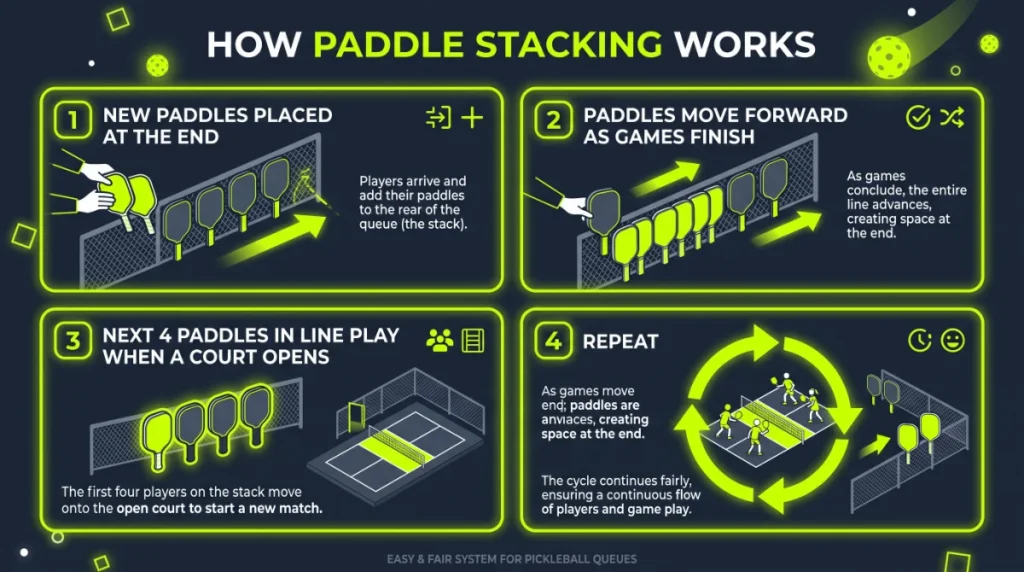
Paddle stacking is a physical queuing system used to manage court rotation. When you arrive, you place your paddle in a designated holder, rack, or slot. Your position in that queue represents your place in line for the next available court.
The first four paddles in line form the next group to play when a court opens up.
How Paddle Stacking Works
When a game ends, the next four paddles in line rotate onto the court. Your paddle moves forward as games finish.
Key rules to remember:
- Each player can only have one paddle in the bin at a time.
- If you wish to stay with your partner, stack your paddles next to each other.
- Placeholder paddles are not allowed. Players must be present to have a paddle in the stack.
- When playing, you may not stack your paddle until you have completed your game.
Common Paddle Stacking Mistakes
Don’t jump ahead in line. Do not invite someone else forward or rearrange paddles so they can move up. If you want to play with someone, move yourself back in line instead.
Do not stack your paddle and leave. If you need to leave mid-session, remove your paddle from the queue. Leaving it in line when you are absent stalls rotation for everyone waiting.
Do not call a lower score to avoid leaving the court. Play your game. If you lose, rotate off. That is how the system works.
Do not start a second game to avoid leaving. When your time is up, leave the court.
Different Rotation Systems: Winner Stays vs. Four On, Four Off
Different courts use different rotation systems. You need to know which system your court uses before you start playing.
| System | How It Works | Best For |
|---|---|---|
| Winner Stays | Winners remain on the court and take on challengers. Losers leave. | Competitive play |
| Four On, Four Off | All four players rotate off after each game. New players come in. | Social play |
| Paddle Stack | Paddles are placed in a queue. First in, first out. | Most courts |
| Three-Peat Rule | Any individual winning 3 games in a row must leave the court and return to the line. | Balanced play |
Always ask which system the court uses before you start playing. If you are unsure, watch other players for one game.
The Three-Peat Rule
Many facilities have a “three-peat rule.” This rule says that any individual winning 3 games in a row must leave the court and return to the line.
Why it exists:
- Prevents one player from dominating the court
- Gives other players a chance to play
- Keeps rotation fair for everyone
How to follow it:
- Count your wins
- After your third win, leave the court
- Put your paddle back in the queue
- Wait your turn to play again
How to Use Paddle Stacking to Play Together
If you show up with three other people and would like to play together, you can stack your paddles on top of each other. This signifies that you want to all play at the same time.
How to do it:
- Place all four paddles in the stack
- Your paddles will be called when the next court opens
- Do not mix your paddles with other paddles
Rules to remember:
- Each player can only have one paddle in the bin at a time
- Do not rearrange paddles to jump ahead
- If you leave, remove your paddle
Know the Vibe
Open play sessions have different vibes. Some sessions are competitive, some are social, and others are beginner-friendly. Pay attention to the players around you. If everyone is playing relaxed, do not be the person screaming and slamming balls. If everyone is competitive, step up your game. Match the energy of the court.
During the Game: In-Play Etiquette
Call the Score Clearly
Before every serve, the server must call the score out loud and clearly. If you’re unsure about how scoring works, our pickleball scoring guide covers everything in detail. In doubles, that is three numbers: server score, receiver score, server number. This small habit prevents confusion, disagreements, and unnecessary replays.
If you are serving, say the score loud enough for everyone to hear. Receiving players should listen carefully. When in doubt, ask before the serve.
Call Your Own Faults
Pickleball relies on honesty. If you commit a fault, call it on yourself. This includes foot faults on serves or in the non-volley zone. Do not wait for your opponents to notice. Call it immediately. Accept fault calls from your opponents graciously.
Practice Good Sportsmanship on Line Calls
Line calls are the most common source of conflict in pickleball. Here is how to handle them correctly.
Call only on your side. You call lines on your side of the court. You do not call lines on the opponent’s side.
Be certain. Do not call a ball “out” unless you see it clearly and are certain it is out. If you are unsure, the ball is in.
Use voice and hand signals. Say “OUT” loudly. Use a distinctive hand signal. This is especially important for players who are deaf or hard of hearing.
Call promptly. Call “out” before the opponent hits the ball. Do not wait to see where your shot goes before making the call.
Correct wrong calls. If your partner makes a wrong call, correct it immediately.
Resolve uncertainty in favor of opponents. If there is any doubt, the ball is in.
Do not argue. If you question an opponent’s call, do so respectfully. If you defer a line call to your opponents, accept their call graciously. Do not question an opponent’s line call repeatedly.
Never ask for line calls from spectators.
Hand Signals for Line Calls
The preferred word to indicate a line call is “OUT.” But sometimes verbal calls are not enough. You may be playing on a noisy court. You may be playing with someone who is deaf or hard of hearing.
Distinctive hand signals can be used in conjunction with a verbal line call, or in lieu of one. If you cannot hear the call, you can see it.
Words such as “wide,” “long,” “no,” and “deep” are also acceptable. But the preferred word is “OUT.”
When to use hand signals:
- When it is too noisy to hear verbal calls
- When playing with deaf or hard of hearing players
- When you want to confirm your call visually
Handle Partner Disagreements
In doubles, if partners disagree on a line call, the call is “in.” For a complete guide to singles play, check out our singles pickleball rules guide. That is the rule. Do not argue with your partner on the court.
Know the Non-Volley Zone Rule
Respect the kitchen. Do not step into the non-volley zone during volleys. Be mindful not to crowd your opponent at the net. Giving each other space allows for cleaner play.
Keep the Game Moving
Do not waste time between points. Retrieve balls quickly. Serve promptly. If you are not ready, hold up your hand. But do not delay unnecessarily.
Mind Your Space
Stay within your designated playing area. Avoid encroaching on neighboring courts. Do not back up onto other courts when chasing a ball. Instead, turn and move sideways.
Avoid Unsolicited Coaching
Offering advice to a player you do not know without being asked is the most universally disliked behavior in open play pickleball. If someone asks for guidance, share away. Otherwise, let players enjoy the game and learn at their own pace.
Be a Respectful Partner
Support your partner. Avoid criticism and negative non-verbal communications. Do not dominate the court by taking every shot. Remember that everyone is there for different reasons. Everyone is there for different reasons. Some want to win. Others want exercise. Many just want to have fun.
Partner Communication Hand Signals
In doubles, you and your partner can use pre-arranged hand signals behind your back. These signals communicate your serving strategy or which player will cover the middle or poach.
This is especially useful when you are serving, because your partner can see your signal without the opponents seeing it.
Common hand signals:
- Pointing down: “Stay put”
- Finger pointing left: “I’m going left”
- Finger pointing right: “I’m going right”
- Hand waving: “Switch positions”
These signals help you stay coordinated without giving away your strategy.
Safety: Protecting Everyone on the Court
Stop Play for Stray Balls
Safety always comes first. If a ball rolls onto your court, stop play and call it out loudly right away. Preventing collisions and injuries is more important than any point.
Warn Others When Your Ball Goes Off
If your ball enters another court, immediately warn players whose safety may be in jeopardy. Loudly call “BALL!” or some other warning.
Do Not Walk Behind Active Courts
Never walk behind or through active courts while a point is being played. If you must cross over or behind an active court, wait until play is stopped. Then cross quickly in a single group.
Return Balls Safely
If a ball strays onto your court, make eye contact with the correct person and roll or toss it back to them without disrupting play on other courts. Do not throw balls hard or randomly. If the ball is rolling behind a court and does not present danger, wait until play stops to retrieve it.
Clear the Court Promptly
When a game ends, gather your gear and exit the court efficiently. Pickleball courts are often shared spaces. Moving along quickly keeps rotations fair and minimizes wait times for other players.
Ball Etiquette: Respecting Ball Ownership
Pickleball balls seem to have a mind of their own. They roll off courts, get lost, and get mixed up.
Here is the rule: Pickleball players are super particular about their balls. Never swap your worn-out balls for someone else’s newer ones without asking.
If your ball goes into another court:
- Wait until play stops
- Retrieve your ball
- Return to your court
- Do not take someone else’s ball
If a ball from another court rolls onto your court:
- Stop play immediately
- Warn players with “BALL!”
- Pick up the ball
- Make eye contact with its owner
- Gently roll it back to them
Never throw balls across courts. You might hit someone.
Spectators Should Not Make Line Calls
If you are watching from the sidelines, you have no right to call any lines. Spectators should never make line calls for players.
Why:
- Only players are in the correct position to see the line
- Spectators may have a biased view
- It disrupts the game
If you are asked by a player about a line call, you may say what you saw. But do not make a call unprompted. Let the players decide.
Playing with Different Skill Levels
Be Kind to Weaker Players
As a stronger player in social play, be kind to other players. Do not slam the ball directly at them. Avoid hitting excessively to a weaker player. Play in a way that keeps the game fun for everyone.
Be Considerate About Playing Up and Down
Be willing to play sometimes with less-skilled players. Do not demand to play with more skilled players. If you want to play with better players, ask them nicely.
Be Welcoming to New Players
New players will miss shots. They will forget the score. They will ask questions. That is okay. Patience and encouragement help build the community and keep the sport thriving.
Accommodate Adaptive Players
Accommodate players with adaptive needs when possible. Pickleball is an inclusive sport. Everyone should be able to play.
What to Do If You’re the Weaker Player on the Court
Being the weakest player on the court can be uncomfortable. But it is also a great learning opportunity.
Don’t apologize for being new. Everyone started where you are. Apologizing constantly makes others uncomfortable.
Focus on having fun. The score matters less than the experience. Play your best and enjoy the game.
Ask questions politely. If you are unsure about a rule or rotation, ask between games. Most players are happy to help.
Work on fundamentals. Practice your third-shot drops and dinks. These are the building blocks of better pickleball.
Don’t take it personally if you lose. Losing is part of learning. Even the best players lose sometimes.
Thank your opponents after the game. “Good game” goes a long way, even if you lost badly.
How to Play Down Without Being Condescending
Playing with less-skilled players is a skill in itself. You want to keep the game fun without making others feel bad.
Don’t slam balls at weaker players. This is intimidating and discouraging. Play softer, more controlled shots.
Don’t just hit to the weaker player. This is called “picking on” someone. It is poor etiquette.
Practice different shots. Use the game as a chance to work on your drops, dinks, and placement.
Keep the score close. If you are winning easily, play more conservatively. Let the other team win a few points.
Be positive. “Nice shot!” “Great effort!” – words matter.
Don’t show frustration. If you get frustrated about a weak shot, keep it to yourself.
Remember why you are there. A game with a weaker player is not a match. It is a way to share the joy of pickleball.
Balancing Competitiveness with Good Sportsmanship
Pickleball is competitive. But competition should never come at the cost of good sportsmanship.
Play to win, but don’t lose your temper. It is okay to want to win. It is not okay to yell at opponents or throw your paddle.
Celebrate your points, but keep it respectful. A fist pump or a quiet “Yes!” is fine. Running around the court screaming is not.
Accept bad calls gracefully. It happens. Disputing every call is worse than losing the point.
Respect your opponents’ skill. You can still play hard without being disrespectful. Treat everyone with dignity.
After the game, be gracious. Win or lose, you shake hands. You tap paddles. You say “good game.” That is the rule.
The goal is to win, but the goal is also to be a player people respect. If you accomplish both, you have won twice.
Post-Game: Ending on a Positive Note
Tap Paddles at the Net
At the end of each game, meet the other players at the net and tap paddles. Tapping paddles before and after every game is the universal pickleball handshake. Refusing it is considered one of the most offensive things you can do on a rec court.
Even if you are frustrated, tap paddles. It is a sign of respect and good sportsmanship.
Thank Your Opponents
After tapping paddles, say “good game.” A simple acknowledgment goes a long way.
Thank the Referee (If Applicable)
In officiated matches, thank the referee. They are volunteers trying to make the game better.
Clean Up
If you brought balls, take them with you. If you see trash, pick it up. Leave the court better than you found it.
Spectator Etiquette
Spectators are part of the pickleball community too. Here is how to behave.
Do Not Shout During Points
Do not shout during points. It distracts players and disrupts concentration.
Do Not Distract Players
Do not make sudden movements or loud noises while a point is being played. Stay behind the court boundaries.
Do Not Offer Line Call Opinions
Never make calls for your opponent’s side of the court. Never ask for nor accept line calls from spectators.
Respect Officials
In tournament play, respect referees and officials. Do not argue with them from the sidelines.
What Spectators Should Say (And Not Say)
Spectators want to be supportive. But sometimes they say the wrong thing. Here is what to say and what to avoid.
Do say:
- “Good shot!”
- “Nice hustle!”
- “Great effort!”
- “Let’s go!”
Don’t say:
- “That was out!” (You are not the ref)
- “You should have hit it differently!” (No coaching from sidelines)
- “How did you miss that?” (Negative comments)
- “He/She is not that good!” (Disrespectful)
When to speak: Cheer between points, not during them. Keep it positive and keep it respectful.
Tournament Etiquette vs. Recreational Etiquette
Tournament play is different from recreational open play. Here are the key differences.
Tournament Play
- Referees: Matches have officials. Respect them.
- Stricter rules: Rules are enforced more strictly.
- No unsolicited coaching: Coaching is not allowed during points.
- Sportsmanship: Conduct expectations are higher.
Recreational Open Play
- Self-officiated: No line judges — you call your own balls.
- Flexible: Rules are applied more casually.
- Social: The focus is on having fun, not winning.
- Welcoming: New players are expected and encouraged.
When you switch between the two, adjust your behavior accordingly. Do not bring tournament intensity to a rec game. Do not bring rec casualness to a tournament.
2026 Rule Changes: Sportsmanship & Conduct
The 2026 rulebook has several updates related to sportsmanship and conduct. These apply to sanctioned tournaments, not recreational open play.
Key changes:
- Referees can now issue verbal warnings or technical fouls before a match even begins
- Timeout communication rules are tightened — you must clearly signal a timeout
- Sportsmanship and conduct rules are stricter
- The UPA-A has introduced a separate rulebook for PPA Tour and MLP with stricter disciplinary measures
What this means for you:
- Be on your best behavior even before your match starts
- Signal timeouts clearly
- Respect officials and opponents
Common Etiquette Mistakes Beginners Make
Here are the most common etiquette mistakes and how to avoid them.
1. Not Knowing the Paddle Stack System
Mistake: Walking onto a court without understanding the queue.
Fix: Ask how the rotation works before you play. Watch the paddle rack. Follow the order.
2. Offering Unsolicited Advice
Mistake: Telling strangers how to improve their game.
Fix: Do not coach unless asked. No one wants tips from someone they just met.
3. Taking Too Many Shots
Mistake: Dominating the court by taking every middle shot.
Fix: Share the court. Let your partner play.
4. Arguing Line Calls
Mistake: Questioning every close call.
Fix: If you are unsure, the ball is in. Give the benefit of doubt to your opponents.
5. Walking Behind Active Courts
Mistake: Walking behind a court while a point is being played.
Fix: Wait until play stops. Cross quickly in a group.
6. Not Tapping Paddles
Mistake: Leaving the court without acknowledging opponents.
Fix: Always tap paddles after every game.
7. Over-Celebrating
Mistake: Celebrating excessively after an opponent’s error.
Fix: Keep celebrations respectful. A simple paddle tap or “nice shot” is enough.
8. Stacking a Paddle and Leaving
Mistake: Leaving your paddle in the queue when you are not present.
Fix: Remove your paddle if you leave.
What to Do When Someone Breaks the Etiquette Rules
It will happen. Someone will cut the paddle queue. Bad line calls will happen. Unsolicited advice will be offered. Here is how to handle it.
Stay Calm
Do not get angry, yell, or confront aggressively. The goal is to resolve the issue, not escalate it.
Be Polite
Use polite language. “Excuse me, I think I was next in line.” “I’m not sure about that call. Could we replay it?” “I appreciate the advice, but I’d rather focus on my game right now.”
Give Grace
Sometimes people do not know the rules. Sometimes they made a mistake. Give them the benefit of the doubt. If the issue is minor, let it go. For repeated violations, talk to the person privately after the game. Keep it calm and friendly. “Hey, I wanted to mention something. When you [describe the behavior], it can be frustrating for other players.” Keep it calm. Keep it friendly.
If It Is Serious
If someone is aggressive, abusive, or creating a safety risk, report them to facility staff. Your safety is more important than a game.
Facility-Specific Rules
Different facilities have different paddle stacking rules. Some allow stacking paddles together to play with specific people, while others don’t allow rearranging paddles for people to stick together.
Examples of facility-specific rules:
- Some courts allow mixing paddles to play together
- Some courts do not allow rearranging paddles
- Some courts have a “first in, first out” rule
- Some courts have a “winners stay” rule
Always ask or observe before you play:
- Watch other players for one game
- Ask the person managing the court
- Read any posted rules
Etiquette for Recording Matches
More players are recording matches to review their game. But there is etiquette for doing it.
Do:
- Ask permission before recording
- Let everyone know you are recording
- Keep the camera away from the court
Don’t:
- Record without permission
- Use recordings to argue calls
- Post videos without consent
Dress Code Etiquette
Not all courts have a dress code, but some do. Here are general guidelines.
Wear:
- Athletic apparel (shorts, skirts, leggings)
- Court shoes with non-marking soles
- A shirt that covers your chest
Avoid:
- No jeans or street clothes
- No bare chests
- No worn-out or inappropriate clothing
If you are unsure, check with the facility before you arrive.
Mixed Doubles Etiquette – Gender Dynamics
Mixed doubles is one of the most popular formats in pickleball. But it comes with its own etiquette considerations.
Play to the weak player, but don’t target them. It is okay to hit to the weaker player. That is strategy. It is not okay to slam the ball directly at them or hit excessively to them to the point where they are uncomfortable.
Respect both opponents equally. Mixed doubles does not mean “men vs. women.” Both players are opponents. Treat them equally.
Communicate with your partner. Mixed doubles requires extra communication. Know who is taking the middle. Know who is covering the poach.
Don’t criticize your partner. This is true for all doubles, but it is especially important in mixed doubles, where one partner may be less skilled. Keep it positive.
Keep the game fun. Mixed doubles is supposed to be social. Win graciously. Lose gracefully. Celebrate the good shots.
Gender Dynamics in Mixed Doubles
Be aware of power differences. In mixed doubles, men often have more power. That does not mean they should dominate the game. Play strategically, not aggressively.
Let both players contribute. Do not just target one person. Hit to both opponents. Keep the game balanced.
Mixed doubles is a great equalizer. Women often have superior finesse and placement. Men often have more power. The best mixed doubles teams use both.
Once you’ve mastered etiquette, make sure you understand all the official rules. Our Complete Pickleball Rules 2026 Guide covers everything from the kitchen to line calls.
Frequently Asked Questions
Q: What is the most important rule of pickleball etiquette?
A: Respect. Treat everyone with courtesy and respect. Everything else follows from that.
Q: What should I do if I accidentally walk behind an active court?
A: Wait until play is stopped. Then cross quickly in a single group. If you disrupt a point, apologize.
Q: Can I coach my partner during a game?
A: Yes, if you are partners. But keep it supportive. Do not criticize. Provide coaching only when requested.
Q: What if I disagree with a line call?
A: If you question an opponent’s call, do so respectfully and do not argue. If you defer to them, accept their call graciously.
Q: Do I have to tap paddles after every game?
A: Yes. It is the universal pickleball handshake. Refusing it is considered offensive.
Q: What is the paddle stacking rule?
A: Place your paddle in the designated rack when you arrive. Your position represents your place in line. Do not jump ahead. Remove your paddle if you leave.
Q: Can I ask spectators for line calls?
A: No. Never ask for nor accept line calls from spectators.
Q: What if someone offers me unsolicited advice?
A: You can say, “Thanks, but I’d prefer to focus on my game right now.” If they persist, ignore them or talk to them after the game.
Q: How do I handle a player who makes bad calls consistently?
A: If it is a rec game, give them grace. If it is a tournament, bring it to the referee’s attention. If it is serious, talk to facility staff.
Q: What are the 2026 etiquette rule changes?
A: Referees can now issue warnings before matches begin. Timeout communication rules are tightened. Sportsmanship and conduct rules are stricter.
Q: What is the three-peat rule?
A: If you win 3 games in a row, you must leave the court and return to the line. This keeps rotation fair.
Q: Can I use hand signals for line calls?
A: Yes. Hand signals can be used in conjunction with or in lieu of verbal calls, especially for deaf or hard of hearing players.
Q: Can I record matches?
A: Yes, but ask permission first. Do not use recordings to argue calls or post videos without consent.
Q: What should I do if I’m the weakest player on the court?
A: Focus on having fun, ask polite questions, and don’t apologize for being new. Everyone started somewhere.
Q: How do I play down without being condescending?
A: Don’t slam balls at weaker players. Practice different shots. Keep the score close. Be positive and encouraging.
Q: What is mixed doubles etiquette?
A: Respect both opponents equally. Communicate with your partner. Don’t target weaker players aggressively. Keep the game fun for everyone.
Conclusion
I still remember the relief when I finally understood the paddle stack. No more awkward waiting. No more accidentally jumping ahead. I could just show up, play, and enjoy the game. I had a student named Dave, a beginner who was terrified of open play. He was a great player but avoided public courts because he was afraid of being judged. We worked through the basics, taught him the paddle stack, and gave him a simple script for introducing himself. A few weeks later, he sent me a message: “I played my first open play session today. Nobody yelled at me. I had a great time. I can’t wait to go back.” That moment—seeing a player go from terrified to excited—is exactly why I keep coaching and writing these guides.
Everything in this guide comes from real courts and real feedback from the players I have coached—from nervous beginners to seasoned veterans. I personally use every piece of advice I give, and I update this guide every year as court customs and rules evolve. You can trust that what you read here is current, practical, and based on hands-on experience. Bookmark it. Use the checklist. And most importantly, walk onto that court with confidence. You have got this.
