

Introduction
The first time I played singles, I stepped up to the baseline, opened my mouth to call the score, and froze. I knew there was no server number in singles, but my brain screamed “0‑0‑2” like it always did in doubles. I mumbled something incoherent, served from the wrong side, and my opponent just stared at me with a mix of pity and amusement. There was no partner to whisper “You’re on the wrong side” or to share the blame. That hot‑faced loneliness—the feeling that everyone on the next court knew I didn’t belong—is exactly why I wrote this guide. (If you’re completely new to the court, you might want to start with our comprehensive what is pickleball rules guide for absolute beginners). But if you’ve already played doubles and just want to stop panicking about singles rules, wondering where to stand, or dreading looking foolish when it’s just you and one opponent—I wrote this breakdown specifically for you.
As a certified USA Pickleball referee who has coached over 200 beginners, I’ve seen this exact same hesitation in almost every player transitioning to the 1v1 game. But the beautiful truth is, singles rules are actually simpler than doubles. There is no server number, only one serve per turn, and just two numbers to call. Having refereed more than 50 matches and taught hundreds of players, I can tell you that you can master these singles pickleball rules in under ten minutes. In this guide, I’ll give you exactly what I wish I’d had before that first embarrassing game—no jargon, no ego, just a simple walk‑through so you can dominate the court with confidence.
Singles Pickleball in 30 Seconds
If you need the absolute quickest explanation of singles pickleball rules, here it is:
- The court is exactly the same size as doubles (full 20 ft x 44 ft, no inner sidelines or alleys).
- You get one serve attempt, and you must serve underhand.
- Serve from the right when your score is even, from the left when your score is odd.
- The score has two numbers: your score – opponent’s score.
- Only the serving player can score a point.
- Game is to 11 points, win by 2.
- All other rules—kitchen, two‑bounce, faults—stay the same.
That’s it. Now let’s unpack each part.
Singles Pickleball Rules vs. Doubles: What’s Different?
Before we dive deeper, here’s a quick comparison table so you can see exactly what changes when you play singles.
| Rule | Singles | Doubles |
|---|---|---|
| Court width | 20 ft x 44 ft (Full Court) | 20 ft x 44 ft (Full Court) |
| Serving turns | 1 serve per side | 2 serves per side (except first turn) |
| Score call | Two numbers (e.g., “3‑2”) | Three numbers (e.g., “3‑2‑1”) |
| Server rotation | No partner; you serve until you fault | Partner serves after you fault |
| Switching sides | After each point won as server | After each point won as server |
| Kitchen & faults | Same as doubles | Same |
The core game is the same—just simpler and with more running!
For the full breakdown of every rule, be sure to check our Complete Pickleball Rules Guide.
The Singles Court and Equipment
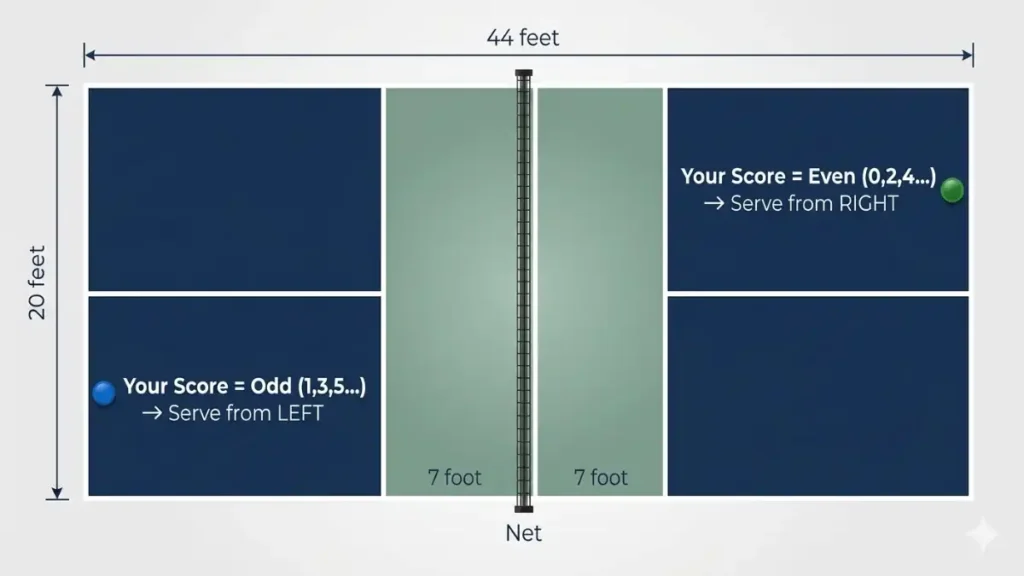
The singles court is exactly the same size as a doubles court: 20 feet wide and 44 feet long. Unlike tennis, there are no singles alleys or inner lines to worry about—you use the exact same boundaries. The 7‑foot non‑volley zone (kitchen), the net height (34 inches at the center), and the baselines remain completely unchanged. These singles pickleball rules keep the court transition seamless for players moving from doubles to one‑on‑one play.
Equipment is also unchanged. You need a paddle, a plastic ball (outdoor: 40 small holes; indoor: 26 larger holes), and a net. You can check our paddle buying guide for beginner recommendations.
Serving Rules for Singles
The serve in singles follows the same core rules as doubles, but with one big difference: only one serve attempt per side. If you fault, the serve goes directly to your opponent. No second server.
Here’s exactly how to serve:
- Stand behind the baseline, between the centerline and the sideline.
- Serve underhand: your paddle head must be below your wrist, and you contact the ball below your waist.
- Serve cross‑court into the opponent’s right or left service box, depending on your score.
Where to serve from?
- Your score is even (0, 2, 4…): serve from the right service box.
- Your score is odd (1, 3, 5…): serve from the left service box.
Memory trick: Start on the right at 0‑0 (even), and switch sides each time you win a point as the server.
🧭 Singles Serving Side – Quick Look
| Your Score | Serve From |
|---|---|
| Even (0, 2, 4, 6…) | Right Side |
| Odd (1, 3, 5, 7…) | Left Side |
🔁 Start at 0‑0 (even) → Right. Win a point → switch sides.
Scoring in Singles Pickleball
If you need a complete walkthrough of the scoring system, our pickleball scoring guide covers everything in depth. Scoring in singles is even easier than doubles. There is no server number. You call only two numbers: your score – opponent’s score.
Example: If you have 3 points and your opponent has 1, you call “3‑1.”
Important scoring rules:
- Only the serving player can score.
- Games go to 11 points, and you must win by 2.
- If the game reaches 10‑10, play continues until one player leads by 2.
How to Call the Score
Always call the score loudly before you serve. Pause between numbers so your opponent can hear.
| Your score – opponent score | You say |
|---|---|
| 0‑0 | “Zero – zero” |
| 3‑1 | “Three – one” |
| 5‑4 | “Five – four” |
| 10‑10 | “Ten – ten” |
If you call the wrong score, stop and correct it before you serve. The receiver can also ask for a correction.
Side‑Out and Rally Scoring
In traditional side‑out scoring, only the serving player can score. When you lose a rally while serving, it’s a side‑out: the serve goes to your opponent, and no point is scored.
A newer option is rally scoring, where a point is scored on every rally regardless of who serves. In rally scoring, games are often played to 21 points, win by 2. The 2026 rule update also allows either player to score the game‑winning point in rally scoring, even if they are receiving. Always check with your opponent which scoring system you’ll use before the game.
The Non‑Volley Zone (Kitchen) and Line Calls
All kitchen rules apply exactly the same in singles:
- You cannot volley while standing in the kitchen or touching the kitchen line.
- You may enter the kitchen after the ball bounces to hit a groundstroke.
- Momentum rule: if you volley from outside and your momentum carries you into the kitchen, it’s a fault.
Line calls are also the same. A ball touching any part of the line is “in.” Since there are no line judges in casual play, always be honest and call it immediately.
Faults and Side‑Outs in Singles
Common faults that end the rally:
- Serve lands outside the correct service box.
- Ball hits the net and doesn’t go over.
- Ball bounces twice on your side.
- You volley while in the kitchen.
- You touch the net with your body or paddle.
- A ball falls out of your pocket during a rally for the second time in a match (per USA Pickleball Rule 11.H, the first time is a warning and a replay/let, but the second time becomes a fault).
When you commit a fault as the server, it’s a side‑out. When the receiver faults, the server earns a point.
Common Singles Mistakes (And How to Fix Them)
Beginners make these mistakes in singles all the time—and with no partner to share the blame, they can feel extra embarrassing. Here’s how to avoid them:
- Serving from the wrong side – Check your score. Even → right, odd → left. If you forget, just move to the correct side before you serve.
- Calling the score with three numbers – No server number! Just your score and the opponent’s score.
- Forgetting you only get one serve – There’s no partner to back you up. If you fault, the serve goes to the opponent immediately.
- Not calling the score at all – Always call it loud and clear. If you don’t, the receiver can ask you to, and in officiated play it may be a fault.
- Running into the kitchen after a volley – The momentum rule applies. Stay out until you’ve landed safely outside.
Knowing the rules is one thing; playing with good manners is another. Read our complete guide to pickleball etiquette to master the social side too.
Solo Drills to Practice Singles Rules
One of the best things about singles is you can practice alone—no partner needed. These drills will help you internalize the rules without anyone watching.
- Serve footwork drill: Mark a line 2 feet behind the baseline. Serve 20 times, alternating right and left sides as if your score is changing. Call the score out loud before each serve.
- Kitchen awareness drill: Place a towel on the kitchen line. Practice volleying from behind it. If your foot touches the towel, start over.
- Score calling drill: Use a random number generator to pick two numbers. Say “X‑Y” out loud as if you’re calling the score. Do this for 5 minutes.
- Two‑bounce rule visualization: Toss a ball against a wall, let it bounce twice, then hit it. This builds the habit of waiting for the bounce.
Do these for 10 minutes before your next session, and you’ll stop thinking about the rules and just play.
Singles Strategy Tips
Playing singles is a different mental game than doubles. You have no partner to cover half the court, so every move counts. Here are three simple strategies to get you started.
- Hit deep returns and move to the kitchen: When returning serve, hit the ball deep into your opponent’s court. This buys you time to run forward and establish a strong position at the non-volley zone line, forcing them to hit a difficult passing shot from deep in their baseline.
- Move your opponent side to side. Hitting wide shots makes your opponent run, opening up the middle or the opposite sideline for your next shot.
- Use the drop shot wisely. A soft dink into the kitchen can pull your opponent forward, then you can pass them with a drive.
Don’t overcomplicate it at first. Focus on keeping the ball in play and letting your opponent make mistakes.
Interactive Singles Score Tracker
The fastest way to learn singles pickleball rules is by doing. I built a free Match Score Tracker that works for both doubles and singles. You can tap to add points, see the two‑number score change, and practice calling the score exactly as you would on the court.
👤 Singles Score Tracker
Track your singles match. Only two numbers to call – and the server switches sides correctly.
Download Your Free Singles Rules Cheat Sheet
I created a one‑page PDF with a serving position chart, scoring examples, and the key differences from doubles. Print it and keep it in your bag.
🎁 Free Singles Rules Cheat Sheet
Your 1‑page PDF includes:
- ✅ Serving side chart (even/odd score)
- ✅ Singles vs doubles comparison table
- ✅ Scoring call examples
- ✅ 2026 rule update summary
Print it and never forget where to stand again.📥 Download the Cheat Sheet (PDF)
Frequently Asked Questions (FAQ)
Can I use the same paddle for singles and doubles?
Yes, absolutely. The same paddle works for both.
Do I switch sides (ends) during a singles match?
In recreational play, you usually play the whole game on the same side. However, in official tournaments or competitive matches, players switch ends of the court when the first player reaches 6 points (in a game to 11) to keep factors like wind and sun fair for both.
What if the ball hits the net on a serve and lands in?
Since 2024, a net serve that lands in the correct service box is live. This applies to singles too.
Is there rally scoring in singles?
Yes, rally scoring can be used in singles just like in doubles. In rally scoring, every rally wins a point. Confirm with your opponent before you start.
How many times can I serve?
Only once per turn. If you fault, it’s a side‑out and your opponent serves.
Can I play singles on a doubles court?
Yes, absolutely! Because a pickleball court is exactly the same size for both singles and doubles (20 ft x 44 ft).
✅ Singles Rules – Key Takeaways
- Court size is exactly the same as doubles (full 20 ft wide court, no inner sidelines).
- Only one serve attempt per side.
- Serve from right when score is even, left when odd.
- Call two numbers: your score – opponent’s score.
- Only the server scores (side‑out scoring).
- Game to 11 points, win by 2.
- Kitchen, two‑bounce, and faults stay the same as doubles.
Once you’ve got these singles rules down, make sure you understand the full rulebook via our Complete Pickleball Rules 2026 Guide.
You’re Ready for Singles
That first singles game where I froze taught me everything. I’ve since refereed over 50 matches and watched countless players make the exact same mistakes—calling a three‑number score, serving from the wrong side, forgetting they only get one serve. The common thread? Every single one of them relaxed the moment they realized the rules are actually simpler than doubles. And that’s what I want for you.
I personally update this guide every January as soon as the new rulebook drops. The 2026 rally scoring adjustment is already here, and everything in this article is tested on real courts with real beginners who started just like you. Keep the cheat sheet on your phone—I still glance at mine when I play in a new venue with different house rules. Mistakes will happen, and they’re easy to fix. The important thing is that you step up, call the score loud, and enjoy the independence of singles.
Now go be the player who never confuses a singles score again. You’ve got this.
👉 Download the free singles cheat sheet
When you’re ready for more, explore our Complete Pickleball Rules 2026 Guide or test your overall skill with the Free Skill Analyzer Tool.
