
Introduction
You’re reading this because a friend invited you to play this weekend, or you keep hearing about this fast-growing game and need a clear answer to what is pickleball without the jargon or the judgment. I get it. The strange numbers like “0‑0‑2,” the weird “kitchen” rule, the fear of looking stupid—I’ve been there.
I wrote this ultimate beginner’s guide so you can skip the embarrassment I went through. Fully updated with the latest 2026 rules, this guide will take you just a few minutes to learn the basics, court layouts, what to buy, and exactly how to show up confident. No fluff. No ego. Let’s go.
What Is Pickleball?
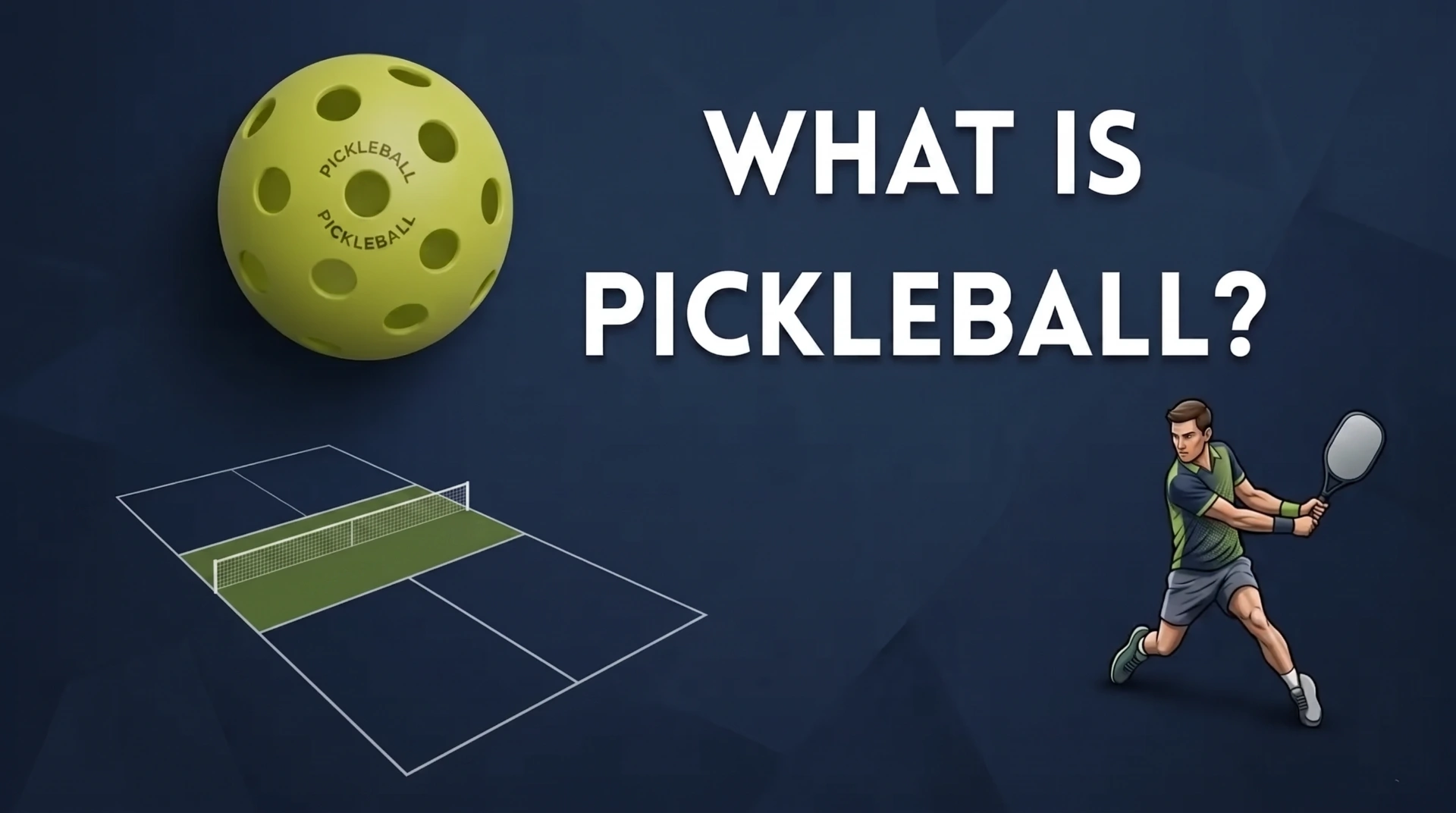
Pickleball is the fastest-growing paddle sport that perfectly blends the best elements of tennis, badminton, and ping‑pong. Played on a compact, badminton-sized court with a solid paddle and a perforated plastic ball, the net sits slightly lower than a standard tennis net. Whether you play singles or doubles, the game is incredibly easy to learn for beginners but offers a lifetime of fun and competitive depth.
If you are looking for a quick, one‑sentence definition:
Pickleball is a fun, low-impact paddle sport played on a 20×44 foot court using a solid paddle and a plastic wiffle-style ball, making it highly accessible and engaging for all ages.
What Is Pickleball? Name, History & Origins
Pickleball was invented in 1965 on Bainbridge Island, Washington. Three dads—Joel Pritchard, Bill Bell, and Barney McCallum—created the game to entertain their bored kids. They used a badminton court, lowered the net, and grabbed some ping‑pong paddles and a plastic ball. The sport grew from a backyard pastime to a worldwide phenomenon.
So why the odd name? There are two popular stories.
- One says Pritchard’s dog, Pickles, kept chasing the ball, so they named it after him.
- The other says it came from a “pickle boat”—a crew term for a boat of leftover rowers. Since the game was a mix of leftover sports, the name fit.
Most historians lean toward the pickle boat theory. Either way, the quirky name stuck.
A Quick Look at the Court
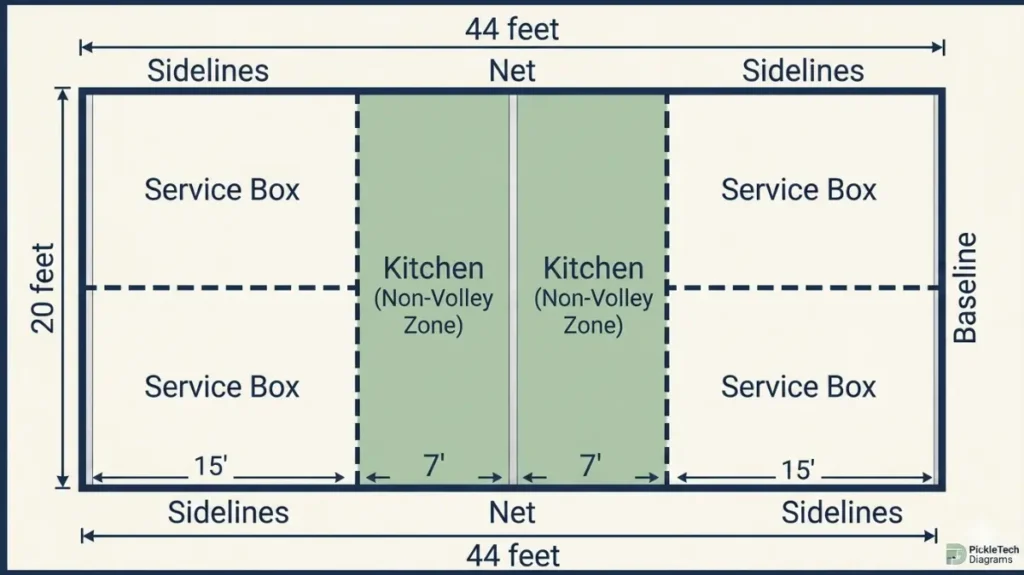
The court is 20 feet wide and 44 feet long—the same size as a badminton court. A net divides it in half. On each side, a 7‑foot zone called the kitchen (non‑volley zone) sits next to the net. You cannot stand in the kitchen and smash the ball out of the air.
The remaining area on each side is the service court, split into left and right boxes. The lines themselves are “in.”
Equipment You Need (And How Much It Costs)
You don’t need to spend a fortune. Here’s exactly what you need to start playing pickleball, and what it will cost you.
- Paddle: Graphite or composite paddles cost $30 to $80. Avoid cheap wooden ones for regular play.
- Ball: Outdoor balls are harder and have 40 small holes. Indoor balls are softer and have 26 larger holes. A pack of three costs about $10.
- Net and court: Many public parks have free courts. A portable net costs $50–$100 if you play in a driveway.
You can be fully equipped and on the court for around $60. That’s less than a gym membership for a month. No special shoes required; just wear comfortable athletic shoes. If you get more serious, dedicated court shoes help, but they’re not mandatory on day one.
Basic Pickleball Rules in 60 Seconds
You don’t need to memorize a massive rulebook on day one. Focus on these five essential rules first, and if you want the full breakdown later, you can always read our complete pickleball rules guide. These are the exact core mechanics that will keep you from looking lost or getting “yelled at” on the court.
- The two‑bounce rule – After the serve, the ball must bounce once on the receiving side and once on the serving side before anyone can volley (hit the ball out of the air).
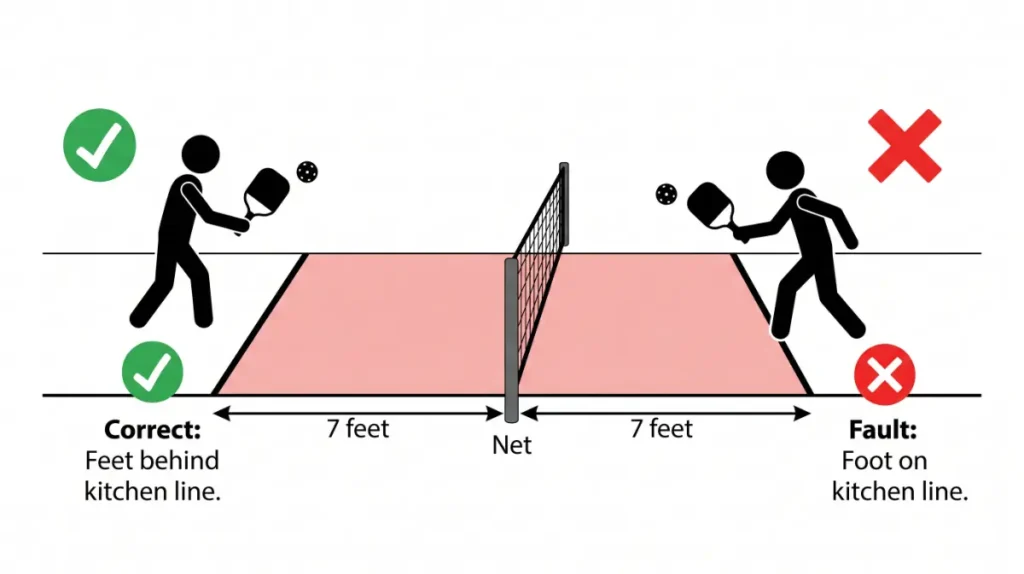
- The kitchen rule – You cannot volley while standing in or on the kitchen line. You may only enter the kitchen zone after the ball bounces.
- Serving underhand – Your paddle contact must be below your waist, and you get only one serve attempt.
- Only the serving team scores – You earn points only when your team is serving. The receiving team cannot win a point directly.
- Line calls – A ball touching any part of the boundary line is considered “in.” Make your calls immediately and honestly.
If you’re being invited to a game this weekend, just memorize these five. They’re your fast‑track to stepping onto the court with total confidence!
The Serve
The serve must be underhand. Your paddle head stays below your wrist, and you contact the ball below your waist. You serve cross‑court into the opponent’s right or left service box, depending on your score.
There are two types of serves:
- Volley serve: Hit the ball out of the air before it bounces.
- Drop serve: Drop the ball and let it bounce once, then hit it. This is easier for beginners.
You get only one serve attempt. If you fault, the serve goes to the other team (in doubles, your partner serves next).
The Two‑Bounce Rule
After the serve, the receiving team must let the ball bounce once. Then the serving team must let the return bounce once. After those two bounces, you can volley or play off the bounce. This rule stops “serve and volley” and keeps the rallies longer.
The Kitchen (Non‑Volley Zone) Explained
The kitchen is a 7‑foot area on both sides of the net. Think of it like lava. You can stand in it after the ball bounces, but you can never volley while touching the kitchen or its lines. Even if you volley from outside and your momentum carries you into the kitchen afterward, it is a fault.
This includes your hat, your paddle, or any piece of clothing. The momentum rule keeps the game safe and fair. If you remember only one thing about the kitchen: when the ball is in the air, stay out. That’s the heart of what is pickleball’s most famous—and most broken—rule.
Scoring Made Simple
Confused by the three numbers? You’re not alone. While you can always bookmark our complete guide to pickleball scoring absolutely free, here is the quick crash course to get you through your first game.
Games are typically played to 11 points (must win by 2), and only the serving team can score points.
In doubles, the score is always called out using three distinct numbers in this exact order:
Serving Team’s Score — Receiving Team’s Score — Server Number (1 or 2)
- Example: A call of “5 – 3 – 2” means the serving team has 5 points, the receiving team has 3 points, and the current server is the second server of the rotation.
The server must call the score loud and clear before every single serve. When your team wins a point on your serve, you and your partner switch sides (left/right) on your court, and you serve again. The receiving team never switches sides.
📢 What to Say: Scoring Call Cheat Sheet
| Situation | You Call |
|---|---|
| Start of game (doubles) | “0 – 0 – 2” |
| Your score 3, opponent 5, you are 1st server | “3 – 5 – 1” |
| You win a point, switch sides | “4 – 5 – 1” (your score changed) |
| Your partner loses the rally | “4 – 5 – 2” (second server) |
| Second server loses rally → side out | Opponents now serve: “5 – 4 – 1” |
🔊 Always call loud enough for the opponent to hear. If they can’t hear, they can ask you to repeat.
Pickleball vs. Tennis vs. Padel
How does pickleball compare to other racket sports? Here’s a quick table.
| Sport | Court size | Equipment | Learning curve | Physical demand |
|---|---|---|---|---|
| Pickleball | 20×44 ft | Paddle, whiffle ball | Very easy | Low impact, but can be intense |
| Tennis | 78×27 ft (singles) | Racquet, tennis ball | Harder | High impact |
| Padel | 32×65 ft | Solid paddle, low-pressure ball | Easy | Moderate |
Pickleball is the quickest to learn and the gentlest on your joints. But don’t confuse “low‑impact” with “easy.” A fast‑paced doubles game can work up a serious sweat.
Health and Social Benefits
Pickleball isn’t just fun—it’s genuinely good for you. A 150‑pound person can burn 300–400 calories per hour during casual play. The constant movement, quick stops, and direction changes improve balance, agility, and cardiovascular health without the joint pounding of running or tennis. Even if you have bad knees or are recovering from an injury, you can still play and get a great workout.
And then there’s the social side. Pickleball might be the friendliest sport on the planet. Courts are full of laughter and conversation. The small court size makes it easy to chat during and between points. Many people join a league or open play just to meet new friends, and they end up finding a whole new community. If you’re looking for a way to connect with others while being active, pickleball is the answer.
Who Can Play Pickleball?
Anyone. Seriously.
- Kids: Light paddles and a slower ball make it easy to learn.
- Seniors: Low impact and a smaller court keep it joint‑friendly.
- Indoor/outdoor: You can play year‑round.
- Adaptive athletes: Wheelchair pickleball is official, and the 2026 rules include a Standing Adaptive Division that allows two bounces.
If you can hold a paddle, you can play pickleball. I’ve seen seven‑year‑olds dink with their grandparents and everyone has a blast.
🎯 What’s Your Pickleball Level?
Not sure where you stand? Take our free 2‑minute Skill Analyzer. Answer 3 simple questions and get your USAPA rating plus personalized improvement tips. Analyze My Skill →
Common Beginner Mistakes (And How to Avoid Them)
These are the missteps that make new players feel embarrassed. Learn them now, skip the red face later.
- Stepping into the kitchen while volleying – Stay behind the kitchen line when the ball is in the air.
- Hitting the serve too hard – Placement matters more than power. Aim deep, not fast.
- Forgetting the two‑bounce rule – Count the bounces before you rush the net.
- Calling lines too late – If you hesitate, the ball is “in.” Make the call instantly.
- Not calling the score – Always say the score loud and clear before serving.
💡 Common Myths vs. Facts
| Myth | Fact |
| You can never step in the kitchen. | You can absolutely enter the kitchen anytime after the ball bounces. You just cannot volley (hit the ball out of the air) from inside the zone. |
| The serve must be bounced first. | False. Both the volley serve (striking the ball directly out of the air) and the drop serve (letting the ball bounce first) are 100% legal. |
| Pickleball is only for seniors. | All ages play! Millions of kids, young adults, and pro athletes in their 20s completely dominate the professional tour today. |
| You need expensive gear to start. | Not at all. A quality beginner paddle costs around $30 to $50, and public parks are usually free. You can start playing for under $60 total. |
Avoiding these common beginner mistakes is much easier when you understand the unwritten rules of the court. To master the social side of the game seamlessly, check out our complete guide to pickleball etiquette.
How to Start Playing Today
Ready to step onto the court? Here’s your no‑guesswork, fast-track action plan to start playing pickleball today:
- Find a local court – Visit places2play.org or download local community sports apps to locate free public courts right in your neighborhood.
- Grab a beginner paddle – Any entry-level graphite or composite paddle under $50 is perfect to start. Check out our comprehensive pickleball paddle buying guide to avoid overpaying.
- Master the full rulebook – Now that you know the baseline mechanics, dive deep into our Complete Pickleball Rules 2026 Guide to stay completely ahead of the game.
- Test your starting level – Want to know exactly where you stand? Use our free 2-minute Pickleball Skill Analyzer Tool to get your official starting rating instantly.
✅ Before Your First Game – Quick Checklist
| Borrow or buy a beginner paddle ($30–$50) | ☐ |
| Get a pack of outdoor pickleballs ($10) | ☐ |
| Wear comfortable athletic shoes | ☐ |
| Bring water and a towel | ☐ |
| Arrive 10 minutes early to stretch and listen | ☐ |
| Remember: call the score before you serve | ☐ |
| Stay out of the kitchen when volleying | ☐ |
📖 Pickleball Lingo: Speak Like a Player
| Dink | Soft shot that lands in the opponent’s kitchen |
| Kitchen | The non‑volley zone (7‑foot area next to the net) |
| Volley | Hitting the ball before it bounces |
| Side‑out | When the serving team loses the serve to the opponent |
| Rally | Continuous play after the serve until a fault |
| Two‑bounce rule | Both teams must let the ball bounce once before volleys are allowed |
Download Your Free “What is Pickleball?” Cheat Sheet
I created a one‑page PDF with the court diagram, the 5 must‑know rules, and the kitchen illustration. Print it and take it to your first game.
🎁 Free Downloadable Cheat Sheet
Your 1‑page PDF includes:
- ✅ Court diagram with kitchen and service boxes
- ✅ The 5 must‑know rules for beginners
- ✅ Kitchen rule illustration
- ✅ Scoring call examples
Print it, keep it in your bag, and never feel lost again.📥 Download the Cheat Sheet (PDF)
Frequently Asked Questions (FAQ)
It’s a fun paddle sport that combines tennis, ping‑pong, and badminton. It’s played on a small court with a paddle and a plastic ball with holes. The rules are easy for beginners.
Yes. The court is smaller, the ball moves slower, and the underhand serve is simpler. Most people can play a short rally within 20 minutes.
The exact origin is debated. The most popular theory is that it comes from the phrase ‘stay out of the kitchen,’ meaning don’t interfere. Another theory credits the Pritchard family’s dog, Pickles, though historians generally favor the ‘pickle boat’ theory for the sport’s name itself. Whatever the origin, the rule itself is crystal clear: no volleying from the kitchen.
A decent paddle costs $30–$80. Public courts are often free. A pack of balls is $10–$15. Total starter cost: around $60.
Absolutely. Many community centers, gymnasiums, and YMCAs have indoor courts. The ball type changes slightly (softer, 26 larger holes) for indoor play.
A dink is a soft shot that arcs just over the net and lands in the opponent’s kitchen. It’s a key strategy to control the point.
Not to start. Any comfortable athletic shoe works fine. If you get more serious, court shoes with good lateral support can help prevent ankle rolls.
You’re Ready to Play
I still remember the knot in my stomach before my first tournament. I had studied the official rulebook twice, yet when the referee called “0‑0‑2,” I froze and dumped my serve into the net. That humbling moment happened five years ago. Since then, I’ve refereed over 50 matches and taught hundreds of new players exactly what to expect—and what to ignore—so they can relax and actually enjoy their first game.
Through all my coaching, one truth stands out: the rules are not there to punish you. They exist to make the game fair and keep it fun. Every fault you commit is a learning moment. You don’t need to memorize everything at once. Start with the five priority rules in this article, then add one new rule each week. The social connection matters far more than perfect knowledge of the rulebook. I’ve watched players win line‑call arguments but lose friendships. Don’t be that person. Use the polite scripts I shared—they work in real‑life pickleball drama.
I personally update this article every January as soon as the new USA Pickleball rulebook is published. You can trust that what you’ve just read is current, tested on actual courts, and built on real experience—not just theory. I still keep a copy of this guide on my phone when I play in a new league with different house rules. You should too.
Now go play. Make glorious mistakes and laugh about them. The welcoming pickleball community is already waiting for you. You’ve got this.
👉 Download the Free Cheat Sheet and take it to your first game. And when you’re ready to go deeper, check out our Complete Pickleball Rules Guide or test your skill with the Free Skill Analyzer.
